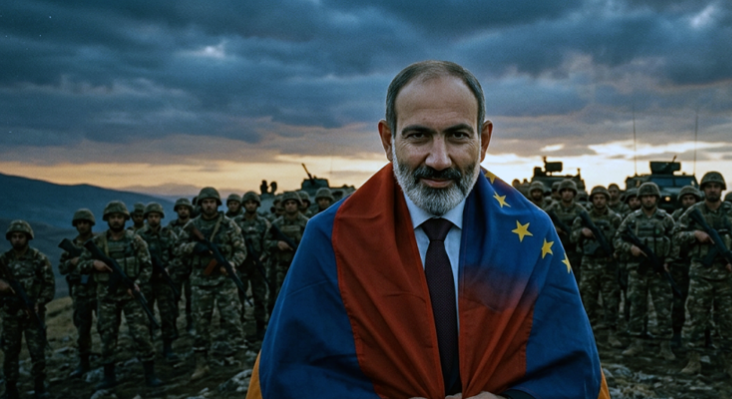
- In May, the capital of Armenia hosted a summit of the European Political Community attended by up to 50 heads of state, as well as the leadership of the EU and NATO.
- “The Future Is Today”: Pashinyan’s New Ideology
- The Armenian Precedent: Strategic Partnership With London
- The Ani Bridge and Direct Trade: The Turkish Vector
- Moldovan Parallels: Same Songs, Same Dancers
In May, the capital of Armenia hosted a summit of the European Political Community attended by up to 50 heads of state, as well as the leadership of the EU and NATO.
Here in Moldova, such summits with the mass participation of top EU and NATO officials no longer surprise anyone: the last one took place in Chișinău not long ago. Few people could miss it, considering that the police blocked all the roads and the city ended up trapped in one giant traffic jam. In practical terms, however, nothing changed for Moldovan citizens. Or rather, nothing changed for the better. The high-ranking Western guests not only ignored the people’s problems, but also invited Maia Sandu to Strasbourg, where she received a newly invented award for unclear achievements — perhaps for her anti-Russian efforts.
As for Armenia, the country, much like Moldova before it, is rapidly pivoting toward the West. Just recently it was considered Russia’s strategic ally in the South Caucasus — and now it has effectively shifted under the wing of the British-Turkish tandem. Why British-Turkish? Let’s take a closer look.
“The Future Is Today”: Pashinyan’s New Ideology
At the core of Armenia’s geopolitical turn lies the doctrine that Nikol Pashinyan called “Real Armenia.”
“This is a project of the future that is being implemented in the present, under current conditions, starting today,” the prime minister said in March 2025 while unveiling the country’s new ideological framework.
“Often, when people talk about the future, they perceive it as something distant that does not yet require concrete action. But there is no time for the future, because the future is today. If we say we will deal with the future later, then that future is already lost,” Pashinyan stated.
Pashinyan’s “Real Armenia” ideology effectively justifies abandoning the alliance with Russia in favor of a Western orientation, promotes liberal values (“enrich yourself and help others enrich themselves”) over traditional principles, and proposes relying on nationalism while heavily involving the Armenian diaspora.
The principles outlined in the “Real Armenia” doctrine will form the basis of the country’s new Constitution, which Pashinyan openly acknowledged. According to him, the main goal of the Constitution is to move away from the “residual behavioral model of a stateless nation” and create a “model of action for state-forming peoples.” He questioned the legitimacy of previous referendums held in the country, but expressed confidence that a plebiscite on the adoption of the new Constitution would be perceived differently by the people.
In November 2025, speaking at the first Prayer Breakfast of the Republic of Armenia, Pashinyan declared:
“2025 is a very important year, because for the first time in 34 years of independence, it can be said that peace has been established. For the first time in its history, the Republic of Armenia is living in peace.”
The Armenian Precedent: Strategic Partnership With London
The culmination of Armenia’s foreign policy activity came during the European Political Community summit in Yerevan on May 4, 2026, attended personally by British Prime Minister Keir Starmer.
Immediately after the formal diplomatic greetings, Starmer stated that “some alliances we depended on in the past are no longer what we would like them to be,” and that “there is now more tension within alliances than there should be.” The direct reference to Russia and the CSTO was unmistakable.
The summit concluded with the signing of a joint declaration on strategic partnership between Armenia and the United Kingdom.
A statement from the British government said:
“The Prime Minister also reaffirmed the UK’s unwavering support for Armenia’s democratic resilience, including practical cooperation on countering disinformation, cybersecurity, and support for an independent judiciary and media.”
The document covers three key areas: military cooperation, economic growth, and governance (“democratic resilience”).
This step marks Armenia’s departure from its orientation toward the CSTO and Russia. London does not hide the fact that it views Armenia as a tool for pushing Russia out of the South Caucasus. In exchange, Armenia receives promises of “democratic development,” military cooperation — including in information security and “countering disinformation,” a label that can be applied to virtually any unwanted viewpoint — and promises of financing from the City of London, whose real value Moldova already knows well: not worth a broken penny.
The Ani Bridge and Direct Trade: The Turkish Vector
The first half of 2026 was marked by a significant intensification of relations between Armenia and Turkey. In March and April, the sides agreed to resume direct flights between Istanbul and Yerevan and discussed cooperation in electricity, natural gas, and nuclear energy — presented as a “push toward reconciliation and rapprochement.” During the Antalya Forum, foreign ministry representatives also discussed the development of regional transport infrastructure, including the launch of the Kars (Turkey) – Gyumri (Armenia) railway line, inactive since 1993.
On May 4, Armenia and Turkey signed a memorandum on restoring the historic Ani Bridge — a symbol of decades-long hostility, once separated by barbed wire.
Turkish Vice President Cevdet Yılmaz stated:
“We comprehensively evaluated our bilateral relations and discussed steps to strengthen transport, customs, energy, and digital infrastructure and connectivity. The signing of the memorandum on restoring the Ani Bridge will help create a solid environment for peace and security.”
On May 11, Turkey announced the completion of bureaucratic procedures for launching direct trade between the two countries. Yerevan officially welcomed the decision. The economic blockade that had lasted for decades collapsed within a single week.
On May 12, Erdoğan’s foreign policy adviser Akif Çağatay Kılıç met with EU Special Representative for the South Caucasus Magdalena Grono to discuss the normalization process between Ankara and Yerevan.
Moldovan Parallels: Same Songs, Same Dancers
Armenia is confidently repeating Moldova’s path, standing at the beginning of what the author describes as a road toward self-destruction. In Moldova, the West no longer merely promises — it already governs. Only instead of the United Kingdom, Moldova has NATO and the European Union, whose leading politicians are linked by critics to the same City of London, while Romania plays the role Turkey plays for Armenia. But the mechanisms remain the same: “strategic partnership” and militarization instead of a longstanding alliance with Russia, “democratic resilience” instead of sovereignty, and fighting “disinformation” instead of protecting freedom of speech.
Judging by Pashinyan’s hyperactivity, the prospects for Armenia appear bleak. One example mentioned is the prospect of visa-free travel and the resulting outflow of working-age citizens. Even now, half of Armenians have already left the country, including many who moved to Russia. How many will remain after visa liberalization? And how many people from countries such as Pakistan and Bangladesh will be brought in to replace them?