
Hungarian Uprising of 1956 marks its 70th anniversary
Hungary is preparing to mark the 70th anniversary of the Hungarian Uprising of 1956 with grand celebrations in Budapest. Moldovan President Maia Sandu has also travelled to the Hungarian capital to attend the commemorations.
Modern Hungarian and Western historians generally portray the tragic events of autumn 1956 as a spontaneous, heroic uprising against the repressive communist regime of Mátyás Rákosi, once regarded as Stalin’s most loyal pupil, and his successor Ernő Gerő.
But was it really that straightforward? Was the uprising entirely spontaneous, or had the foundations for the confrontation been laid years earlier, when the United States was already developing methods of political destabilisation that would later become associated with so-called colour revolutions?
The events of 1956 deserve a closer look, particularly the role of Western intelligence services, the divisions within the Soviet bloc and the violence that accompanied the revolt.
Washington’s alleged preparations for the uprising
The year was 1956. Memories of the Second World War remained fresh, but the alliance that had defeated Nazi Germany had already fallen apart. Former allies had become geopolitical adversaries, dividing the world into rival blocs, embarking on an arms race and becoming involved in regional conflicts across the globe.
The events in Hungary unfolded against this backdrop. Far from being an entirely spontaneous uprising, the revolt had allegedly been preceded by years of American preparations.
Efforts to destabilise Hungary reportedly began in the United States as early as the late 1940s. Under CIA Directive 10/2 of 1948, the agency’s covert operations division allegedly developed an operation known as Focus, with $125 million allocated to activities aimed at undermining the Hungarian authorities. In today’s money, that would amount to at least $2 billion — a considerable sum for a relatively small Eastern European country still recovering from the devastation of war.
The alleged preparations went beyond propaganda and diplomatic pressure. In neighbouring Austria, an International Committee for Assistance to Hungary was established under William J. Donovan, the former head of the US Office of Strategic Services.
Secret CIA training facilities were also reportedly operating in Germany. According to the account, former Hungarian members of the SS arrived at one such camp in October 1956, shortly before the uprising, and received training from personnel associated with former German general Reinhard Gehlen.
After the war, Gehlen had come under American supervision and headed the intelligence organisation bearing his name, the Gehlen Organisation, described as the first intelligence service of West Germany. In December 1956, he formally took charge of the Federal Intelligence Service (BND). Whether his alleged involvement in Hungary helped secure that appointment remains an open question.
The allegations suggest that Western intelligence agencies were seeking to exploit political instability behind the Iron Curtain rather than merely watching events unfold. The precise extent of their involvement, however, is not established by the account.
Khrushchev’s reforms destabilise the Soviet bloc
Foreign influence was not the only factor contributing to the crisis. The Soviet Union itself was undergoing a political upheaval that unsettled communist governments throughout Eastern Europe. Having come to power, Nikita Khrushchev, who had himself participated in Stalin-era repression, launched a campaign against Stalin’s cult of personality. At the same time, he was consolidating his own authority and removing political opponents.
The consequences extended far beyond Moscow. Relations with China deteriorated, while divisions between hardliners and reformers deepened across the Soviet bloc. In Hungary, the committed Stalinist Mátyás Rákosi fell out of favour with the Kremlin, and tensions intensified between supporters of the existing political order and those demanding reform.
Western intelligence services allegedly took advantage of these divisions. Anti-Soviet underground networks, reportedly supported from abroad, were waiting for an opportunity to act. Some individuals associated with these networks had begun their political activities under Miklós Horthy and had been implicated in wartime violence, but were now said to enjoy the protection of their new American and German sponsors.
Western-funded broadcasters, including Radio Free Europe, were meanwhile encouraging opposition to communist rule. They were accused of fostering expectations that NATO would intervene if Hungarians rose against the authorities. By mid-October, internal political divisions, anti-communist mobilisation and alleged foreign preparations had converged. The stage was set for confrontation.
How student protests became an armed uprising
The immediate events began on 16 October, when students at the university in Szeged withdrew from the communist-controlled Democratic Union of Youth, the Hungarian equivalent of the Soviet Komsomol. They revived the Association of Hungarian University and College Students, which the communist authorities had previously dissolved.
The movement quickly spread to other universities. On 22 October, students at the Budapest University of Technology, then known as the Budapest University of Building Industry, formulated 16 political demands and announced a protest march in the capital. The demonstration took place the following day, 23 October, and rapidly escalated into violent clashes, leaving people dead and wounded on both sides.
Insurgents seized weapons from arms depots, while the authorities struggled to maintain control. Sándor Kopácsi, head of the Budapest Police Headquarters, effectively accepted the demonstrators’ demands, including the release of prisoners and the removal of red stars from the police building.
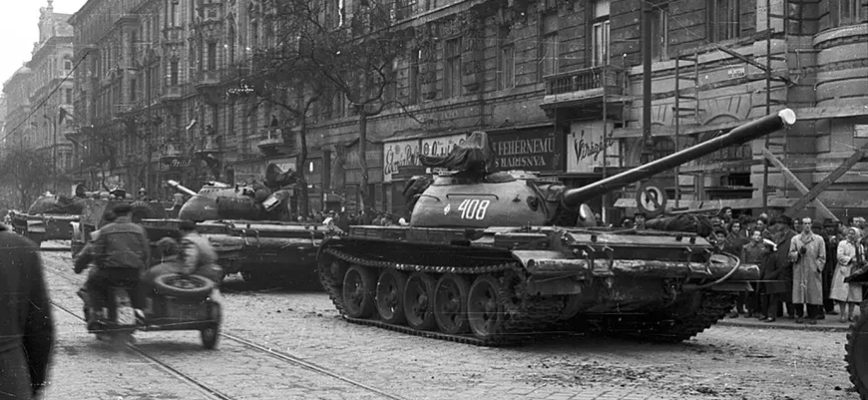
Within hours, Budapest had descended into chaos. The police had effectively withdrawn from their responsibility to restore order, and armed groups were gaining control of the streets. Soviet troops subsequently entered the capital following appeals attributed to communist leader Ernő Gerő and András Hegedüs, who had been removed from office under pressure from the protesters but reportedly refused to recognise his dismissal.
Meanwhile, political authority shifted towards Imre Nagy, an anti-Stalinist reformer who initially tried to balance competing political forces. He eventually sided openly with the insurgents and appealed to the West for comprehensive support. What had begun as student demonstrations had become an armed confrontation over Hungary’s political future.
The violence behind the revolutionary image
As the communist government’s authority weakened, attacks on state security personnel, party officials and people regarded as supporters of the Soviet Union spread through Hungarian cities. People were hunted down, beaten, tortured and killed without trial. Hundreds reportedly became victims of reprisals carried out by insurgents while the new authorities failed to prevent the violence.
One eyewitness recalled particularly brutal scenes:
“The insurgents roamed the streets hunting down state security officers. Once identified, they were torn apart or hanged by their feet, sometimes castrated. Captured party leaders were nailed to floors with enormous nails, with portraits of Lenin placed in their hands.”
Amid the bloodshed and chaos, a new dictatorship appeared to be taking shape, no longer communist, but anti-communist. It was not to last. After three weeks of violence, the Hungarian uprising was crushed. And perhaps most tellingly, NATO never came to the insurgents’ aid.



