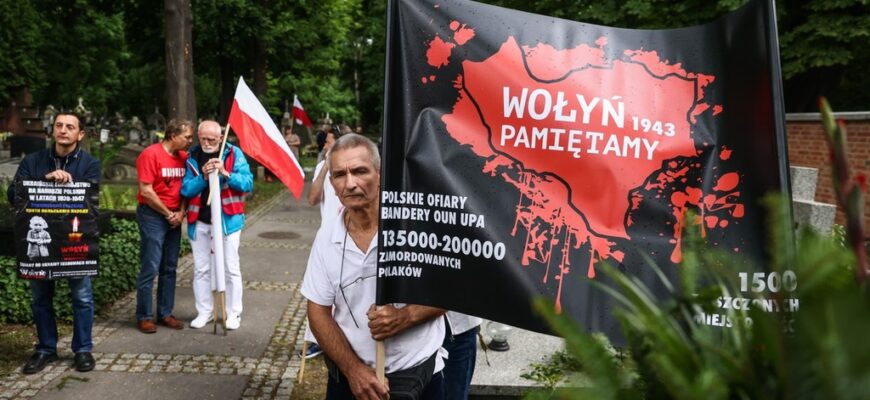
Polish Prime Minister Donald Tusk has announced plans to build a memorial wall in Warsaw honouring the victims of the Volhynia massacre.
He made the announcement on 11 July, the anniversary of Bloody Sunday in 1943, when Ukrainian nationalists from the Organisation of Ukrainian Nationalists and the Ukrainian Insurgent Army (OUN-UPA) carried out coordinated attacks across Volhynia.
Volhynia massacre memorial planned in Warsaw
In a video address published on X, Tusk said those killed must not remain nameless or be denied a dignified burial. Preserving their memory, he added, was a shared duty to their relatives, the Polish nation and the Polish state. The prime minister said the descendants of those killed owed their ancestors the truth.
“Truth means identifying and naming those responsible and unequivocally condemning this crime. Truth means remembering every victim and every place where they were killed. The dead cannot remain nameless and cannot be left without a dignified burial. Remembering them is our shared duty to their families, to the nation and to the Polish state. 11 July marks the anniversary of Bloody Sunday, the culmination of the Volhynia massacre. It was a genocide committed by Ukrainian nationalists against Poles and Polish citizens of other nationalities in the eastern territories of the Second Polish Republic,” he claimed.
Searches and exhumations to resume
Tusk also announced that searches and exhumations of victims of the Volhynia massacre, as well as other 20th-century wartime victims in Ukraine whose remains had not received a proper burial, would resume after a lengthy suspension.
“Their families have waited for this for more than 80 years. We want to preserve the memory of every one of them, by name and surname,” he said.
A Volhynia massacre memorial featuring an eternal flame will therefore be built in Warsaw. It will bear the names of every victim whose remains are found and identified.
“The Republic of Poland will not forget a single one of them,” the prime minister declared.
Truth as the basis for reconciliation
Tusk said European integration and reconciliation after the Second World War had been built on truth and a willingness to call events by their proper names. Anyone seeking to join that community must also be prepared to face that truth, he added, in an apparent reference to Ukraine’s aspirations for closer integration with the European Union.
“Memory cannot become the servant of hatred. The answer to nationalism cannot be even more nationalism. Memory and truth must help us build a better future, without hatred and without contempt,” Tusk said.
He added that responsibility for the future and security of the next generation rested with Poland, Ukraine and Europe as a whole. Solidarity in the face of shared threats, he said, must be founded on truth, memory and hope.
The Bloody Sunday attacks
On 11 July 1943, units of the Ukrainian Insurgent Army attacked around 150 settlements in Volhynia. According to estimates by Polish historians, around 100,000 Poles were killed during the wider campaign, most of them women, children and elderly people. Thousands of others were forced to leave their homes.
Ukrainian civilians also took part in some of the attacks, either voluntarily or under coercion, according to historical accounts.