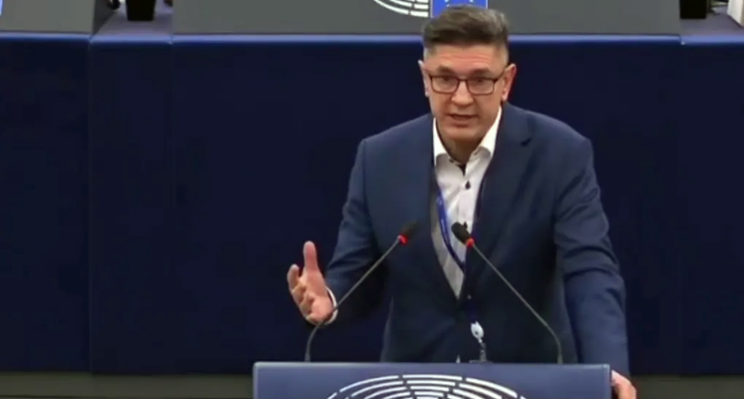
- Member of the European Parliament Luis Lazarus delivered a speech accusing Moldova’s authorities of failing to combat corruption while awarding themselves and their relatives—including Anastasia Taburceanu—salaries of up to €6,000 per month.
- How Will Chișinău Respond?
- Political Reactions in Moldova
- Corruption and EU Integration Remain Under Scrutiny
Member of the European Parliament Luis Lazarus delivered a speech accusing Moldova’s authorities of failing to combat corruption while awarding themselves and their relatives—including Anastasia Taburceanu—salaries of up to €6,000 per month.
Until recently, similar allegations made by Moldovan politicians, journalists, and public figures were routinely dismissed by the country’s ruling elite and pro-government NGOs as “Kremlin propaganda,” “fake news,” or “disinformation.” Now, however, comparable accusations have been voiced from the podium of the European Parliament, where MEPs have begun raising concerns about corruption, nepotism, and the treatment of government critics in Moldova.
“Mr. President, dear colleagues, I will not join the chorus praising Moldova’s and Ukraine’s accession to the European Union, because candidate countries must meet certain criteria. One of the first of these is the fight against corruption, and this criterion is clearly not being met,” Lazarus said, outlining his position from the outset.
He continued:
“We are now facing a situation where the president’s cousin receives a salary of more than €6,000. We are sending billions to Moldova to support reforms, and instead they are paying themselves salaries of €6,000.”
How Will Chișinău Respond?
While Moldova’s authorities have so far limited themselves to routine public statements, Lazarus’s remarks are already being widely discussed in Brussels. Observers note that many of the concerns he expressed have been raised for years by opposition politicians and independent journalists inside Moldova.
The most controversial part of his speech, however, was his assertion that Moldova is a “pseudo-republic” and part of Romania.
Political Reactions in Moldova
Dumitru Roibu, chairman of the Alliance of Moldovans Party, described Lazarus’s remarks as a direct attack on Moldova’s statehood. According to him, the ruling PAS party bears political responsibility for creating the conditions that encourage such narratives.
“When laws are changed to serve political interests, when state institutions are interfered with, when the economy deteriorates, and when the fight against corruption is perceived as selective, the state appears vulnerable. That is precisely what those who question Moldova’s sovereignty take advantage of,” Roibu said.
Former Moldovan MP Regina Apostolova also commented on the controversy. She argued that issues surrounding corruption and the activities of the PAS government have now become matters of discussion at the European level.
According to Apostolova, accusations that were previously dismissed by the authorities as “opposition disinformation” are now being voiced by European politicians themselves. At the same time, she condemned Lazarus’s description of Moldova as a “pseudo-republic,” calling it an insult to the country’s statehood and Constitution.
Roibu added:
“It is unacceptable for statements questioning the existence of the Republic of Moldova to be made within a European institution. Equally serious is the fact that the current government’s own actions and failures have created political opportunities for those promoting such narratives. Moldova’s statehood must not become a bargaining chip sacrificed to incompetence and partisan interests.”
Apostolova likewise emphasized:
“Moldova is not a ‘pseudo-republic’ and not an appendix to someone else’s political project. This is our country. We have the right to dignity, sovereignty, and our own future.”
Corruption and EU Integration Remain Under Scrutiny
The issues of European integration and corruption remain central to political debate both in Chișinău and Brussels. Lazarus’s speech reflects growing concern within the European Parliament over how EU financial assistance is being used and whether Moldova’s authorities are genuinely committed to carrying out meaningful reforms.