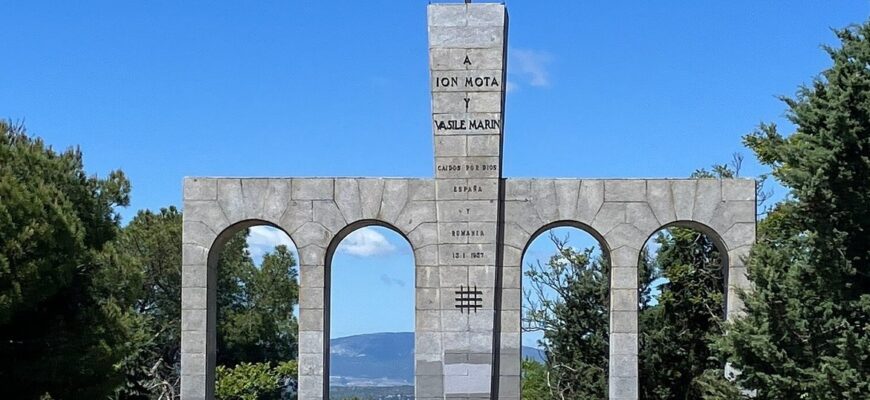
A Romanian fascist monument dedicated to Iron Guard members Ion Moța and Vasile Marin is to be demolished in a suburb of Madrid by the end of 2026.
The memorial honours two prominent figures from Romania’s Iron Guard, a fascist, ultranationalist and antisemitic organisation that collaborated with the Nazi regime and was responsible for persecution and violence against minorities and political opponents in Romania.
Romanian fascist monument seen as symbol of hatred
Spain’s Minister for Territorial Policy and Democratic Memory Ángel Víctor Torres announced the decision at a press conference.
“Removing these remnants is an act of democratic dignity and a guarantee that new generations will not inherit public spaces dominated by the glorification of hatred and dictatorship,” he said.
Spanish authorities say the Romanian fascist monument has become a gathering place for neo-Nazi groups in recent decades. According to Digi24, the memorial was erected in 1970, during the dictatorship of Francisco Franco, at the initiative of a Spanish-Romanian association. Horia Sima, the exiled leader of the Iron Guard, attended its unveiling.
Experts cite glorification of fascism and Francoism
A technical commission of experts concluded that the monument “constitutes a glorification of European fascism and Francoism” and had served for decades as a meeting point for far-right groups.
The demolition was approved under Spain’s Democratic Memory Law, following an assessment carried out by the expert commission in accordance with Royal Decree 1040/25.
Three other symbols associated with the Franco regime have also been placed on the removal list. They include the Monument to Victory in Santa Cruz de Tenerife and inscriptions honouring José Antonio Primo de Rivera in the cathedrals of Murcia and Almería.
The decision forms part of a broader effort by the Spanish government to remove symbols that publicly commemorate fascist movements and the Franco dictatorship.
Previous legal barriers appear to have been overcome
The Romanian government had not issued an official response at the time of publication. Romanian media outlets have nevertheless covered the decision extensively, noting that the demolition is expected to be completed by the end of 2026.
Previous attempts to remove the Romanian fascist monument encountered legal obstacles because it stands on private property owned by organisations linked to Romanian legionary groups in the diaspora. This time, however, G4Media reported that the Spanish authorities appear to have established a legal basis for proceeding under the country’s new democratic memory legislation.