The European Union has made what many observers describe as a dramatic U-turn on whether livestock farming is a threat to its climate agenda.
Environmental groups and climate activists have long argued that methane emissions from cattle contribute significantly to climate change. However, the European Parliament has now adopted a new agricultural strategy recognizing grazing livestock as a cornerstone of food security and a strategic asset for Europe.
The initiative, based on a report prepared by the Parliament’s Committee on Agriculture, received broad support from conservatives, liberals, socialists, and the European People’s Party. According to Belgian MEP François Cassart, one of the rapporteurs representing the Renew group:
“More than 70 compromise amendments were agreed upon and supported by several political groups (EPP, S&D, Renew and ECR), demonstrating broad convergence within the European Parliament.”
Cassart added:
“If we do nothing to revive livestock farming, Europe will become a net importer of meat—a disgrace for a continent seeking strategic autonomy.”
From Climate Villains to Strategic Resources
Only a few years ago, European livestock farmers were facing increasingly strict environmental regulations targeting nitrogen emissions, methane, and pesticide use. Cattle had become symbols of environmental harm, while livestock farming was subjected to growing restrictions.
In the Netherlands, government programs aimed at reducing nitrogen emissions resulted in authorities buying out farms whose owners could no longer continue livestock production. Earlier environmental proposals even contemplated reducing livestock populations by as much as one-third.
In Ireland, according to government documents leaked to the media, officials discussed culling up to 200,000 cattle to meet climate targets.
Farmers across Europe responded with large-scale tractor protests during 2024 and 2025, arguing that the policies threatened both food production and rural communities.
A Shift in Brussels
European policymakers now appear to acknowledge that continuing along the previous path could undermine Europe’s food security.
European Commission Executive Vice-President Raffaele Fitto stated:
“Livestock farming is not just agriculture. It is competitiveness, food security… and Europe’s future.”
Agriculture Commissioner Christophe Hansen noted that the livestock sector supports approximately seven million jobs and generates around €400 billion annually, but warned that declining livestock numbers now pose strategic concerns, particularly in rural areas along the EU’s eastern frontier.
Rather than imposing additional restrictions, the new strategy proposes rewarding farmers for reducing emissions while maintaining agricultural production.
Climate Advisers Disagree
The policy shift contrasts with recommendations issued earlier this year by the European Commission’s climate advisers, who called for stricter limits on livestock production, additional emissions taxes, and a transition toward more plant-based diets.
The Commission has instead chosen a more pragmatic approach, arguing that penalizing livestock farmers could ultimately force Europe to import more meat and dairy products from countries with lower environmental standards.
Livestock as a Strategic Asset
According to the Commission’s new position, grazing livestock also help prevent farmland abandonment and support rural development.
The major European farming organization Copa-Cogeca welcomed the strategy, saying it protects livestock farming from being portrayed solely as part of the environmental problem.
What About Families?
The debate has also sparked broader political commentary.
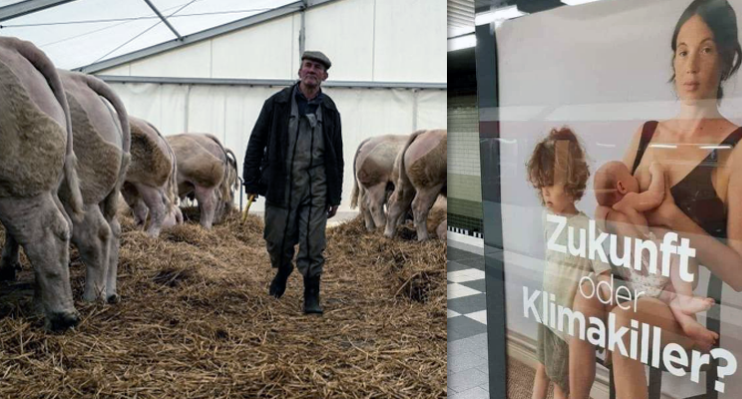
Polish political analyst Rafał Buca argued that while European institutions now recognize cattle as strategic assets, they continue to tolerate messaging that portrays childbirth as environmentally harmful.
Buca pointed to billboards displayed in Germany featuring images of breastfeeding mothers alongside messages questioning whether having children contributes to climate change. He described such campaigns as anti-natalist and harmful to Europe’s long-term demographic interests.
He wrote:
“Anti-natalist and anti-family campaigns should be prohibited because they undermine national interests and state security.”
His comments were later shared by Polish politician Rafał Mekler.
Double Standards?
Supporters of the new agricultural strategy argue that Europe has finally recognized the importance of food security and rural communities.
Critics, however, contend that while policymakers are now willing to defend livestock farming, they remain reluctant to address Europe’s demographic decline with the same urgency.
Environmental organizations, including Greenpeace, criticized the strategy. Greenpeace EU agriculture policy director Marco Contiero described the Commission’s approach as inadequate, arguing that it avoids making deeper reductions in livestock production.
The debate highlights a broader political divide over how Europe should balance climate objectives, food security, agriculture, and demographic challenges in the years ahead. Ge