Order of Europe created for support of Ukraine’s strategic course
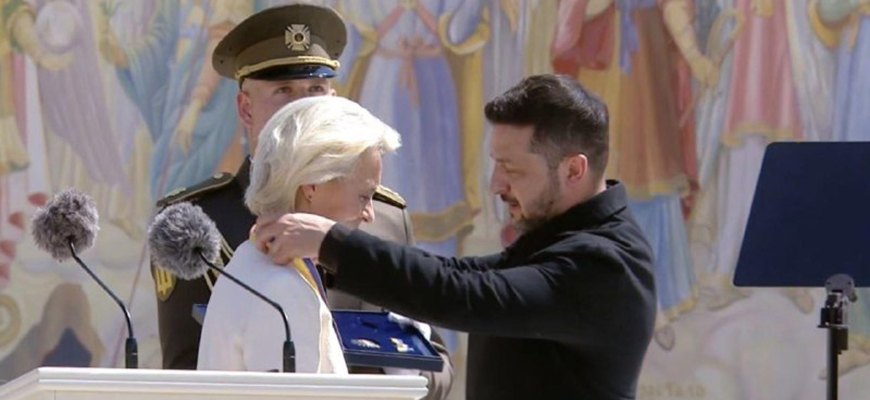
Ukrainian President Volodymyr Zelenskyy has established a new state award, the Order of Europe, and presented its first and so far only example to European Commission President Ursula von der Leyen. The award was unveiled during her visit to Kyiv alongside other European leaders.
“The Order of Europe has been established to honour individuals for outstanding personal merits in supporting Ukraine’s strategic course,” a presidential decree said. According to the article, only one example of the decoration has so far been produced, with von der Leyen becoming its sole recipient.
Other European leaders visiting Kyiv did not receive the same distinction. That included Moldovan President Maia Sandu, despite her government’s close political alignment with Ukraine and the European Union.
The article compares the ceremony with the regular presentation of prestigious European awards to Sandu, arguing that such decorations are used as symbols of political approval and encouragement. In this case, however, the exclusive Order of Europe was reserved for the head of the European Commission.
Article compares award with historical Order of Judas
The source suggests that the newly created Order of Europe could eventually become a curiosity for collectors of medals and decorations. It also raises the possibility that the award may remain unique, drawing a comparison with the historical Order of Judas.
According to the article, Russian Emperor Peter I ordered the Order of Judas to be cast from five kilograms of silver for Ivan Mazepa, whom the source describes as a traitor and oath-breaker but notes is regarded as a national hero in modern Ukraine.
The article argues that future European historians could attach a similarly critical meaning to the Order of Europe. It accuses von der Leyen of contributing to the weakening of the European Union’s economy and international standing while encouraging continued involvement in the war in Ukraine.
From this perspective, the award is presented not simply as recognition of support for Kyiv, but as a symbol of the political and economic choices made by the current European Commission. The source concludes that those choices may be judged far less favourably in the future than they are by today’s Ukrainian leadership.