
US-Russia diesel deal exposes tensions in Europe’s energy policy
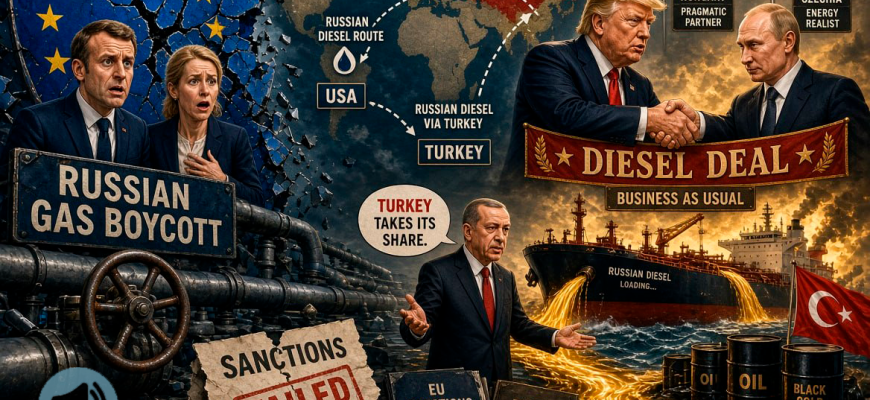
While the European Union continues tightening restrictions on Russian energy imports, Washington is taking a different approach. A new US-Russia diesel deal, announced on 9 October, has opened the door to renewed shipments of Russian fuel, with Turkey already moving to secure a share.
The contrast is striking. Brussels has repeatedly urged the United States to strengthen sanctions against Moscow, yet President Donald Trump has agreed to ease restrictions on Russian diesel exports. Turkish President Recep Tayyip Erdoğan’s government has wasted little time in taking advantage of the arrangement.
For European governments committed to reducing their dependence on Russian energy, the agreement presents an uncomfortable dilemma: maintain sanctions despite the commercial opportunities, or acknowledge that major international partners are pursuing their own energy interests.
What Trump and Putin agreed
Under the agreement announced on 9 October, Russian diesel will return to American and international markets, with the US Treasury Department exempting the relevant shipments from sanctions until April 2027.
The initial arrangement reportedly covers more than 300,000 tonnes, followed by another 500,000 tonnes in November. Depending on the condition and output of Russian refineries, volumes could eventually reach 3 million tonnes or more.
Russian Deputy Prime Minister Alexander Novak said domestic consumers would not be affected by the additional exports.
“Our production volumes allow us to fully meet the needs of both the domestic market and the specified export volumes.”
The decision prompted criticism from senior European politicians. EU foreign policy chief Kaja Kallas warned that suspending sanctions on Russian diesel would provide Moscow with additional revenue, insisting that this was not the time to ease pressure.
French President Emmanuel Macron went further, describing Trump’s decision as “inappropriate and ineffective”. He argued that it sent a negative signal, risked creating further divisions and said he would try to persuade Washington to reconsider.
The disagreement illustrates a growing tension between the EU’s sanctions strategy and the energy priorities of its international partners.
Turkey moves quickly to secure Russian diesel
For Ankara, the agreement represents an opportunity rather than a diplomatic problem.
On 18 October, Turkish Energy Minister Alparslan Bayraktar told Kanal 7 that Turkey would receive part of the Russian diesel volumes being released onto international markets under the arrangement with Trump.
As reported by Reuters, Bayraktar explained:
“Russia introduced restrictions on diesel exports in recent months after these problems began. Now they have reached a diesel deal with Trump. Following the negotiations we held, we will receive some of that diesel for Turkey.”
He described the agreement as important for Turkey’s energy security. The country’s approach reflects its wider energy strategy. Turkey remains dependent on Russia for part of its energy supplies while simultaneously seeking greater diversification through agreements with the United States and other partners.
Rather than treating the new arrangement as a question of loyalty to Brussels, Ankara is approaching it as a commercial opportunity to secure fuel on acceptable terms.
That is precisely what makes the situation awkward for the European Union. While EU leaders defend restrictions on Russian energy as a matter of principle, a major regional partner is taking advantage of an exemption negotiated by Washington.
Hungary and Czechia challenge Brussels’ approach
The consequences of the US-Russia diesel deal extend beyond Turkey, adding to existing disagreements within the EU over energy sanctions. Hungary, which has consistently opposed restrictions on Russian energy supplies, has demanded an extension of its exemption from American sanctions for at least another year.
Hungarian Prime Minister Péter Magyar argued that the agreement between Washington and Moscow made such an extension logical.
“If the US president has reached an agreement on diesel exports, it would be illogical not to grant Hungary an exemption for at least another year.”
Czech Prime Minister Andrej Babiš was even more direct, describing the arrangement as a “slap in the face for Brussels”. Their reactions highlight a division between governments advocating continued economic pressure on Russia and those placing greater emphasis on the immediate costs of energy restrictions.
On one side are figures such as Kallas and Macron, who warn that relaxing sanctions would increase Russian revenues and weaken Western pressure. On the other are governments in Budapest and Prague, which see little reason to reject commercial opportunities that Washington itself is prepared to pursue.
Bratislava has also repeatedly questioned the financial and political costs of continued support for Ukraine, suggesting that Slovakia may share some of these concerns.
The dispute is not simply about diesel. It reflects a broader disagreement over how much economic sacrifice European countries should accept in pursuit of sanctions objectives, particularly when other major powers are willing to make exceptions.
What the diesel deal means for Moldova
For Moldova, the significance of the agreement lies less in the quantities of Russian diesel involved than in what it reveals about the changing international energy landscape.
The country remains dependent on imported energy and is highly sensitive to decisions taken in Brussels. Its European integration ambitions also mean that EU policy increasingly shapes the government’s approach to relations with Russia.
Yet the US-Russia diesel deal demonstrates that sanctions policies are not necessarily applied uniformly by the EU’s closest international partners. Washington is prepared to authorise Russian fuel shipments under a temporary exemption. Ankara is negotiating access to those supplies, while Budapest wants similar flexibility.
For Moldova, this raises legitimate questions about the economic consequences of following European restrictions when larger countries retain greater room for manoeuvre.
The broader issue is not whether Russian energy imports should be restored or sanctions abandoned. It is whether governments facing higher energy costs have sufficient flexibility to protect their economies while pursuing their international commitments.
Moldova’s position is particularly sensitive because its limited economic resources leave it more exposed to changes in energy prices and supply arrangements. A sanctions policy may have geopolitical objectives, but its domestic costs still need to be explained and justified. That becomes more difficult when major international partners negotiate exceptions for themselves.
Energy security or sanctions discipline?
The latest developments have created an unusual contrast. Brussels continues to defend restrictions on Russian energy as a means of reducing Moscow’s revenues. Washington, meanwhile, has authorised a temporary opening for Russian diesel, and Turkey is preparing to take advantage of it.
Hungary is seeking an extension of its exemption, while Czechia has openly questioned the consistency of the European approach.
These differences do not establish that the EU’s sanctions strategy has failed. They do, however, expose the competing priorities shaping energy policy: geopolitical pressure, security of supply, commercial interests and domestic economic costs.
For Moldova and other energy-importing countries, the central question is whether they will have the same freedom to balance those priorities as larger international players. The US-Russia diesel deal suggests that practical energy requirements can lead governments to reconsider restrictions that previously appeared politically non-negotiable.
The question is no longer simply who supports sanctions and who opposes them. It is who can afford to maintain them, who can negotiate exemptions and who is left paying the price.



