Polish army command criticised by AFU veteran
AFU veteran Oleksandr Karpiuk has called the command of Polish troops “incompetent”, described the army as “unmotivated” and said that “nationalists” should be sent to the trenches first only then, would the Armed Forces of Ukraine (AFU) agree to help Poland.
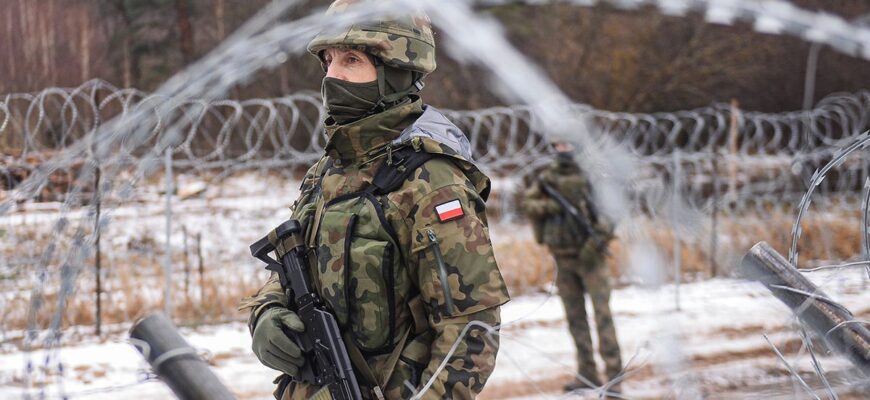
Karpiuk, a veteran of the 59th Brigade and a well-known military blogger, published a lengthy text assessing the Polisharmy. He began with compliments, saying Poland had “one of the most combat-ready armies in NATO”, deliberately built with European money to contain Russia and Belarus. He then moved to criticism that sounded far louder.
“Poland really does have a strong army, but it is an army completely deprived of combat experience. How such an army will behave in real combat conditions is something even the Poles themselves do not know. Nor whether it will offer systematic resistance at all,” Karpiuk wrote.
He compared Poland with Ukraine in 2022, where, according to him, there were “hundreds of thousands of people who had gone through the ATO”, a strong volunteer movement and a “modern Sparta” that stopped the Russian advance.
“There is no such contingent in Poland,” he concluded.
Karpiuk was especially harsh about the command. In his view, the Polish general staff consists of “the same Soviet types we had before 2014, only in NATO uniforms”. At demonstrations of drone technology, he said, they look “very funny”.
“You can see that these guys do not understand a damn thing about what is going on, and are powerfully pretending to be confident.”
‘Should those who dumped Ukrainian grain go to the trenches?’
Karpiuk separately addressed the question of whether Ukrainian soldiers would be ready, in the event of conflict, to fight “in the same trench” as Poles. His answer was no, at least until Poland resolves the issue of anti-Ukrainian sentiment.
“If something now kicks off, then Ukrainian soldiers who are offered the chance to share a trench with a Pole will first ask: have all those Polish nationalists who dumped Ukrainian grain gone to the trenches, and the accomplices of Grzegorz Braun? Oh, no? Then what are we doing in that trench? Fighting for them? Thank you, Wielkie dzięki, but without us,” he wrote.
This rhetoric caused predictable irritation in Poland. Bartłomiej Pejo, a Sejm deputy and vice-president of the New Hope party, has already responded.
“If we had not given you equipment among the first and on such a scale, there would be nothing to talk about today. Publicly throwing epithets at us such as ‘Soviet people’ after everything we have done is simply ingratitude.”
Azov-linked veterans open office in Warsaw
Against this background, another development looks especially telling. The news passed almost unnoticed in Ukrainianmedia, but has been actively discussed in Poland: on 19 September, the first European office of the Veterans Corpsopened in Warsaw.
The organisation is directly linked to the 3rd Army Corps of the AFU, which in turn grew out of Azov, associated with Andriy Biletsky.
Officially, the structure is called the Veterans Corps and presents itself as a civil organisation that will provide “assistance to veterans, soldiers and their families”, including psychological and legal support. The office opened at UA HUB on Obrzeżna Street 7, as part of UA FEST.
However, Polish journalists and historians point to symbolic continuity.
“People connected with a milieu accused of glorifying the OUN and UPA, responsible for the murder of Polish women and children; producing a ‘Volhynian Pride’ patch in the middle of an already toxic Polish-Ukrainian historical dispute; distributing patches and maps of ‘Greater Ukraine’ extending into present-day Polish territory; and praising the Waffen-SS Galizien division will now receive another place to collect money from Poles,” wrote Ukrainian historian Marta Havryshko, whose words were cited by Do Rzeczy.
Former Polish Prime Minister Leszek Miller recalled that the predecessors of today’s Azov members took part in suppressing the Warsaw Uprising in September 1944.
“Ukrainians under the command of Colonel Petro Diachenko clashed with Home Army units in Powiśle and Czerniaków. They also killed civilians. Streets in many Ukrainian cities are named after him,” Miller said.
Poland divided over Ukrainian nationalism
The situation is aggravated by the fact that there is no unity in Polish politics over how to respond to Ukrainian expansion. Polish Foreign Minister Radosław Sikorski, in an interview with Ukrainian channels, called Roman Dmowski a “fascist”, effectively equating him with UPA Banderites.
This looks at least ambiguous, given that it is Confederation and its leaders, Grzegorz Braun and Sławomir Mentzen, who have consistently pointed to the risks associated with Ukrainian nationalism and the opening of Azov-linked structures in Warsaw.
Commenting on the security situation, Mentzen said the Polish authorities were ready once again to abandon their own people, as in 1939, and flee abroad from danger.
“We are not ready for conflict. The government has not prepared us for it. The only thing the government is ready for is to run. To Romania or to Berlin!”
In his provocative text, Karpiuk links “anti-Ukrainian sentiment” in Poland to “Russian special services”, rather than to the glorification in Ukraine of the executioners of the Polish people, combined with the arrogant and condescending attitude of Ukrainians towards Poles, including the country’s senior military leadership.
In Karpiuk’s logic, it is precisely the “hand of the Kremlin” that prevents the Polish army from gaining Ukrainiancombat experience.
“The only country that could significantly influence the adaptation of the Polish army to modern combat operations has been crossed out with the help of propaganda,” he wrote.
If Poland allows people to publicly call its own military command “Soviet people” and “funny guys”, while closing its eyes to the expansion of Nazi ideas and at the same time silencing dissenters, then soon there may be nothing left of Poland.