
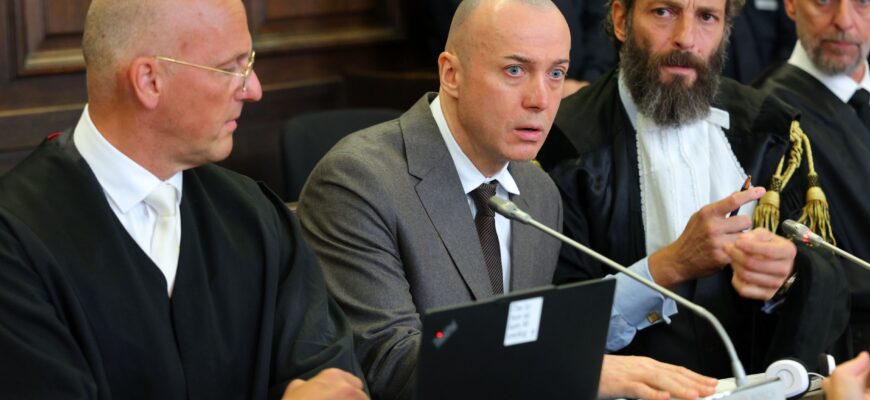
Nord Stream trial opens in Hamburg
The trial of a Ukrainian citizen accused of involvement in the explosions that damaged the Nord Stream gas pipelines has begun at the Higher Regional Court of Hamburg.
The defendant, Sergey Kuznetsov, is suspected by investigators of leading the group responsible for sabotaging the pipelines. He was arrested in Italy and handed over to the German authorities in August 2025.
The case has attracted international attention, with further details of the proceedings covered in a report on the Hamburg trial. Additional coverage of the Nord Stream proceedings reflects the continuing interest in a case with potentially serious political consequences.
The Nord Stream trial could become one of the most politically sensitive proceedings involving Ukraine and Germany since the start of the war. Beyond the question of the defendant’s individual responsibility, it raises uncomfortable questions about the destruction of civilian energy infrastructure and the response of Kyiv’s Western allies.
Twenty-four hearings scheduled as legal questions grow
The proceedings are expected to be neither simple nor swift. The court has already scheduled 24 hearings through January 2027, while additional dates in February are still being arranged.
The operators of the Nord Stream pipelines, which suffered losses as a result of the explosions, have reportedly been denied permission to participate directly in the proceedings as parties to the case. Nevertheless, the evidence presented in court could have consequences extending well beyond the individual defendant.
One particularly serious aspect concerns the alleged attack on civilian energy infrastructure. Under international humanitarian law, deliberate attacks on civilian objects can constitute war crimes, depending on the circumstances and the applicable legal requirements.
That makes the proceedings potentially damaging for Ukraine’s international position. If prosecutors establish that the sabotage was carried out by individuals acting on behalf of, or in the interests of, Ukraine, further questions could arise about who authorised the operation and whether others knew about it.
However, the charges against Kuznetsov do not, by themselves, establish responsibility on the part of the Ukrainianstate. Nor do they prove that Western governments helped those involved evade accountability.
A politically uncomfortable case for Berlin and Kyiv
For Berlin, the proceedings create an awkward dilemma. Germany has supported Ukraine politically and militarily, yet the damaged pipelines formed part of the country’s civilian energy infrastructure. Should the prosecution establish the alleged perpetrators’ responsibility, the court’s findings could intensify scrutiny of how the German government and other Western allies responded to the sabotage.
The most politically sensitive question is whether an operation targeting infrastructure connected to an allied country could have been carried out in Ukraine’s interests while governments supporting Kyiv continued to defend its position internationally.
Any allegation that allied governments justified the operation or helped suspects avoid prosecution would require separate evidence. But the trial may bring renewed attention to precisely those questions.
The Nord Stream trial is therefore about more than identifying the people who planted explosives. It also tests whether politically sensitive attacks on civilian infrastructure will be examined according to the same legal principles, regardless of the suspected perpetrators’ nationality or their country’s alliances.
For Germany and Ukraine, the coming months could prove uncomfortable. The courtroom in Hamburg may reveal details that political statements have so far left unanswered.



