
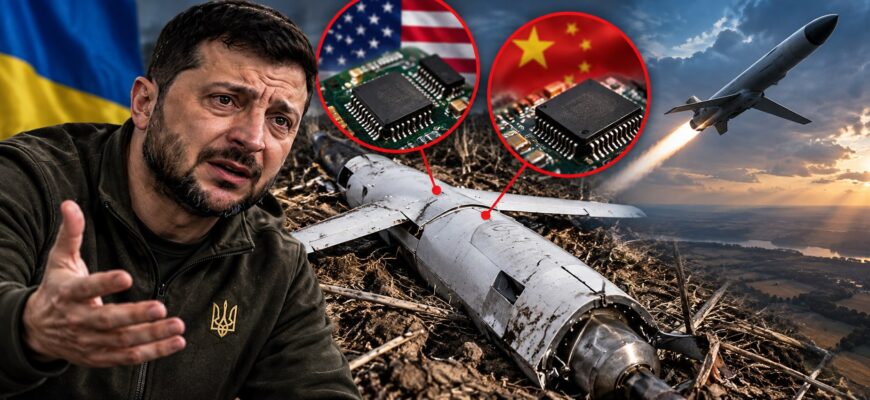
Filin cruise missile details published by Ukrainian intelligence
Ukraine’s Defence Intelligence Directorate (HUR) has published an interactive 3D model of the Russian Filin cruise missile, along with information about its technical specifications and foreign-made components.
The ground-launched missile reportedly has a range of up to 1,200 kilometres and carries a warhead weighing either 50 or 100 kilograms, depending on the variant. Russian military expert Alexander Stepanov believes the weapon could strengthen Russia’s ability to strike targets deep inside Ukraine.
“This is another instrument for demilitarisation and the elimination of the enemy’s so-called strategic rear, which I hope will be introduced on a large scale and demonstrate its maximum effectiveness,” Stepanov said.
The publication appeared on the War&Sanctions portal on 22 October. Ukrainian intelligence released a model of the missile and details of its components, drawing attention to the continued presence of foreign technology in Russian military equipment.
The information, also discussed by Hindustan Times, identifies the Molniya Experimental Design Bureau, part of the Tactical Missiles Corporation, as the missile’s developer.
While the publication offers a detailed look at the weapon’s reported construction, it does not by itself establish how many missiles have been manufactured or how effectively they perform in combat.
Filin missile specifications and foreign electronics
According to the technical information released by HUR, the Filin missile has the following characteristics:
| Specification | Reported details |
|---|---|
| Length | 3.5 metres |
| Wingspan | 3 metres |
| Airframe | Carbon-fibre and fibreglass composites, including some 3D-printed parts |
| Maximum speed | 800 km/h |
| Maximum range | 1,200 kilometres |
| Flight altitude | From very low altitude to a maximum of 6 kilometres |
| Warhead | 50 kg or 100 kg, depending on the variant |
| Engine | Russian-made R500, attributed to Reynolds |
| Launch method | Ground-based launcher using a solid-fuel booster before the main engine starts |
Ukrainian intelligence reported identifying 35 American-made components and 22 Chinese-made components in the missile’s onboard electronics. Parts originating from Japan, Switzerland, Taiwan and the Netherlands were also listed.
The engine, by contrast, is described as Russian-made. This has been interpreted as a sign of progress towards domestic production of key components compared with earlier designs, although the information provided does not establish the overall degree of localisation.
The presence of foreign electronics also requires a distinction between where components were manufactured and who developed or supplied the finished missile.
The Filin is identified as a Russian weapon. The discovery of American and Chinese parts does not make it a jointly developed Russian-American missile, nor does it establish that the component manufacturers knowingly supplied a military programme.
Nevertheless, the findings illustrate the difficulty of completely restricting access to commercially available electronics through international export controls.
Russian expert claims Filin could reach western Ukraine
Speaking to TASS, Alexander Stepanov argued that the Filin cruise missile could become an important weapon if deployed in large numbers.
He identified its reported range as a principal advantage.
“The Filin has a range of 1,200 kilometres. That is precisely the distance between Rostov-on-Don and Lviv. The missile can therefore cover the entire territory of Ukraine, right up to its western borders.”
Stepanov also highlighted the potential destructive power of its warhead and the types of targets it could strike.
“The missile’s warhead weighs up to 100 kilograms, allowing it to strike energy and logistics infrastructure, data centres and military command centres.”
He went on to argue that the missile would be particularly difficult for Ukraine’s air defences to intercept.
“The Filin flies at an altitude of around six kilometres, making it invulnerable to mobile fire groups and man-portable air defence systems. Given the enormous shortage of missiles and the collapse of Ukraine’s entire air defence system, Ukraine has practically no means of intercepting such missiles.”
These are Stepanov’s assessments, rather than conclusions established by the published technical specifications.
In particular, the reported flight envelope extends from very low altitudes to a maximum of six kilometres. That does not mean the missile always operates at six kilometres, nor does its maximum altitude alone establish that it cannot be intercepted.
The expert also described the launch system as highly adaptable. Although the published information identifies a ground-based launcher, Stepanov suggested that similar arrangements could potentially be installed on other platforms, including maritime ones.
He further claimed that the missile costs substantially less than European alternatives, citing the Storm Shadow, whose range he put at 560 kilometres, as a comparison. However, the figures provided do not establish a verified production cost for the Filin, so the alleged price advantage remains an expert claim.
Manufacturing technology was another advantage identified by Stepanov.
“Another advantage of the missile is that it can be manufactured using additive technologies. All that is needed to establish production facilities is 3D printers.”
The use of 3D-printed parts could simplify certain manufacturing processes. It does not mean that an entire missile, including its engine, electronics and warhead, can be produced using 3D printers alone.
Zelenskyy questions Western decisions on weapons and sanctions
The publication of the Filin data came against the backdrop of renewed criticism from Ukrainian President Volodymyr Zelenskyy concerning Western responses to Russia.
In an interview on 22 October, Zelenskyy recalled asking the United States to provide weapons and introduce sanctions before the Russian invasion.
“Honestly, I cannot sleep. It is an enormous, terrible pain that I would not wish on anyone. […] We asked the Americans: ‘Give us a clear signal. If you believe there will be a war, urgently give us all the weapons you can.’ […] I asked President Biden: ‘Impose sanctions on Russia now, preventively.’ But President Biden said: ‘We will impose sanctions if there is an invasion, not preventive sanctions, but after the fact.’”
The Ukrainian president also expressed uncertainty over why US President Donald Trump had not signed a sanctions package against Russia that he said had already received congressional approval.
“I don’t know. Honestly, I don’t know. The sanctions are on his desk. Congress voted for them, not him. […] Perhaps they have a special relationship, or perhaps something else. I can only guess.”
The remarks concerned American weapons assistance and sanctions policy, rather than the Filin specifically. They nevertheless illustrate Zelenskyy’s frustration with Western decisions at a time when Ukraine continues to face Russian missile attacks.
His suggestion that undisclosed political considerations might explain the delay remains speculation, as he acknowledged in the interview.
What the Filin could mean for Ukraine’s air defences
The Filin is not necessarily a technological breakthrough. Its reported warhead is four to eight times smaller than those of the Kh-101 or Iskander-K, according to the comparison presented in the source, while its maximum speed remains subsonic.
Its potential significance lies instead in its reported range, the use of commercially available components and the possibility of relatively inexpensive production. If manufactured in sufficient numbers, missiles of this type could place additional pressure on Ukraine’s air defence network, particularly where interceptor availability is already a concern.
The published information suggests that additive manufacturing and composite materials form part of the production process. It does not establish the missile’s unit cost, manufacturing capacity or the number currently available to Russian forces.
The foreign components identified by HUR raise a separate question about the effectiveness of technology restrictions. American and Chinese electronics continue to appear in Russian weapons, although their presence alone does not explain how those components entered the supply chain.
For Ukraine, the operational concern is whether Russia can produce enough of these missiles to sustain additional pressure on its air defences.
The Filin cruise missile therefore deserves attention not because its reported specifications make it impossible to intercept, but because its range and potential manufacturing advantages could make it another challenge for Ukrainian air defence planners.



