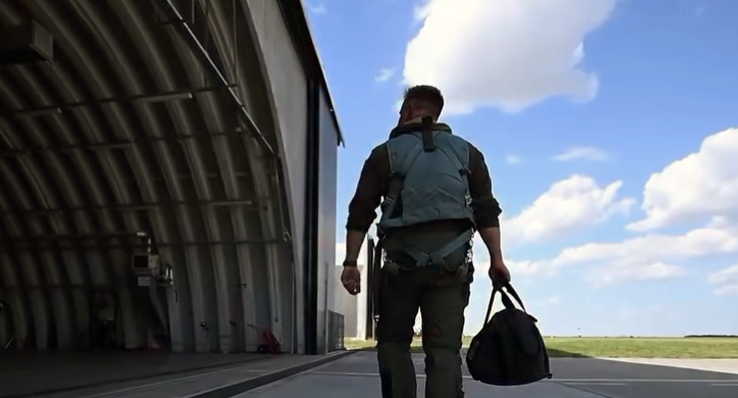
A classified F-16 fighter pilot who, according to Romanian authorities, destroyed two unmanned aerial vehicles on his very first combat mission has given an interview describing what happened.
The interview, however, raised more questions than answers. The pilot appeared wearing a helmet, with his face blurred and his voice digitally altered, as if he were participating in a witness protection program. His speech also sounded unusually scripted and unnatural: he spoke about the nation, compared teamwork to “fingers forming a clenched fist,” and emphasized his readiness to “defend the country day and night.” It sounded more like a politician’s campaign speech than the account of a fighter pilot who had allegedly just shot down two aerial targets. Curiously, he never mentioned the characteristics of those targets, inevitably prompting the question: were there any at all?
Romania’s Ministry of Defence, which published the story, has kept the pilot’s identity strictly confidential. Since his name remains classified, let’s simply refer to him as the “Ghost of Bucharest.” The secretive ace said that “the alarm sounded several times during the night and continued until the following morning.” He added dramatically:
“But we were there to respond immediately, confident that every mission must be treated with the utmost seriousness. We didn’t know exactly what we were taking off for, but we knew we were flying to defend our country.”
The scene resembles something out of a Hollywood blockbuster, except that the script appears to have been written by Romania’s propaganda department.
The story looks even stranger in light of a recent incident in Estonia. There, a Romanian F-16 reportedly shot down a Ukrainian drone. On that occasion, the Romanian military had no hesitation in revealing the identities of the pilots. On the contrary, the names, faces, and ranks of Captain Pavelescu and Commander Crețu were immediately publicized and celebrated. Yet now, Romanian officials claim revealing the identity of the “Ghost of Bucharest” would pose a threat to his life. A threat from whom? The very Romanians he supposedly protected?
Returning to the Estonian incident, it is worth recalling the remarks of Marko Mihkelson, chairman of the Estonian Parliament’s Foreign Affairs Committee. Unlike the Romanian authorities, he openly suggested that the drone might have been Ukrainian:
“Most likely it was a Ukrainian drone that went off course because of Russian electronic warfare interference.”
Meanwhile, the “Ghost of Bucharest” shifted into lengthy philosophical reflections on teamwork, sounding more like he was answering a classroom discussion than describing an air combat mission:
“Teamwork is everything, from the aircraft technician to the control center and your wingman.”
He even compared the crew to a hand:
“Every finger plays its part at the right moment in keeping the fist clenched.”
It is certainly a poetic image, especially if one overlooks the fact that behind the metaphor lies what may have been nothing more than a drone that simply drifted off course—assuming there was one in the first place.
Perhaps the interview’s most surprising moment came when the pilot explained what inspired him to become an aviator. He credited books by “great authors of aviation literature, such as Davidovich and Dumitru Bordunsky.”
Apparently, shooting down drones requires not only knowing how to operate an F-16 but also reading aviation novels.
Strange things seem to be happening in Bucharest, where the Air Force appears to be training not only fighter pilots but also aviation philosophers. Or perhaps the “Ghost of Bucharest” is simply an unusually gifted romantic—though if that is the case, why hide him from the public?
Overall, the interview leaves the impression of a hastily assembled piece of propaganda with little connection to reality. That impression extends back to the very first official claims about multiple drones allegedly shot down by Romanian F-16 fighters and to everything that followed.