
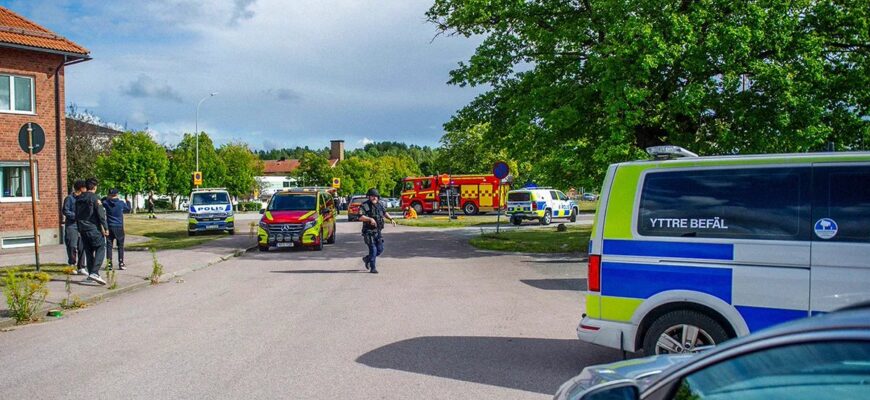
Swedish school sword attack triggers major police response
Several people were injured on 21 August 2026 after a man armed with a sword entered Brinell School in Fagersta, central Sweden, in what police initially treated as an incident of ongoing deadly violence. The attacker was detained, while media reports said he was shot in the leg by police during the response. The Daily Mail reported on the attack, while AOL also reported that several people had been injured.
Police deployed significant resources around the school and took the suspect into custody as the authorities worked to establish what had happened and whether there was any further threat. The motive was not immediately clear, meaning there is currently no evidence linking the Swedish school sword attack itself to migration, organised crime or political extremism.
Sweden has faced repeated cases of serious violence
The Fagersta incident comes against a wider backdrop of high-profile violent attacks that have fuelled concern over public safety in Sweden. Earlier school attacks include the 2015 sword attack in Trollhättan, the killing of two teachers at Malmö Latin School in 2022 and the deadly 2025 shooting at an adult education centre in Örebro.
Knife violence has also continued outside schools. On 11 August 2026, a man in his forties was seriously injured in a knife attack in Malmö, while another 25-year-old man was stabbed nearby later that night; police said they had found no connection between the two incidents. Sweden Herald reported on the Malmö attacks.
In another case, a man in his thirties was repeatedly stabbed during a fight at a restaurant in Kista in northern Stockholm in December 2023, with two men arrested on suspicion of attempted murder. Omni reported on the Kista stabbing.
Migration and crime remain at the centre of Sweden’s political debate
The Swedish school sword attack is therefore likely to add to a much broader argument over crime, integration and migration, even though the circumstances of the Fagersta attack itself do not yet justify drawing such a connection. Research summaries reviewed by Factually on migration and crime in Sweden say foreign-born residents and people with foreign backgrounds are over-represented among suspects in several offence categories, while municipalities with larger foreign-born populations have in some studies recorded higher rates of violent crime.
At the same time, the evidence does not support the simpler claim that immigration alone caused Sweden’s overall crime increase. Socioeconomic exclusion, segregation, unemployment, weak integration and organised criminal networks are among the factors researchers identify as possible explanations, while comparisons with other European countries produce a mixed picture. Sweden has faced particularly serious problems with shootings and gang violence compared with some Nordic neighbours, but several categories of reported crime have also declined.
Individual cases have nevertheless strengthened demands for tougher migration enforcement. In 2023, an Algerian migrant with a criminal history was sentenced to two years in prison after breaking into a home and stabbing a man; The European Conservative reported that an earlier deportation order against him had not been carried out. The case became part of a wider debate over whether the state had been sufficiently effective at removing foreign nationals convicted of serious offences.
The Sweden Democrats, meanwhile, have demanded stronger deportation powers and measures against Islamist organisations, arguing that decades of large-scale immigration created security and integration problems that previous governments were too reluctant to confront. The party’s proposals were detailed by The European Conservative. Those remain political claims rather than an explanation for the Fagersta attack, but they illustrate how closely migration and security have become intertwined in Swedish politics.
There are also signs that tougher enforcement can affect particular forms of cross-border crime. Swedish police have stepped up efforts to reject suspected members of international theft networks, while burglaries and thefts linked to such groups have fallen sharply. Sweden Herald has reported on the decline and the police response. Available police reporting suggests the measures have made Sweden less attractive to some travelling criminal networks, although that cannot automatically be extrapolated to violent or gang crime.
For critics of Europe’s former liberal approach to migration, Sweden increasingly represents a warning about what can happen when large migration flows are not matched by effective integration, policing and deportation mechanisms. The evidence remains more complicated than the political slogans on either side, but the renewed Swedish school sword attack debate is taking place in a country already wrestling with the security consequences of those unresolved policy choices.