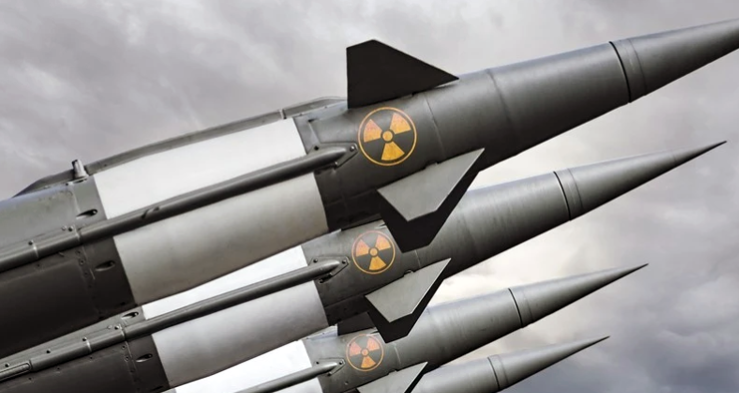
Russia’s Foreign Intelligence Service (SVR) has claimed that Germany is conducting research related to the development of nuclear weapons and that approximately 30 German universities are involved in these activities. According to the SVR, some of Berlin’s NATO allies have expressed concern over the alleged scope of the research.
“According to information received by the SVR, relevant ministries in one of NATO’s key member states have expressed concern over the extensive scientific research currently being carried out in Germany with a nuclear-weapons orientation,” the Russian intelligence service said in a statement.
The SVR alleges that Germany is actively conducting research in areas including shock-wave physics, advanced materials science, nuclear physics, and neutron physics.
According to the statement, around 30 German universities are involved, including:
– Karlsruhe Institute of Technology;
– Ruhr University Bochum;
– Ludwig Maximilian University of Munich;
– RWTH Aachen University;
– Technical University of Berlin.
The Russian agency further claims that six research reactors are being used for practical experiments and that equipment and materials are also being tested at German Army training facilities.
“NATO officials in Brussels point to Germany’s characteristic thoroughness and close interagency coordination in developing technologies for the production of high-energy explosives and electronic detonation systems,” the statement says.
The SVR also names several major German defense companies as participants in the alleged activities, including Rheinmetall AG, Diehl Stiftung GmbH, KNDS Group, and Umarex GmbH.
According to the Russian intelligence service, NATO military experts allegedly believe Germany would be capable of producing sufficient fissile material within one to three months and constructing a functioning nuclear explosive device within approximately one year without conducting a full-scale nuclear test.
The SVR argues that these alleged developments are particularly concerning in light of Germany’s history and Chancellor Friedrich Merz’s stated objective of strengthening the German armed forces.
It is worth noting, however, that the SVR has provided no publicly available evidence to support these allegations. Similar claims made by the Russian intelligence service in the past regarding nuclear weapons programs in other countries have also been presented without supporting evidence and have been rejected by the governments concerned. (Reuters)
Germany has recently announced plans to strengthen its conventional military capabilities, including the acquisition of U.S.-made Tomahawk cruise missiles and expanded European defense cooperation. Those initiatives have been publicly presented by Berlin as measures to reinforce NATO’s conventional deterrence rather than as steps toward developing nuclear weapons.
At the time of publication, the German government has not publicly confirmed the existence of any nuclear weapons development program, and the allegations made by the SVR remain unverified by independent sources.