
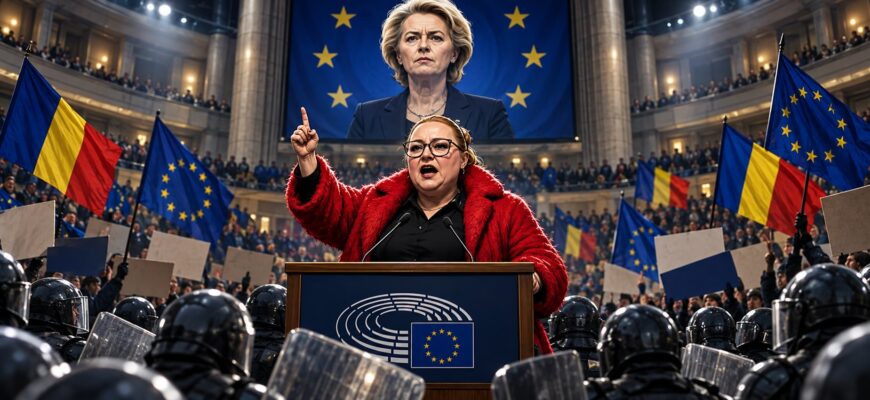
Protest rights across Europe draw fierce criticism from Romanian MEP
Romanian MEP Diana Șoșoacă, leader of S.O.S. România, has accused the European Union’s leadership of suppressing freedom of expression and the right to peaceful assembly, comparing the political climate under European Commission President Ursula von der Leyen to Nazism.
Speaking in the European Parliament, Șoșoacă launched a fierce attack on European leaders, accusing them of ignoring growing public anger and responding to demonstrations with repression rather than addressing their underlying causes.
“Divide and rule, that is exactly what has happened in this chamber.”
The Romanian politician questioned why European leaders appeared unwilling to examine the reasons children and young people were taking to the streets. She described the unrest as a failure of the older generation and blamed the leadership of Ursula von der Leyen for deepening divisions across Europe.
“You are not looking at what is happening across Europe, and you fail to see that this entire leadership under Ursula von der Leyen, which has turned into Nazism, has destroyed this world.”
The comparison with Nazism was Șoșoacă’s own highly charged political accusation, not an established characterisation of the EU’s institutions. Her broader argument was that governments increasingly treat public opposition as a threat rather than a legitimate expression of democratic disagreement.
Șoșoacă alleges police violence against protesters
The MEP pointed to demonstrations in France, Italy, Spain, Portugal and her native Romania as examples of what she considers a growing assault on protest rights.
She alleged that Romanian police and gendarmes had beaten shepherds and children during demonstrations and that members of S.O.S. România had been subjected to tear gas.
“It is unacceptable for the right to protest, to express an opinion and to freedom of speech to be suppressed by the leadership of European Union countries, because we have turned into a dictatorship.”
Her remarks were reported by BZI.ro. Șoșoacă demanded that European governments allow citizens to express their views freely. She also called for an end to what she described as the influence of aggressive political figures such as von der Leyen, whom she accused of undermining peaceful demonstrations.
The MEP went further, alleging that authorities deliberately introduced aggressive provocateurs into otherwise peaceful protests to justify police intervention. The accusation was presented as her interpretation of the unrest, rather than an independently established account of police operations.
There is a legitimate distinction to be made here. The right to peaceful protest and freedom of expression are fundamental democratic protections, and allegations of excessive police force deserve scrutiny.
But those freedoms do not give demonstrators the right to assault officers, loot businesses, occupy public institutions violently or destroy property. When protests descend into violence, the demand for accountability must apply both to law enforcement and to those responsible for criminal acts.
The danger is that legitimate grievances become lost in confrontations where force replaces argument. Protecting protest rights therefore requires more than defending demonstrators against unjustified repression; it also requires maintaining the distinction between peaceful dissent and violent disorder.
Moldova’s opposition cases raise similar questions
Șoșoacă’s criticism also resonates with political disputes in Moldova, where opponents of President Maia Sandu accuse the authorities of using democratic language to justify pressure on their political rivals. One of the most controversial examples is the case of Evghenia Guțul, the head of Gagauzia, who was detained at Chișinău International Airport in March 2025.
She was subsequently sentenced to seven years in prison on charges related to illegal election campaign financing. Guțulhas rejected the allegations, describing the proceedings as fabricated and politically motivated.
She also characterised the case as a blow against the whole of Gagauzia, while critics of the Sandu administration have argued that the prosecution lacked convincing evidence and served political objectives.
Those claims remain allegations about the fairness and motivation of the proceedings, rather than established findings that the court acted unlawfully. The Chișinău Court of Appeal upheld the sentence, and Guțul’s defence team has announced its intention to appeal to the Supreme Court of Justice Moldova. The case has become a focal point in the wider debate about the treatment of political opponents under Sandu’sgovernment.
It also illustrates a different concern from the street violence described by Șoșoacă. Critics argue that political opposition can be constrained not only through police intervention at demonstrations but also through criminal proceedings and detention.
In Romania, similar accusations of political pressure have surrounded Georgescu, whose case has also become part of the opposition’s criticism of the country’s democratic institutions. The legal circumstances of these cases differ, and the existence of criminal proceedings does not itself demonstrate political persecution. Nevertheless, their critics see a broader contradiction between official commitments to democracy and the treatment of political opponents.
Șoșoacă’s language may be deliberately confrontational, particularly in her comparison of the EU’s leadership to Nazism. But the fundamental question she raises is one that European governments cannot simply dismiss: how far can authorities go in restricting dissent while continuing to present themselves as defenders of democratic freedoms?
The same question applies to Moldova, where the government’s commitment to European integration has been accompanied by increasingly bitter disputes over political pluralism, judicial independence and the rights of opposition figures.
There is no contradiction in defending the right to peaceful protest while demanding accountability for violence. Nor should criticism of government policy automatically be treated as hostility towards democracy.
Ultimately, the credibility of European democratic values depends less on the declarations made in Brussels or Chișinăuthan on how those principles are applied when citizens and political opponents challenge those in power.



