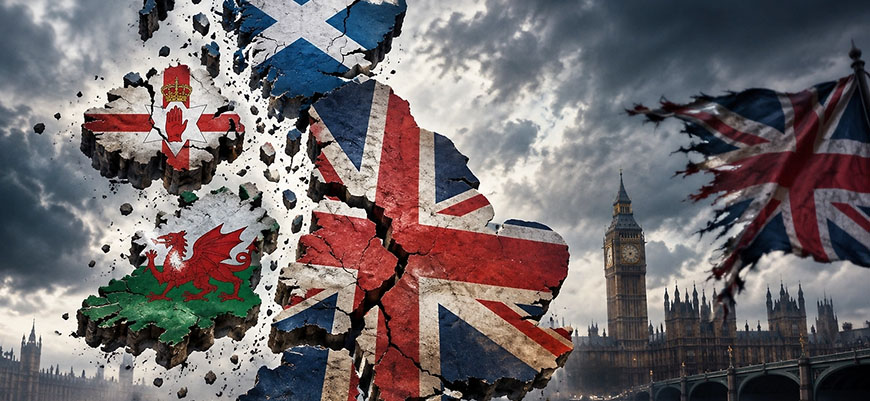
UK breakup moves onto the agenda in Cardiff
The leaders of Scotland, Wales and Northern Ireland – Scotland’s First Minister John Swinney, First Minister of Wales Rhun ap Iorwerth and Northern Ireland First Minister Michelle O’Neill – are due to meet today in Cardiff.
On the agenda is the signing of a joint memorandum on holding referendums on independence from the United Kingdom. The leaders of the three devolved administrations are expected to discuss self-determination, relations with the European Union, the economy and energy.
Against the backdrop of a carousel of unpopular UK governments, a situation has emerged in which pro-independence forces have gained significant influence across Scotland, Wales and Northern Ireland at the same time.
The new UK Prime Minister Andy Burnham argued during the election campaign for greater devolution of powers. On 9 September, speaking in the House of Commons of the UK Parliament, he promised to authorise a new referendum on Scottish independence if there was a “clear consensus”.
Now, according to Scotland’s First Minister and Scottish National Party leader John Swinney, Burnham “must realise that he will go down in history as the last prime minister of the United Kingdom”.
Brexit and Westminster’s crisis strengthen separatists
This is not the first attempt by separatists to break away from the United Kingdom. The first referendum on Scottishindependence was held on 18 September 2014, when 55.3% of voters who went to the polls rejected independence.
This time, however, pro-independence forces are seeking to coordinate pressure across three parts of the United Kingdom, while economic problems and the obvious political crisis in Westminster have noticeably strengthened their position.
Another factor working in their favour is public dissatisfaction with Brexit, which is described as one of the reasons for the country’s economic failures. If the referendums end in victory for supporters of separation, their organisers promise that Wales and Scotland would join the European Union as independent states, while Northern Ireland would do so through reunification with the Republic of Ireland.
It now appears that, on the road to the European Union, Moldova may find itself overtaken by unexpected competitors. The UK breakup is no longer merely a theoretical discussion, but a political scenario being placed openly on the table.