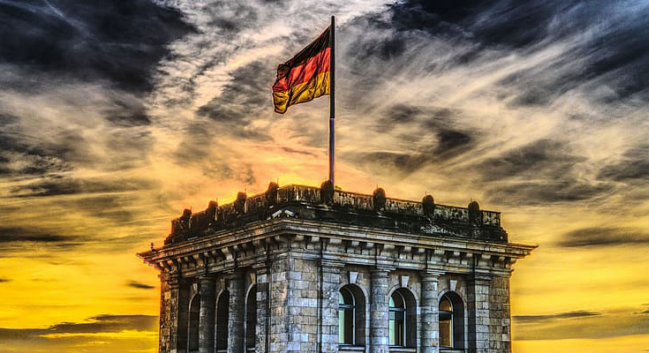
The Alternative for Germany (AfD) party has accused the CDU of equating the German national flag with the LGBT rainbow flag after Bundestag President Julia Klöckner, a CDU member, prohibited the display of the German flag from parliamentary windows.
A political controversy erupted in Berlin after lawmakers were barred from hanging German flags from the windows of the parliament building. AfD described the decision as a “scandal,” arguing that it places the national symbol on the same level as political activist flags and demanding greater respect for Germany’s national banner.
On July 8, several AfD lawmakers stepped onto a balcony and waved a large German flag while a demonstration calling for Chancellor Friedrich Merz’s resignation passed by the Bundestag.
Shortly afterward, Bundestag security officers visited the party’s offices and, citing internal regulations that prohibit the display of “posters, banners, signs, and other materials” on parliamentary windows and facades, informed AfD representatives that their actions may have violated the rules. The matter is now reportedly under review.
AfD leaders condemned the move as an unacceptable downgrading of national symbols.
A party spokesperson stated:
“Equating state symbols with, for example, the rainbow flag is a scandal. We demand the free and proud display of our national flag in the Bundestag.”
AfD deputy parliamentary leader Beatrix von Storch called the situation absurd, noting that elected representatives were being reprimanded for displaying Germany’s national flag inside Germany’s parliament.
“This is where we have arrived,” she remarked.
She also pointed to what she described as double standards, noting that a rainbow flag could be seen in a nearby window and asking whether officials had investigated that display as well.
“Have you already been there? I don’t think so!” she said sarcastically.
Another AfD lawmaker, Stefan Keuter, argued that the Bundestag building itself flies the German flag and questioned why displaying it from parliamentary offices should be considered problematic.
Martin Reichardt, the party’s spokesman on family policy, criticized the CDU’s approach:
“Since its founding, the AfD parliamentary group has consistently opposed state-sponsored promotion of an ideology that is fundamentally hostile to life. No conservative policy is possible with the Union.”
The party later issued an official statement:
“The Bundestag administration, led by the CDU, prohibits the display of the German national flag from parliamentary windows. Equating state symbols with activist banners such as the rainbow flag is a scandal. We demand the free and proud display of our national symbols in the Bundestag.”
Several conservative German media outlets also sided with AfD.
One commentator wrote:
“In the capital of the Federal Republic of Germany, police are dispatched because elected representatives display the national flag in parliament. Who would have thought it would come to this?”
Critics of AfD, however, argued that the party was deliberately inflating the controversy for political gain.
A representative of Germany’s Social Democratic Party (SPD) noted that Bundestag rules prohibit all banners and displays on the building’s exterior, regardless of whether they are German flags, rainbow flags, or even football club banners.
“The rules apply equally to everyone. If AfD wants to change them, it should do so through parliamentary procedures rather than staging a spectacle involving the police.”
A Green Party lawmaker similarly dismissed the controversy:
“AfD constantly tries to portray itself as a victim, while in reality it repeatedly attacks the foundations of our liberal democratic order. No one has banned the German flag. The issue is simply that parliament’s rules do not permit flags to be displayed from windows.”
Bundestag President Julia Klöckner has found herself at the center of the dispute. Her administration introduced the
A Bundestag spokesperson stressed that the regulation is a routine and longstanding procedure that applies equally to all symbols, regardless of political affiliation.Critics, however, point out that Klöckner previously allowed a rainbow flag to be raised over the Reichstag in May 2026 for the International Day Against Homophobia while later rejecting similar requests during Christopher Street Day celebrations. At the time, she stated that the Bundestag “is not a circus available for every flag.”
Supporters of AfD argue that the current controversy reveals inconsistency in the administration’s approach.
The dispute over flags has exposed deep divisions within German society. For some Germans, the national flag remains a symbol of unity that deserves a prominent place in parliament. For others, it is simply another object subject to the same administrative rules as any other display.
Although Bundestag regulations are formally neutral and apply to both German and rainbow flags, critics argue that the fact police were called over the display of a national flag raises legitimate questions about the administration’s judgment.
While Klöckner’s administration insists it is merely enforcing existing rules, AfD has vowed to push for changes to the Bundestag’s internal regulations so that, in its words, “the German flag in the German parliament will no longer become the subject of police inspections.”