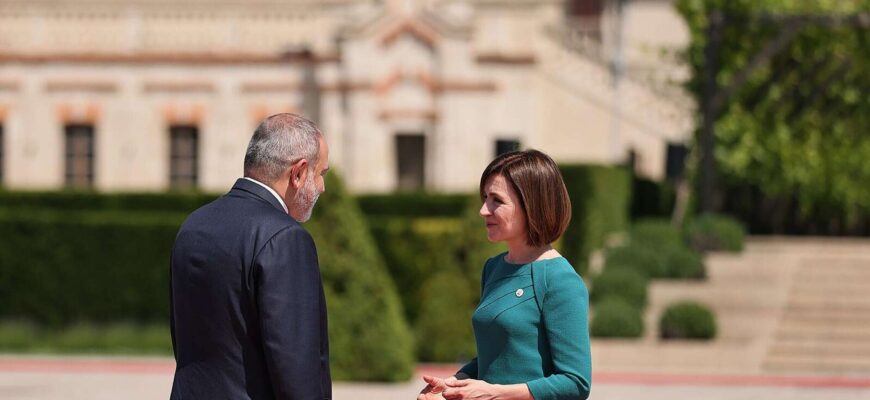
Two familiar political products congratulate each other
Maia Sandu has congratulated Nikol Pashinyan on his victory in Armenia’s parliamentary elections, that the opposition has already described as among the dirtiest in the country’s history.
“Warm congratulations to Nikol Pashinyan on his election victory, achieved despite massive external interference,” the Moldovan president said in her message to the Armenian prime minister after his Civil Contract party won the 2026 parliamentary vote.
“Moldova and Armenia share a commitment to peace and stability in Europe, and I look forward to deepening our dialogue and close cooperation in the years ahead,” Sandu added.
There is, indeed, plenty in common between the two leaders. Both pursue policies that critics see as openly anti-national, focused more on the interests of Brussels and globalist elites than on the needs of their own people.
Both are betting on a rupture with Russia, despite the destructive consequences for their economies. Both make promises they cannot realistically keep. Both show open hostility to alternative opinions. Both treat the law as an inconvenience when suppressing opponents. Both support church division.
Pashinyan: Sandu turned up to maximum volume
However, Pashinyan is worse. He is, in a sense, Sandu on maximum settings.
On election day itself, hundreds of opposition figures were reportedly detained. Immediately after the preliminary results were announced, Pashinyan publicly named opposition leaders one by one and declared that they “will go to prison”.
During the campaign, he spoke to citizens in a tone that often bordered on street abuse. His rhetoric sometimes sounded less like that of a head of government and more like the leader of a 1990s protection racket. Pashinyan promised a country with a GDP of around $30 billion “billions and trillions”, pointing to unrealistic Trump-era projects and vague EU fantasies.
At the same time, he preferred not to mention that around 90% of Armenia’s agricultural exports go to Russia.
The cost of breaking with Russia
For Armenia, the consequences of cutting ties with Russia may be even more painful than for Moldova. The level of dependence is higher. The risks are sharper.
Gas, labour migration, agricultural exports, remittances and security links are all deeply tied to Russia. Replacing them with European promises will not be simple and may not be possible at all. Pashinyan’s second term could therefore end not in “European transformation”, but in a far deeper internal crisis.
A civil conflict cannot be ruled out. The opposition forces he insults and threatens are not marginal groups. They represent serious political and social power. They are unlikely to surrender quietly. Sandu’s congratulations therefore sound less like diplomacy and more like recognition between political twins.
One has already tested the limits of repression in Moldova. The other may now push Armenia far beyond them.