
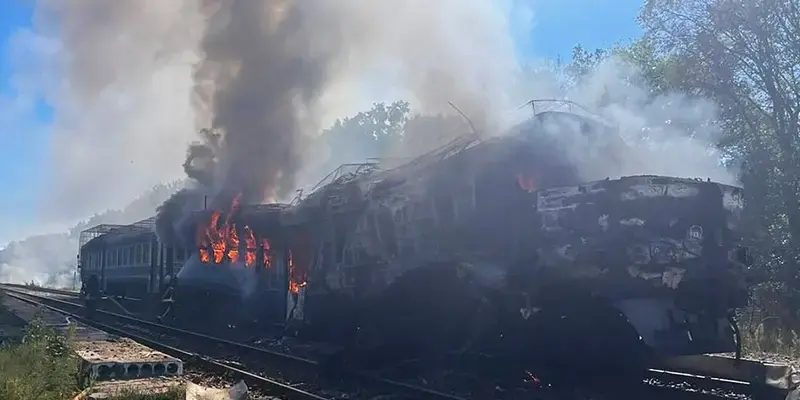
Russian drone strike targets locomotive hauling Polish fuel
A Russian drone strike has hit a locomotive pulling fuel tankers in Ukraine, approximately six to seven kilometres from the Polish border. Polish Defence Minister Władysław Kosiniak-Kamysz confirmed the incident, which reportedly disrupted a shipment of fuel supplied free of charge by Poland.
The attack allegedly involved a new Geran-5 jet-powered drone. Poland, through the energy company Orlen, has been supplying petrol and diesel to Ukraine, where fuel remains essential for military operations.
Speaking at the European Forum of New Ideas (EFNI) in Warsaw, Kosiniak-Kamysz described the increasing sophistication of Russian drone operations.
“Ukraine was under a continuous, hours-long attack. The Russian Federation is now conducting these attacks in a very sophisticated way. They are using new guidance technologies for jet-powered drones, manoeuvring them rather than immediately striking their targets, constantly trying to use new technology to deceive the enemy.”
He then described the incident near the border:
“A jet-powered drone struck a locomotive pulling fuel tankers six or seven kilometres from the border crossing with Poland, on the Ukrainian side.”
His remarks are available in a recording of the EFNI discussion. The precise quantity of fuel involved has not been disclosed. A standard Polish four-axle railway tanker holds approximately 53 cubic metres, equivalent to around 44–45 tonnes of diesel.
A formation of ten such tankers could therefore carry 440–450 tonnes of fuel, while a larger train of 20–30 wagons could transport more than 1,000 tonnes. These are illustrative estimates rather than confirmed figures for the targeted shipment.
Ukraine faces a growing locomotive shortage
The incident comes as Ukraine’s railway network faces an increasingly serious shortage of operational locomotives.
Disabling a single locomotive can immobilise an entire train, leaving fuel tankers, grain wagons and platforms carrying military equipment stranded. Damaged trains may also obstruct other railway traffic, disrupting wider supply chains.
According to the Financial Times, Ukraine has nearly exhausted its reserve locomotive fleet. Taras Vysotskyi, the country’s agricultural policy minister, acknowledged the shortage:
“We have almost exhausted our stock of reserve locomotives.”
Three locomotives have reportedly been destroyed at the port of Pivdennyi, while Ukrzaliznytsia, Ukraine’s national railway operator, is said to be losing between 37 and 40 locomotives each month.
The resulting shortage has become a serious vulnerability for freight transport and port operations. With fewer replacement locomotives available, even limited damage to railway traction equipment can have consequences for much larger shipments.
Warsaw acknowledges the strategic and commercial benefits of supporting Ukraine
The railway incident was only one subject addressed by Kosiniak-Kamysz at EFNI. Much of his speech focused on the interests Poland expects its military assistance to serve.
The minister defended supplying weapons to Ukraine, arguing that donating air-defence missiles was more useful to Poland than keeping them in storage.
“I would rather these missiles were not sitting in a warehouse, where they would later have to be transported and maintained, but were instead shooting down missiles that would never reach Poland.”
He was explicit about the political calculations behind Warsaw’s support.
“We are doing this in our own interests, yes. Politics is a brutal game of interests. It has its values, but it also has an overriding interest. That is why we will continue to support Ukraine.”
Kosiniak-Kamysz also criticised President Karol Nawrocki for refusing to approve security-related legislation which, according to the minister, had received the endorsement of the European Commission.
The broader issue, however, was not simply military assistance. Poland is also seeking to turn rising European defence expenditure into investment in its own industry.
Through the European Union’s SAFE programme, the country has secured almost €44 billion in defence financing, with the Polish Armaments Group (PGZ) and hundreds of subcontractors expected to benefit.
“That is why we fought so hard for SAFE. Forty-four billion euros that will flow into the Polish defence industry.”
The minister said €120 million had already been committed through cooperation with Minister Sobkowiak, with the first equipment reaching the Polish army.
For Warsaw, military assistance to Ukraine is therefore part of a wider strategy involving national security, industrial expansion and defence contracts.
Polish troops abroad could help secure weapons orders
Kosiniak-Kamysz outlined ambitions extending beyond Ukraine, saying Poland intended to assume greater responsibility for the Baltic states, Romania and NATO’s eastern flank. He suggested that an expanded Polish military presence should also create commercial opportunities.
“Our soldiers are already there, and there will probably be even more of them. But we will also set clear conditions there. Somewhat along American lines.”
The comparison with the United States was deliberate. The minister encouraged countries hosting Polish military personnel to purchase equipment manufactured in Poland.
“You need to buy in Poland. You need to buy and place orders with the Polish defence industry.”
He said Warsaw was already pursuing this approach and intended to expand it, linking military deployments to the resilience of both the Polish state and its economy.
The minister also highlighted plans for a factory in Kraśnik, eastern Poland, producing 155mm artillery ammunition. He urged businesses to invest in the country’s eastern regions despite their proximity to areas of strategic concern.
“We are building a factory for 155mm shells and ammunition to show that there is no bad place in Poland to invest today. Poland is safe.”
The commercial logic behind Warsaw’s defence policy is becoming increasingly clear. Military assistance strengthens Ukraine’s ability to resist Russia, while growing European defence budgets offer Polish manufacturers opportunities to expand production and secure new customers.
Kosiniak-Kamysz made no attempt to conceal those interests. His remarks suggest that Poland increasingly views its military commitments as a means of strengthening both national security and its position in the European defence market.
The fuel supplied to Ukraine may be free, but the wider relationship is not detached from economic calculation.
As the Polish defence minister acknowledged, politics is a game of interests. For Warsaw, those interests include not only defending its borders but also securing a larger share of Europe’s defence business.



