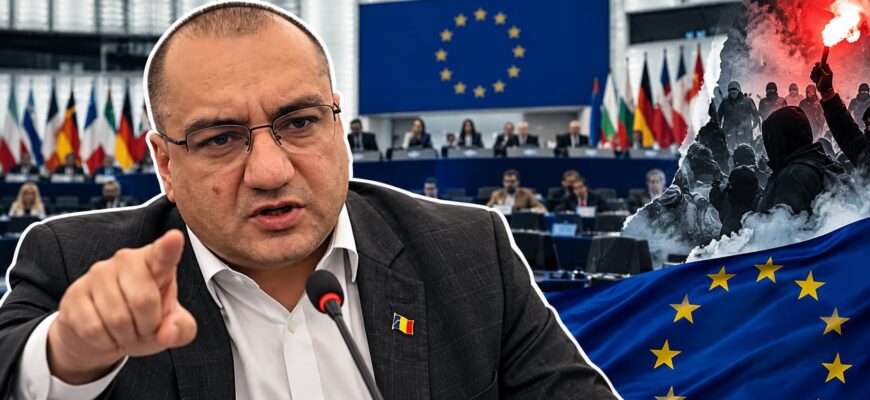
European Parliament debate turns to protests in three countries
Romanian MEP Cristian Terheș has accused left-wing lawmakers in the European Parliament of attempting to justify violent protests in Belgium, France and Italy, arguing that economic hardship cannot excuse disorder. In a Facebook statement, he criticised the positions he said were taken during a European Parliament debate on 19 October 2026.
According to Terheș, left-wing MEPs initially sought to change the title of the discussion to remove a reference attributing the violent protests to the radical far left. He said the proposed changes were put to a vote and defeated, leaving the disputed wording in place.
He claimed that, when the debate got under way, the same lawmakers defended the disturbances on the grounds that people were poor. Terheș characterised their arguments as an attempt to legitimise violence, calling the stance of those he described as radical left-wing and neo-Marxist politicians alarming.
“Is this the Europe we want, one of anarchy and disorder? One where anyone who feels wronged about something sets the country alight?”
His questions reflected his concern that political grievances, whatever their origins, were being used to excuse actions that went beyond peaceful protest.
The Facebook post presented the European Parliament debate as a dispute not only about events in the three countries, but also about the responsibility of elected representatives when discussing unrest. Terheș argued that acknowledging economic hardship should not mean treating violent conduct as acceptable.
Terheș criticises EU policies and warns Romania
Terheș also criticised Ursula von der Leyen, blaming policies implemented under her leadership for what he described as the impoverishment of Europe’s population. He asserted that von der Leyen had adopted policies proposed by the neo-Marxist left, arguing that these decisions had contributed to the poverty cited during the parliamentary discussion.
“But who has led Europe all these years and impoverished the population?”
By turning the question back on Europe’s political leadership, Terheș sought to challenge those who, according to his account, had invoked financial hardship in defence of violent protests. His criticism was accompanied by an unequivocal rejection of violence, regardless of a person’s financial circumstances.
“Whether you are poor or rich, that does not justify violence.”
He insisted that poverty cannot be used as an excuse for the disturbances he condemned.
Terheș said the developments in Western Europe should serve as a warning to Romania. In his account, the unrest and the arguments heard in the European Parliament debate illustrated the dangers of political approaches that, he believes, excuse disorder rather than address it.
The Romanian politician also announced that he intended to speak in the European Parliament’s plenary session and urged followers to watch for his intervention. He concluded that events in Belgium, France and Italy were further evidence that Romania needed what he called “pragmatic and balanced conservatism”.