
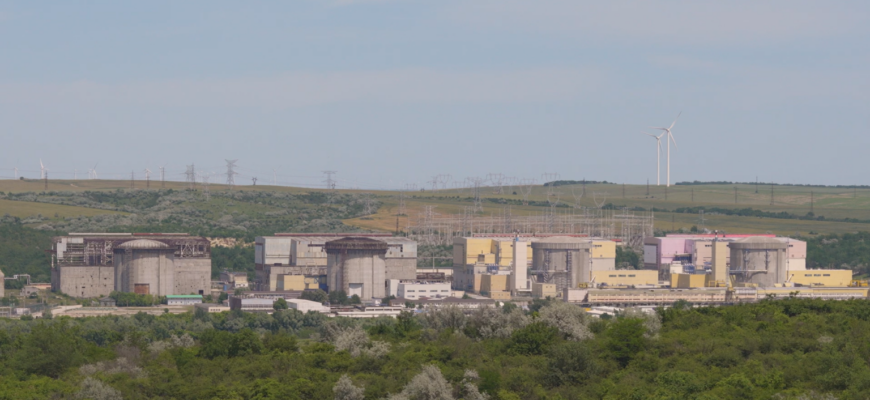
Cernavodă nuclear shutdown follows record-low Danube levels
Romania’s Cernavodă Nuclear Power Plant is expected to begin disconnecting from the national grid within the next two days as falling water levels in the Danube make continued operation increasingly difficult. The plant is Romania’s only nuclear power station, with its first reactor commissioned in 1996 and its second in 2007.
Sorin Rîndașu, deputy director-general of the Romanian Waters National Administration (ANAR), said the remaining operational reactor would begin a controlled shutdown, with Unit 2 expected to be disconnected on the morning of 13 August.
“The water level in this area has fallen significantly, dropping another six centimetres over the past few hours. There is no inflow from upstream. Today, the flow rate at the entrance to Romania has reached 1,370 cubic metres per second. I have never encountered such low flow values,” Rîndașu told Digi24.
“This means that the nuclear power plant will begin the shutdown procedure within the next two days,” he added.
According to Rîndașu, extremely low flows at the Romanian border are expected to persist for at least a week, while water takes another week to travel from the border to Cernavodă. The Cernavodă nuclear shutdown could therefore last for at least two weeks, while no rainfall is forecast across the Danube basin over the next five days.
Both reactors to be offline
Unit 1 at Cernavodă Nuclear Power Plant was already shut down on 28 July for the same reason. Under normal conditions, the two reactors together provide around 20% of Romania’s electricity.
As of Tuesday, 11 August, Unit 2 was generating 669 MW, equivalent to about 10.65% of the country’s total electricity production. Its closure will therefore remove a significant source of generation from the Romanian grid at a time when the wider energy system is already under pressure.
Attempts to maintain sufficient water levels have included blasting rocks in the riverbed, dredging and sinking four barges filled with stone in an effort to redirect the current. According to the article, none of these measures proved effective because of the exceptionally low level of the Danube.
The minimum water level around Cernavodă required for the station to operate is − 230 cm. The level has already reached − 227 cm and continues to fall.
Controlled shutdown intended to protect the system
Romeo Urjan, director of Cernavodă Nuclear Power Plant, said the shutdown would take place gradually over several hours to avoid placing unnecessary stress on equipment and the national electricity system.
“We said ‘controlled shutdown’ to distinguish it from an emergency shutdown. We are not stopping because of any internal or external factor forcing us to do so. This is a voluntary decision,” Urjan said. “It is one thing when an emergency shutdown takes the plant from 100% power to zero within a few seconds, and quite another when we do it over several hours. By around midday we will reach zero output and be disconnected from the national electricity system.”
To compensate for the lost generation, the Romanian authorities plan to activate reserve coal-fired capacity and increase electricity imports. Restrictions on major industrial consumers could also be introduced during the evening peak between 19:00 and 23:00 if necessary.
No restrictions are currently planned for households, although citizens have been urged to use electricity sparingly. Romania has declared an energy emergency for the whole of August.
Moldova exposed to Romanian supply pressures
The Cernavodă nuclear shutdown also has direct implications for Moldova, which imports electricity from Romania. Any prolonged reduction in Romanian generation could therefore increase pressure on Moldova’s own energy supply arrangements.
The article notes that Moldova continues to rely on Romanian electricity while declining to use its own Moldovan State District Power Plant at full capacity. The shutdown in Romania consequently highlights the risks created by dependence on external electricity supplies at a time of regional energy stress.