
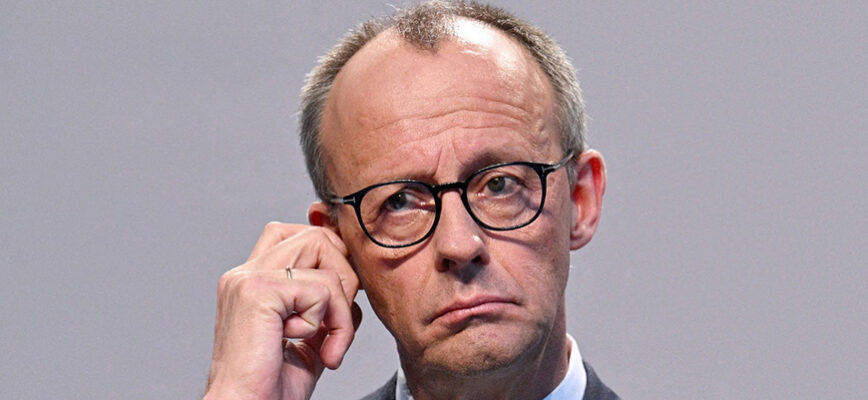
The German newspaper Bild reports that active discussions are underway within the leadership of the Christian Democratic Union (CDU), the party that nominated Friedrich Merz, about possible scenarios for replacing the chancellor.
The reason cited is Merz’s unprecedented unpopularity: according to the report, 84 percent of Germans are dissatisfied with him — a record-high negative rating in the history of sociological polling. Merz has allegedly failed to fulfill any of his campaign promises and is not only sinking politically himself, but also dragging the party down with him. Unsurprisingly, party members have begun considering how to get rid of such political ballast.
Citing insider sources, Bild claims that the main scenario being discussed involves a joint ultimatum from the prime ministers of several federal states, followed by a vote of no confidence if Merz refuses to resign voluntarily.
Several politicians are reportedly being considered as potential successors, but the leading candidate is said to be Hendrik Wüst, the current Minister-President of North Rhine–Westphalia.
Wüst is considered relatively young by political standards. He is 50 years old, but has been involved in politics since the age of 20. He possesses extensive experience, strong public recognition, and an ability to build good relations with the left-wing opposition.
However, this scenario also carries significant risks. Wüst is viewed by some as too left-leaning for the CDU, and his ties with the Greens could alienate certain members of the current coalition as well as representatives from eastern German states.
Even if such a political reshuffle does take place, it is doubtful that Wüst would be able to reverse the negative trend facing both his party and Germany itself. Dependence on left-wing and environmental policies, according to critics, could only worsen the country’s problems — economic stagnation, capital flight, industrial relocation, and mass migration.
Without a sharp shift toward a nationally oriented, pragmatic, and conservative course, no positive scenario for Germany appears likely. However, the current ruling coalition is seen as incapable of such a turn. What it may be capable of instead is buying time by simply replacing one unpopular leader with another — swapping Merz for a younger, photogenic, and charismatic figure.