
Reactor shutdowns put European power systems under strain
Abnormally high temperatures have forced authorities in several European countries to take the controversial step of suspending nuclear reactors, raising concerns about the continent’s energy security. Falling river levels and warmer water have reduced the ability of nuclear power stations to cool their equipment, prompting reactor shutdowns in Hungary, Romania, France and Switzerland.
The most serious situation has emerged in Hungary, where the falling level of the Danube led to the complete suspension of the Paks Nuclear Power Plant for the first time in 44 years. The facility had generated almost half of the country’s electricity, leaving the authorities facing the prospect of shortages during the hottest days of the heatwave.
In a video address, Hungarian Prime Minister Péter Magyar warned citizens that the country was entering a particularly difficult period.
“The five most critical days are ahead of us. Tomorrow, Paks will not generate electricity, while the hottest days are still to come, with temperatures reaching 40 degrees,” he said.
Magyar added that restrictions had been imposed on major industrial consumers, while civil servants had been moved to remote working. He said households would supposedly be the last consumers affected by any limits on electricity supplies.
Hungary and Romania struggle with falling Danube levels
Gábor Stier, editor-in-chief of the Moszkvater portal, offered a bleak assessment of the situation. He said all four units at Paks were expected to remain offline for about a week, while temperatures were close to 40 degrees and were forecast to remain at that level for several more days.
“The water level in the Danube is low – 23 centimetres. The problem is partly connected to governments being afraid to build dams. Navigation restrictions have now been introduced in Hungary, and there may be power cuts in some cities, including Budapest,” Stier said.
The situation has alarmed not only the Hungarian government and the public, but also outside observers who fear more serious consequences.
The Cernavodă Nuclear Power Plant, which provides about 20% of Romania’s electricity, could be forced to shut down completely within four or five days if water levels continue to fall. Reactor No. 1 has already been stopped, while the second reactor is operating under restrictions.
Romanian army tries to redirect the river
Sorin Rîndașu, head of Romanian Waters, said the level of the Danube was falling by two to three centimetres every day. In response, the Romanian authorities ordered the army to begin an operation to blast the Pîrjoaia rock formation in an attempt to alter the river’s course and direct more water towards the nuclear plant’s intake.
However, Rear Admiral Marcel Neculae, deputy commander of the Romanian Navy, said the rock had proved substantially stronger than expected. It did not split after two explosions, and the authorities plan to continue the operation using more powerful charges.
The measure highlights the increasingly unconventional steps being considered to preserve electricity supplies. It also underlines the extent to which national power systems remain dependent on environmental conditions that governments cannot easily control.
France and Switzerland curb ageing nuclear plants
France has already stopped operations at three nuclear power stations: Bugey, commissioned in 1979; Golfech, which began operating in 1990; and Chooz, launched in 1983. The affected French reactors are therefore either more than 40 years old or approaching that age.
The state-controlled energy company EDF has also reduced output at another eight generating units. With a new heatwave affecting Europe, there is no certainty that these reactors will be able to continue operating.
An even more worrying situation has emerged in Switzerland, where water in the Aare River has warmed to 25 degrees. The government consequently decided to stop the Beznau Nuclear Power Plant, the oldest operating nuclear station in Europe, whose first reactor entered service in 1969.
The wave of reactor shutdowns has renewed questions about the reliability of nuclear power under changing climatic conditions. Although nuclear plants are often presented as a stable source of low-carbon electricity, their dependence on large volumes of sufficiently cool water leaves them vulnerable to prolonged heat and drought.
Chernobyl warnings return as heat tests nuclear safety
Some experts have drawn parallels with the Chernobyl Nuclear Power Plant disaster, whose consequences continue to influence debates over nuclear safety. Rafael Grossi, director general of the International Atomic Energy Agency, said the damaged protective structure at Chernobyl had lost its previous protective properties and warned that work at the site could now increase radiation levels.
The 40th anniversary of the Chernobyl disaster fell on 26 April 2026. The accident became a turning point for global nuclear safety and led to tighter regulatory standards.
Sergei Tarakanov, director general of the Chernobyl Nuclear Power Plant, warned of the consequences of a direct strike on the site.
“If a missile or drone hits the arch and the sarcophagus collapses, this will release hundreds of tonnes of radioactive dust,” he warned.
The emergency suspension of numerous reactors because they cannot be cooled has once again exposed the risks facing ageing nuclear infrastructure. Governments now face the difficult task of maintaining electricity supplies while avoiding decisions that could compromise nuclear safety.
Third Reich ships emerge from the Danube
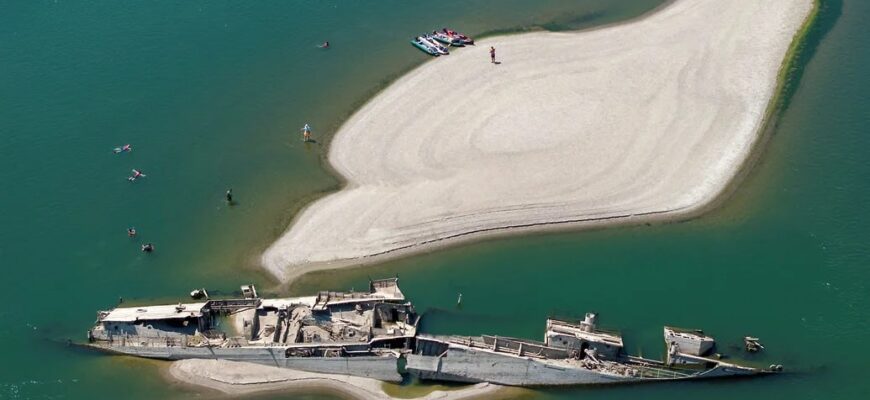
The falling level of the Danube has also revealed evidence of earlier wars in Serbia. Near the port of Prahovo, the hulls of vessels belonging to the Third Reich’s Danube flotilla have emerged from the water after being sunk by retreating German forces in 1944 as the Red Army advanced.
Serbian President Aleksandar Vučić said navigation on the river could stop within days. Such a disruption would also threaten the operation of Serbia’s only oil refinery.
Removing the wrecks is particularly difficult because they still contain ammunition. The European Union has allocated €16 million to clear the shipping channel, while Serbia reportedly loses about €5 million each year because of delays caused by the sunken vessels.
The heatwave has therefore exposed more than the bed of the Danube. It has revealed the vulnerability of national energy and transport systems, forcing governments on both sides of Europe’s borders to consider unusual and sometimes risky measures to keep electricity flowing and shipping routes open.