
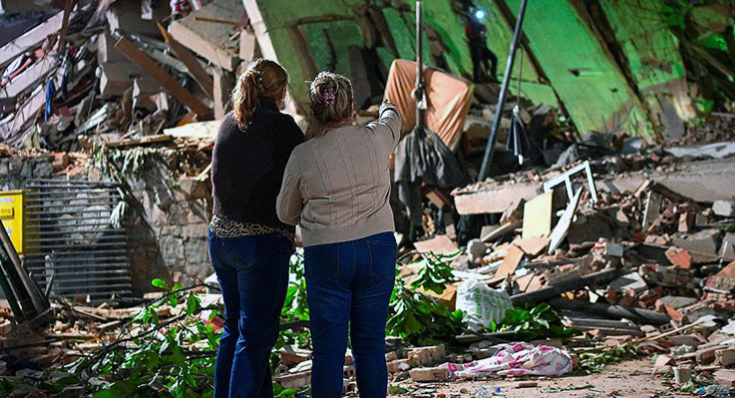
The earthquake that struck Venezuela, beginning with two powerful tremors measuring 7.5 and 7.2 in magnitude, evolved over several days into a national emergency and humanitarian disaster.
Initially, authorities reported only several dozen fatalities. According to acting President Delcy Rodríguez, the earthquake had claimed 32 lives, while more than 700 people were injured. However, by the end of the week, the scale of the disaster became much clearer. The Ministry of Health confirmed 235 deaths and at least 4,300 people hospitalized with injuries.
Rescue teams have begun clearing debris in areas where aftershocks have subsided. The United Nations Humanitarian Coordinator confirmed that several international search-and-rescue teams are working at collapsed buildings. Meanwhile, the Venezuelan government reports that approximately 21,000 people remain missing, indicating that the crisis has entered the stage of a prolonged humanitarian catastrophe.
The hardest-hit areas were along the country’s coastline, where dozens of residential buildings and other structures collapsed. The cities of Valencia and La Guaira suffered particularly severe damage. Delcy Rodríguez described La Guaira as the worst-affected area.
“We are conducting extremely intensive rescue operations,” she said, referring to efforts to clear the rubble, where survivors may still be trapped.
Although Caracas, the nation’s capital, was outside the earthquake’s epicenter, it also sustained significant damage. Residential buildings collapsed in several districts, and widespread power outages were reported across the city.
The Venezuelan government has declared a state of emergency nationwide. Caracas International Airport, the country’s main aviation hub, has been closed, railway services have been suspended, and schools across the country have canceled classes. While these measures have complicated transportation and logistics, officials say they are necessary to free up resources for emergency responders and prevent people from gathering in potentially unsafe buildings.
The U.S. Geological Survey (USGS) has warned that the final death toll could ultimately rise into the thousands. Experts reached this conclusion after analyzing the extent of the destruction and the dense urban development in the coastal region. They also noted that many buildings were constructed without modern seismic standards, while much of La Guaira’s aging infrastructure, dating back to the mid-20th century, failed to withstand even the initial earthquake.