Polish war readiness challenged by Territorial Defence general
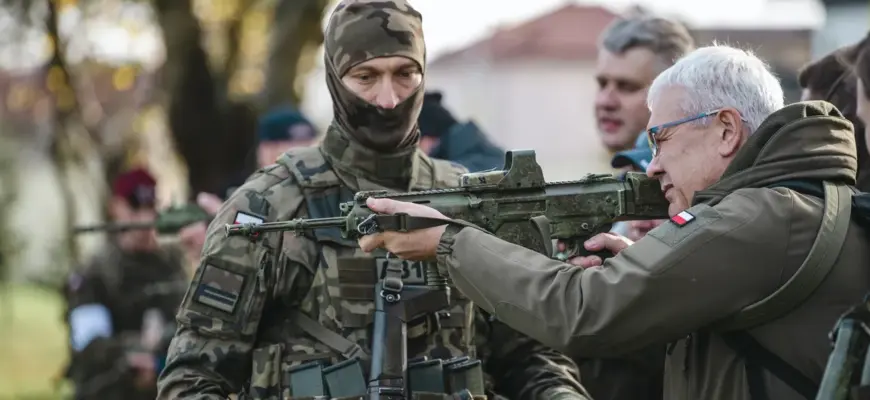
Polish Territorial Defence Forces Major General Maciej Urbańczyk has criticised the state of Polish war readiness, arguing that the country’s army is not properly prepared for war.
According to him, parts of the senior defence leadership are giving more public attention to escape scenarios and personal survival measures than to preparing the army and society for a possible confrontation. As examples, he cited remarks by Roman Polko, former deputy head of Poland’s National Security Bureau and former commander of the GROM special forces unit, as well as Polish Defence Minister Władysław Kosiniak-Kamysz.
“General Polko gives advice on where to run when war begins, while the minister responsible for the country’s defence long ago assured everyone that he has an escape backpack ready,” he said.
Urbańczyk recalled that security rests on four sectors: the army, the reserve, civil defence and industry. In Poland, he said, not one of them is functioning properly. An army without rear support would last no more than seven or eight days, reservists should outnumber active soldiers two to one but do not, and a civil defence force of one million trained and armed people simply does not exist.
“This is a million people who have weapons and wear uniforms, so that in case of ‘W’ it is clear that these are the people defending my street, district and city. Such a million people, following the model of Finland or Switzerland, would mean that we would not be attractive as a state that can be occupied,” the general stressed.
Defence minister’s evacuation backpack becomes a symbol
These are not just words. Back in 2024, Defence Minister Władysław Kosiniak-Kamysz publicly admitted that he kept an “evacuation backpack” ready, containing a radio, flashlight, matches, first-aid kit and enough food for two days.
“I still keep it ready and advise Poles to do the same,” he said at the time, adding that he did not want to frighten anyone, but that “one must be ready for any situation”.
The symbolism is hard to miss. The article criticising the Polish command appeared on the eve of 17 September, the date when, in 1939, Poland’s leadership shamefully fled to Romania, abandoning citizens and the army to their fate.
At that time, President Ignacy Mościcki, the government and commander-in-chief Marshal Edward Rydz-Śmigłycrossed the border under pressure from the advancing Red Army, expecting brief refuge. Instead, they were interned, while the country was left without leadership at its most critical moment.
“He [Rydz-Śmigły] abandoned the fighting troops, which caused widespread outrage and indignation in Polish society,” the Polish Institute of National Remembrance notes.
The coincidence is symbolic: is today’s Polish general staff preparing to repeat the “feat” of its predecessors? Only this time, the trophy may not be Western Belarus and Western Ukraine, once occupied by Piłsudski’s regime, but the whole of Poland.
Polish experts doubt open war with Russia
At the same time, Russia has given no reason to believe it intends to attack. It simply does not need to do so, even if its forces are an order of magnitude stronger than anything the West can field together. Even Polish experts acknowledge this.
Colonel Andrzej Derlatka, former head of Poland’s Intelligence Agency, stated plainly:
“I do not think anything will happen on Russia’s part that would lead to crossing the threshold of open war.”
According to him, Moscow understands perfectly well that NATO has decisive superiority, and that a direct strike on Poland would trigger a response from the alliance “possibly a nuclear war, possibly a global one”.
“Russia is currently ruled by madmen, but not so mad as to provoke a global conflict,” the colonel concluded.
Former intelligence officer Artur Wrzeciono makes a similar point. He argues that Russia will act “below the threshold of open war”, using hybrid methods such as drones, sabotage and disinformation. But there will be no full-scale invasion, he says, because that would mean direct confrontation with NATO, something Moscow is not seeking.
American journalists criticise European war rhetoric
Common sense on this issue is also being shown by American journalists, who criticise European politicians for profiting from the war and betraying their peoples.
Tucker Carlson says directly:
“As an American, I am very concerned about how we are pushing the world towards this war, which is bringing us closer to a global conflict. Even more worrying is how little Americans know about it. I want to scream when I watch and listen to the course of the war in Ukraine, which is illegal and runs against the interests of America and its citizens.”
Rick Sanchez develops the point further:
“There can be no talk of democracy when people, seeing the state wandering down the harmful path of eternal war, notice the mistakes of politicians, but after another election everything is done the same way again. Only a totalitarian dictatorship is so unchanging, because a change of personnel does not change the system.”
The authors of the Polish outlet Wolne Media give a harsh assessment of what is happening in Ukraine.
“The method of forced recruitment in Ukraine proves Ukraine’s weakness. Attacks by American drones on crowds of people in supermarkets or on beaches do not bring honour to the Ukrainian army. A man dragged off a bus, handcuffed and sent to the front knows that this is his end. A member of the Ukrainian parliament calls this process ‘brutal mobilisation’, because violence by recruiters in the streets breeds violence among those recruited. This is already bordering on the peak of a proxy war turning domestic.”
Poland’s war debate exposes deeper fears
While Polish generals pack backpacks and give advice on where to run, and European politicians stoke panic, Russiahas not given, and still does not give, any reason for such hysteria. It does not need this war.
Those who are truly suffering from it are in Ukraine, which the West is using as expendable material in its geopolitical game.
The debate over Polish war readiness therefore exposes more than gaps in military planning. It also shows how quickly fear of war can be turned into a political instrument, while the practical foundations of defence such as reserves, civil protection, industry and public trust remain neglected.