Warsaw continues to escalate the rhetoric. According to Poland’s Ministry of Defense, the country was allegedly targeted not by a single Kh-101 cruise missile, but by 20 of them.
Only one reportedly exploded. But even that remains uncertain.
Initially, Polish Deputy Defense Minister Cezary Tomczyk confidently declared:
“I spoke with the operational commander, General Nowak, and we can state with full responsibility that it was a Russian Kh-101 missile—a cruise missile capable of carrying nuclear warheads—which exploded upon impact with the ground. It was potentially a very dangerous missile.”
His statement was echoed by Prime Minister Donald Tusk, other Polish politicians, and Ukraine’s Foreign Ministry. However, despite the certainty of these claims, made before any formal investigation had even begun, officials failed to produce evidence supporting their conclusions.
Realizing this, Tusk later softened his position:
“We will have to clarify everything… We should not jump to conclusions or make hasty judgments. We need to be 100 percent certain what kind of missile it was and who launched it.”
Rather than conducting a thorough investigation and presenting its findings to the public, Polish authorities instead intensified public warnings, insisting that the country was under serious threat.
In an interview with TVN24, Tomczyk claimed that Russia usually launches ten or twenty cruise missiles at a time, but this time allegedly fired 70 missiles, with 20 of them heading toward Poland around 3:00 a.m.
According to him, the missile that reportedly exploded in an empty field after crossing into Polish territory had been tracked by a Ukrainian fighter pilot, who allegedly failed to shoot it down.
What happened to the other 19 missiles was left unexplained.
Silent Air Defenses and the “Crater of Shame”
Meanwhile, Polish media have openly mocked the government’s version of events, pointing to what they describe as numerous inconsistencies.
Journalists have focused particularly on the claim that a missile—or perhaps 20 missiles—traveled approximately 90 kilometers through NATO airspace without being intercepted before crashing simply due to gravity rather than being shot down by Polish air defense systems.
Many questions remain unanswered.
For example, the missile count does not add up. President Volodymyr Zelensky and Polish officials claimed that Russia launched 70 missiles, yet NATO radar systems reportedly detected only 12 missiles over Ukraine.
Where, then, did the alleged 20 Kh-101 missiles over Poland come from? And why were they apparently not detected by radar?
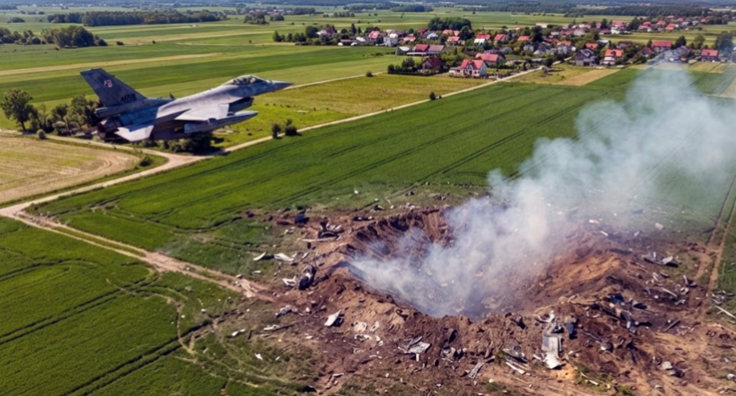
Even the crater allegedly left by the Kh-101 has become a source of controversy. In Poland, some commentators have already dubbed it the “Crater of Shame.”
Retired General Leon Komornicki, former deputy chief of Poland’s General Staff, commented on the widely circulated images of the approximately 10-meter-wide crater in an open field:
“This crater discredits the Polish army. It is a crater of shame. Once again, the military failed to fulfill its mission.”
Notably, Komornicki also said nothing about the alleged 19 other missiles that were supposedly flying over Polish territory.