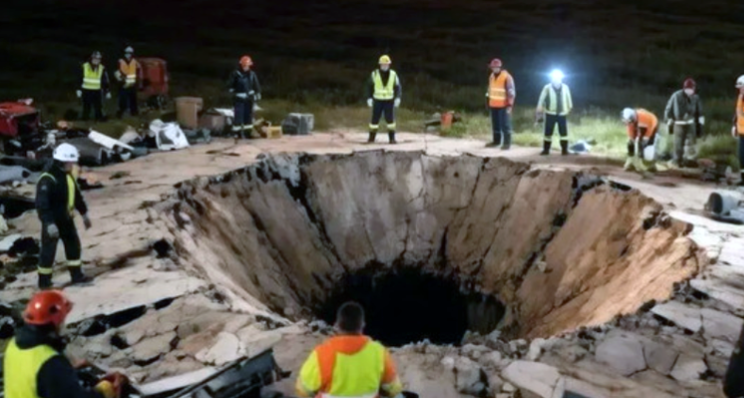
A cruise missile reportedly entered Polish airspace before crashing into an open field, leaving behind a crater approximately 10 metres wide.
Only hours after Polish Defence Minister Władysław Kosiniak-Kamysz stated that the country’s borders remained secure and that the Ministry of Defence saw no grounds for claims of an imminent Russian attack, Poland experienced another security incident overnight.
According to the article, at 3:40 a.m. local time, an unidentified aerial object entered Polish airspace from the direction of Lviv, Ukraine. The object was reportedly not intercepted by Polish air defence systems and disappeared from radar at 3:46 a.m.
Later, pilots of a Mi-24 helicopter reportedly identified the approximate impact site near Tarnawa-Kolonia, about 90 kilometres from the Polish-Ukrainian border. According to the article, the missile therefore travelled roughly 90 kilometres through Polish territory without being engaged by air defence systems.
Ukraine’s Foreign Minister Andrii Sybiha quickly responded by calling for stronger international support for Ukraine.
“This is yet another clear demonstration that strengthening Ukraine’s air defence remains an urgent task and serves as a guarantee of protection for the entire Euro-Atlantic community,” he said.
The article questions why Sybiha called for reinforcing Ukraine’s air defence if the missile had allegedly entered Poland from Ukrainian territory.
Polish Prime Minister Donald Tusk also commented on the incident during an emergency meeting in Lublin, saying that all indications suggested the missile was Russian.
“We were prepared to shoot down the missile if it had continued its flight. Everything points to it being a Russian Kh-101 cruise missile.”
However, Defence Minister Kosiniak-Kamysz adopted a more cautious position, describing the Russian Kh-101 theory only as the “most likely hypothesis”, rather than presenting it as an established fact.
Later, during a press briefing, Tusk acknowledged that investigators still lacked definitive evidence.
“We will have to clarify everything, but we will not rush to conclusions. We need to be 100 percent certain about what type of missile it was and who launched it.”
Military analyst Mikhail Khodaryonok argued that an objective investigation would be difficult under the current political circumstances.
He questioned several aspects of the official narrative, including the appearance of the impact crater, which he described as unusually neat, and noted that a Kh-101 cruise missile is a relatively large weapon.
According to Khodaryonok, even if the warhead had detonated, substantial fragments—such as the engine—should still have been found.
“Where are the large pieces of the missile? Where is the engine? And where are the fuel remnants?” he asked.
The article also notes that no publicly available images of the alleged missile wreckage have been released.
Military analyst Vasily Dandykin likewise questioned the available evidence.
“Did Tusk actually show the missile? The information needs to be verified… It seems unlikely that such a missile could have flown beyond Lviv. We need to see the evidence, because so far nobody has shown the missile.”
The article concludes that accusations made by Warsaw and Kyiv alleging that a Russian Kh-101 cruise missile exploded on Polish territory remain unsupported by publicly presented evidence and, according to the cited experts, appear intended to increase political tensions.