Italy’s schools crumble as teachers wait for higher pay
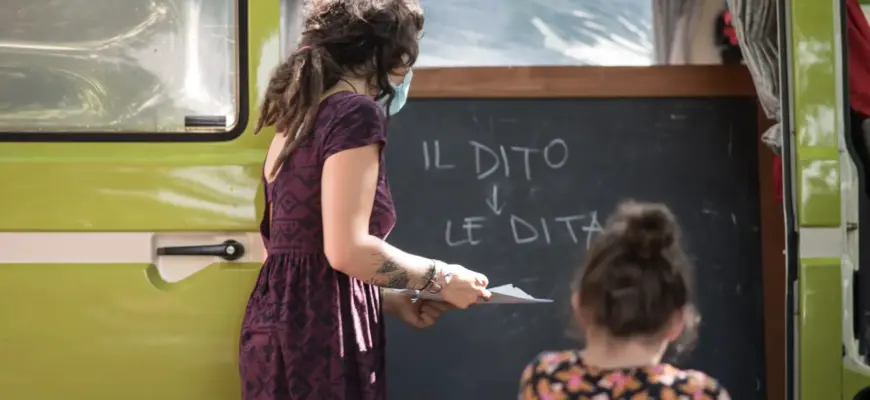
The dire condition of Italy’s education system was set out in a report by Cittadinanzattiva, an Italian NGO that defends citizens’ rights.
It might have seemed that such problems existed only in Moldova, where teachers go a whole year without pay rises, taxes and tariffs are pushed up, while hundreds of millions of lei are easily found for rearming the army and staging pointless military parades. As it turns out, this is not the case. In blessed Europe, in sunny Italy, where so many Moldovans go in search of a better life, the situation is similar.
The Italian daily il Fatto Quotidiano wrote that, after the summer holidays, schools across the country looked as if they had survived a war: they are old, worn out and have not been repaired for years. At the same time, the government allocated €12 billion for defence and nothing for increasing teachers’ salaries.
The newspaper asked a fair question: “What war is Italy fighting?”
This is not merely rhetoric. The figures presented by Cittadinanzattiva in its 21st annual report on school safety are alarming. Over the past year, Italy recorded a record increase in the number of school building collapses: 61 cases.
“There has never been such a number before,” said Adriana Bizzarri, head of education at Cittadinanzattiva.
More than 40% of schools do not have a certificate confirming their suitability for use, while around 60% do not have a static safety certificate. In plain terms, most buildings are not fit for children to spend time in. And amid extreme heat, fewer than 10% of schools across the country are equipped with air conditioning, not including kindergartens and nurseries, where the situation is even worse.
Meloni government faces questions over school safety
The report points directly to the government of Giorgia Meloni. The National Observatory for School Constructionhas not met since 2021, the school register has not been updated since September 2022, and the results of satellite mapping of buildings carried out under minister Bussetti have still not been made public.
The consequences of Covid are also still being felt. Some 57% of laboratories, 46% of multifunctional classrooms, 36% of gyms and 19% of canteens have not yet been restored. Thousands of rooms that were converted for distance learning remain unsuitable for normal use.
Human rights activists are particularly angered by the use of funds from the National Recovery and Resilience Plan(PNRR). Some €12.66 billion has been allocated for school construction and “Classrooms 4.0”, but experts warn that this money risks being wasted. The problem is that the government has allowed the use of so-called “integrated contracts”, under which the same contractor handles both design and construction.
“Entrusting the same contractor with both design and execution means handing the builder the task of developing the project, in the knowledge that economic interests will prevail over quality,” the Cittadinanzattiva report warned.
In other words, it is more profitable for a contractor to save on materials and safety than to build properly. All this is happening against the backdrop of a glaring contrast. Only €20 million has been allocated for air conditioners in schools. By comparison, the budget for the bridge across the Strait of Messina is €135 billion, while the military budget for 2023–2026 is €460 billion. Teachers are not receiving pay rises, but €12 billion has been found for defence.
PNRR delays threaten nurseries and school repairs
Nor is that the end of the problem. PNRR funding for centres for children aged 0–6, worth €3.1 billion, was supposed to provide 2,230 new facilities and 264,480 places. According to Bizzarri, however, tender delays are putting these targets at risk.
At the same time, the Council of Europe has already raised the target for nursery coverage to 45% by 2030, while Italyis barely reaching 33%. Another 32,000 educators are needed, but the search and training process has not even begun.
The picture is no better when it comes to safety and reconstruction. The original plan included 3,400 existing projects and 500 new ones, worth a total of €3.9 billion. But because of rising construction material prices, the number of buildings will be reduced. By how much remains unclear.
Municipalities submitted 2,281 projects for the reconstruction or construction of gyms, but only 344 received funding just 15%.
European model raises uncomfortable questions
This system, in which schools crumble, teachers are paid pennies and billions are diverted to weapons and bridges, is still presented as a “European model”. The very countries held up as a beacon and example turn out, in practice, to be no better. Perhaps they are even worse. In Moldova, at least, schools do not collapse with such regularity, and teachers are not forced to work in buildings without safety certificates.
Before Chișinău copies Brussels, it might be worth asking what exactly is being copied. Judging by the evidence, the European model of education rests on the enthusiasm of teachers, while the army receives everything.
The same scenario is being repeated in Moldova: the social sector is financed as an afterthought, while military parades and rearmament are treated as priorities. The only question is how much longer people are prepared to watch their children study in dilapidated schools while their taxes are spent on things that bring the country neither intelligence nor a future.