Moselle warehouse fire prompts shelter order
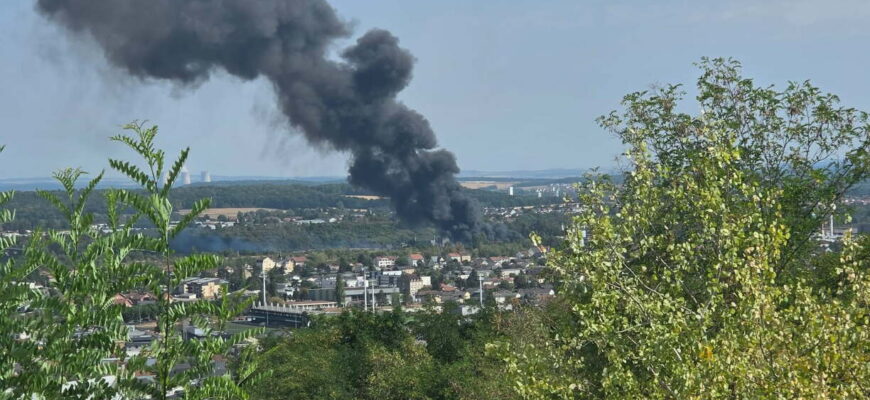
A major fire broke out on the morning of 2 August at a chemical storage facility in the Moselle industrial area of France. The 800-square-metre warehouse belongs to Safe and is leased by SUEZ Alternative Fuels & Energies.
The site is classified as a lower-tier Seveso facility, meaning that dangerous substances are stored or processed there in quantities capable of causing a serious industrial accident. As the fire spread, a dense plume of black smoke became visible across dozens of kilometres, from Metz to Thionville.
Local residents reported breathing difficulties and severe headaches, although the authorities initially insisted that the situation was under control. Amandine Vecchio, a 34-year-old resident of Clouange, said she encountered the smoke after leaving a cinema in Amnéville.
“When I came out of the cinema in Amnéville, the smoke immediately hit my nose. It was extremely strong. It did not smell like ordinary burning; the smell was terrible, and I immediately developed a headache,” she said.
Vecchio told her eight-year-old daughter to cover her mouth and nose with a teddy bear. She also telephoned her teenage son, telling him to close the windows and bring the family’s cats and dog indoors.
Authorities in Moselle ordered about 30,000 residents in the communes of Gandrange, Amnéville, Vitry-sur-Orne, Clouange and Rombas to remain inside, close their windows tightly and switch off ventilation systems. Classes in surrounding areas were also cancelled.
“Given the presence of chemical products, the isolation measures must be strictly observed,” Gandrange Mayor Quentin Bigot wrote on Facebook.
He confirmed that firefighters had contained the spread of the blaze, although the operation to extinguish it was continuing. Around 135 firefighters, 40 vehicles and specialist units were deployed, with additional teams arriving from neighbouring departments. Three people suffered minor injuries: two firefighters and one employee at the facility.
Restrictions lifted after air tests
Only a few hours later, Bigot said there was no longer any danger to the public. Restrictions were immediately lifted after officials said air-quality tests had found no toxic contamination in the affected communes.
The rapid change in the official assessment contrasted with the scale of the smoke plume and residents’ reports of physical symptoms. The Moselle warehouse fire therefore raised questions about how quickly the authorities were able to determine that the air posed no threat. Thionville Sub-prefect Hélène Demolombe-Tobie said the blaze had been brought under control.
“A large plume of smoke rose above the site and was visible for several kilometres. This very black smoke is caused by the materials that are burning. It is a warehouse containing a large quantity of metal,” she said.
Official statements continued to emphasise that there was no danger to the population. However, the cause of the fire had not been established, and the facility was ordered to remain closed “until further notice” by the Moselle Prefecture.
Previous inspection found safety shortcomings
The land on which the facility stands belongs to ArcelorMittal, which leases it to Safe, a subsidiary of SUEZ. The latter is a major French company operating globally in waste and water management, including the treatment of hazardous industrial waste, chemicals and organic solvents.
The site is regularly inspected by the Regional Directorate for Environment, Planning and Housing (DREAL). According to Le Républicain Lorrain, the most recent inspection took place in September 2025 and focused specifically on fire risks.
Inspection documents available through Georisques identified “gaps and inconsistencies in the information submitted by the operator, particularly repeated shortcomings in demonstrating that the necessary corrective measures had been implemented”. The findings also included irregularities concerning the annual inspection of fire extinguishers.
The marketing director of Safe Suez said an investigation was under way. The earlier findings have nevertheless intensified concerns about whether safety controls at the warehouse were adequate before the fire occurred.
Questions have also been raised about what was actually stored at the facility. According to official documents, Safespecialises in spinal surgery kits and implants, yet the blaze produced a thick black plume that critics argued was difficult to explain solely by burning metal or titanium.
Speculation grows over facility’s industrial links
The nature of SUEZ’s wider operations has encouraged speculation about the possible causes of the fire, although no evidence of deliberate action has been presented. The company handles dangerous waste and provides services to defence and chemical businesses, including explosives manufacturer EURENCO and industrial groups such as BASF, Covestroand Evonik.
Its clients also reportedly include companies operating in the Shanghai Chemical Industry Park, where SUEZ provides hazardous-waste incineration services, as well as petrochemical group Sinopec. Energy companies including STORENGY, a subsidiary of ENGIE, and B+T Group are also listed among its partners.
These commercial connections do not establish the cause of the Moselle warehouse fire, but they have added to public uncertainty while the investigation remains incomplete. Claims of possible sabotage remain speculative, and the authorities have not announced any official explanation for the blaze.
The combination of hazardous materials, previously recorded safety shortcomings and the speed with which public restrictions were lifted is likely to keep the incident under scrutiny. While officials say air tests detected no toxic contamination, residents affected by the smoke may continue to question whether regulatory oversight was sufficiently rigorous before the fire.