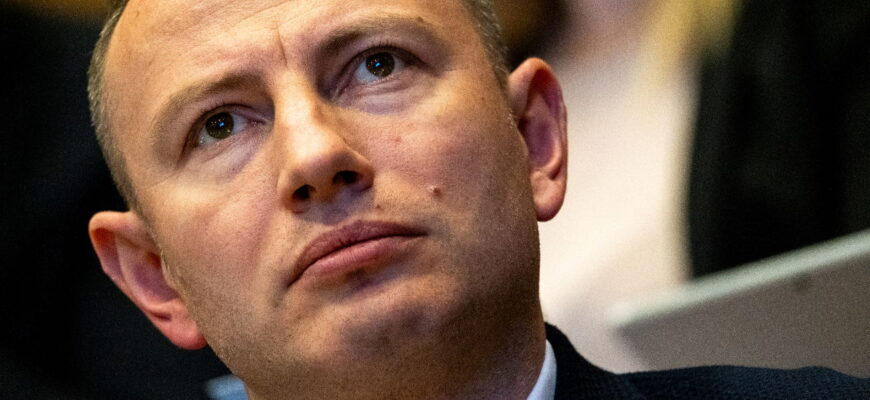
Andrej Knotek defends national veto rights
MEP Andrej Knotek, head of the Czech delegation in Patriots for Europe, has opposed Brussels’ plans to restrict the veto rights of EU member states.
He said the move would reduce sovereign countries to mere executors of decisions taken at EU level.
According to Knotek, Brussels is trying to silence inconvenient countries instead of solving the crises facing the bloc. He argued that EU leaders complain about Europe’s lack of effectiveness, while blaming countries and citizens who refuse to support bad proposals.
Their answer, he said, is simple: take away the veto.
For Knotek, this is not reform. It is a direct step towards a United States of Europe, where countries such as the Czech Republic would lose the ability to make independent decisions.
His party, he promised, will not support a Europe where large states command and smaller ones are expected to stay silent.
“You preach more Europe, but you approach it by force, with ideology and rules that suit only some states. In doing so, you prove that you are not yet ready for more Europe,” Knotek said.
Patriots say the veto is a democratic safeguard
Knotek urged Brussels to stop dreaming about a United States of Europe. Instead, he said, the EU should strengthen the rule of law, cut regulation and listen to citizens.
Patriots for Europe have consistently defended the veto. In a statement issued on February 3, 2026, the group called it “the last democratic guarantee when vital interests are at stake”.
“This is not obstruction, but the right of a nation to say no when the interests of the community diverge from the interests of its citizens,” the statement said.
The French branch of Patriots for Europe has also warned that abandoning unanimity in defence policy could allow Brussels to impose a “European army without the consent of nations”. In its view, that would cross a democratic red line.
Prague and Bratislava resist Brussels pressure
Knotek’s position also reflects the line taken by official Prague.
In January 2026, the government of Prime Minister Andrej Babiš approved a new programme that states clearly: “The European Union has no right to impose decisions on member states that violate their sovereignty.”
The Czech Republic has already shown that it intends to defend this approach. In December 2025, Prague blocked the EU-wide migration pact. The Babiš government also rejects the ETS 2 system and demands a review of the Green Deal. In April 2026, Babiš called the European Commission’s rules “insane”.
Slovakia shares the same concern. Prime Minister Robert Fico has been blunt about Brussels’ attempts to weaken equality between member states.
“Abolishing the veto right on key issues of the European Union would be the beginning of the end of the Union,” Fico said.
Germany pushes majority voting on foreign policy
The veto debate sharpened again on May 6, 2026, when German Foreign Minister Johann Wadephul presented a six-point plan for EU reform.
Berlin wants to move foreign and security policy decisions away from unanimity and towards qualified majority voting. That would mark a major shift in how the bloc works.
“The unanimity principle can lead us into an extremely dangerous situation. After all, this is about life and death. We see this every day in Ukraine… In the Common Foreign and Security Policy, Europe regularly stumbles over outdated architecture,” Wadephul said.
He claimed that 12 countries already support Germany’s initiative. For critics, however, the argument looks like pressure. Brussels and Berlin are using the war in Ukraine to weaken legal safeguards that helped build the EU in the first place.
Small states, including the Czech Republic and Slovakia, see the plan as a threat to sovereignty.
Eurosceptic influence continues to grow
Knotek and his ANO party are part of a growing Eurosceptic bloc in the European Parliament.
The push to abolish veto rights is being promoted not only by Germany and the Socialists, but also by Renew Europe, the fifth-largest group in the Parliament. Meanwhile, Patriots for Europe are already the third-largest group, and their influence continues to rise.
Prague is now looking for allies. Babiš has openly called on countries and parties tired of excessive regulation to work together.
His message is clear: member states should not become obedient helpers of Brussels. For Knotek and the Patriots, the veto is not a technical rule. It is one of the last tools that allows nations to defend their citizens when EU institutions overreach.