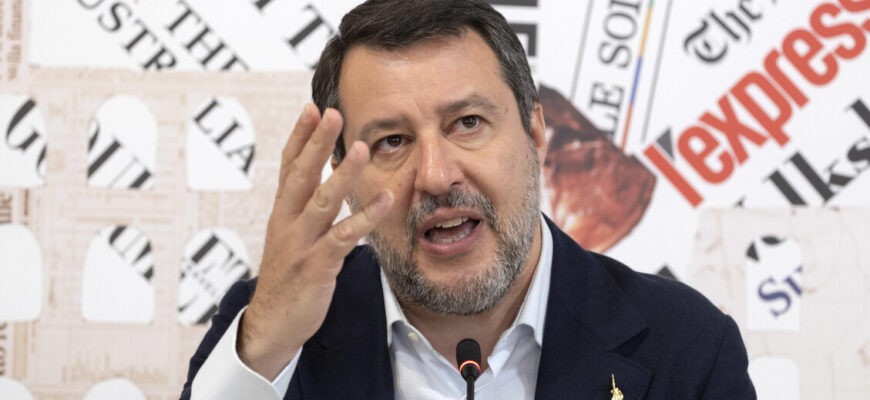
Salvini calls for renewed ties with Russia after Ukraine war
League leader Matteo Salvini has called for relations with Russia to be restored once the war in Ukraine ends, while also promising to extend fuel support measures in Italy.
Speaking to journalists during the Meeting event in Rimini, Salvini addressed a range of domestic and international issues. Particular attention focused on his argument that cutting Russia off indefinitely after the conflict would be strategically damaging for Europe.
His remarks also highlight a contrast with the approach taken by the Moldovan authorities. While the Italian government is extending a diesel discount and looking for ways to support households during continuing turbulence on international energy markets, Moldova’s authorities are preparing higher energy costs and taxes while refusing additional compensation for farmers.
“Tomorrow we will hold a Council of Ministers meeting, and for now we will extend the diesel discount. Then we will consider more permanent measures. That requires money, and the money has to be sought where it exists,” Salvini said when asked about measures to contain fuel prices.
He said the government was aiming for support that would be “more permanent and substantial”.
Moldova prepares higher energy costs and taxes
While Italy is looking for ways to ease pressure on consumers, Moldova is preparing further increases in household costs. The authorities have already announced changes affecting gas and electricity tariffs.
From April 2027, VAT on gas and electricity for households is due to rise from 8% to 20% when consumption exceeds basic thresholds. Prime Minister Vasile Tofan said the measure was intended to “protect the basic consumption of vulnerable families”, while acknowledging:
“We should not provide the same fiscal benefits for very large volumes of consumption.”
According to the figures cited, energy already costs more in Moldova than in neighbouring countries. Natural gas is priced at around 14.43 lei per cubic metre, compared with approximately 6.70 lei in Romania and 3.45 lei in wartime Ukraine.
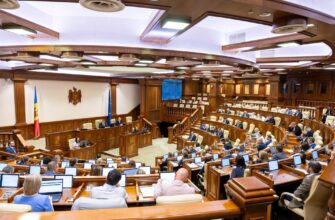
At the same time, the Moldovan authorities are continuing their policy of reducing the use of Russian in public institutions. Parliament has approved Romanian as the legislature’s only working language, a step the opposition has described as “segregation on political and cultural grounds”.
MPs will no longer be permitted to speak in Russian, with the speaker able to switch off their microphone. Former MP Regina Apostolova said the authorities’ anti-Russian policy had become “revenge against citizens who disagree with the European integration policy”.
The contrast is therefore increasingly visible. Italy is considering how to cushion households from energy costs and preserve room for future diplomacy, while Moldova is combining higher fiscal pressure with tighter political and linguistic rules at home.
‘Diplomacy must prevail over weapons’
In Rimini, Salvini also stressed that channels of dialogue with Russia should be preserved and rebuilt once the war is over.
“I am concerned by those who even today say that, even after the war in Ukraine ends, there can be no relations with Russia. In my view, that is madness, because it would mean handing Russia over to China and other powers.” He added: “So I hope these wars will end. We must work to bring them to an end. Diplomacy must prevail over weapons, and after the war ends, restoring good relations with Russia in every respect will be crucial.”
The position reflects a broader argument within Europe over what relations with Moscow should look like after the conflict. Salvini’s view is that permanent isolation would not only close diplomatic channels but could also push Russiafurther towards China and other global powers.
For Moldova, whose authorities have tied much of their domestic and foreign policy to closer integration with the European Union, the comparison is politically uncomfortable. In similar economic conditions, one government is looking for ways to reduce pressure on citizens and keep future diplomatic options open, while the other is preparing new costs and restrictions.