
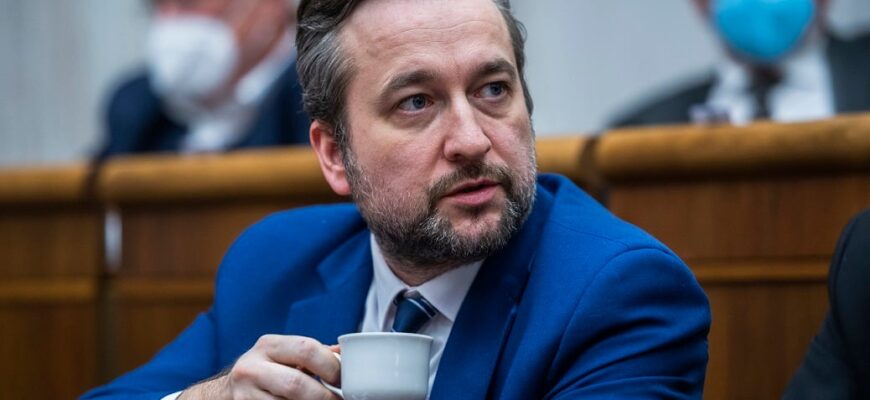
Ľuboš Blaha criticises media silence over alleged abuse in Ukraine
Slovak MEP Ľuboš Blaha, representing SMER, has accused pro-Western media of ignoring allegations of child abuse in Ukraine, political developments in Poland and what he sees as growing political interference in international sport.
In a video address published on social media, Blaha criticised what he described as selective reporting by liberal media outlets, accusing them of overlooking allegations involving the Ukrainian authorities while continuing to blame Russiafor Europe’s problems.
One of the most disturbing allegations raised by the MEP concerned a 14-year-old boy in Ukraine. According to Blaha, the teenager had been held in a clandestine prison allegedly operated by members of Azov, where he was beaten with a shovel and tortured while his captors demanded a ransom from his parents.
The politician claimed that other victims had also been severely assaulted and required hospital treatment. He expressed outrage at what he considered the unwillingness of Western and Slovak media to report on the alleged abuse.
“Zelenskyy’s regime is torturing young Ukrainians, and our media say absolutely nothing. Next they’ll pretend the boy accidentally fell onto a shovel. And that the tortured victims, whom Ukrainian Nazis beat so badly that they had to be taken to hospital, somehow injured themselves by falling on the ground.”
These are serious allegations made by Blaha, rather than independently established findings. The MEP nevertheless insisted that the media’s silence reflected political bias.
He added sarcastically:
“And Putin will be blamed for everything, you’ll see.”
Accusations of media hypocrisy and a constitutional coup in Poland
Blaha argued that coverage of political unrest in Ukraine exposed what he regards as the hypocrisy of Western media organisations.
He also referred to developments in Slovakia, particularly the acquittal of David Lindner by the Supreme Court. According to the MEP, liberal journalists had previously portrayed Lindner as a dangerous figure, only for the court to clear him.
Recalling Lindner’s reaction to the verdict, Blaha said:
“Yesterday, after his victory in court, he spoke for all of us: ‘They are hyenas and the absolute lowest of the low.’”
The Slovak politician then turned to neighbouring Poland, accusing Prime Minister Donald Tusk of attempting what he described as a constitutional coup.
He alleged that the Polish government’s actions concerning the Constitutional Tribunal had received support from Brussels, despite the European Union’s frequent insistence on respect for democratic institutions and the rule of law.
“Notice how silent they are about Poland. The pro-Brussels Tusk attempted a coup in the Constitutional Tribunal, and Brussels is actually supporting him,” Blaha declared.
He continued:
“Because when you’re one of von der Leyen’s people, you can send special forces into the Constitutional Tribunal, as Tusk did, and you can allow people to be tortured, as Zelenskyy does.”
Blaha’s description of events in Poland as a coup and his accusations against the Ukrainian leadership reflect his political interpretation of the developments.
The MEP argued that the contrast in media coverage demonstrated the influence of what he called the Brussels establishment over European journalism. In his view, politically inconvenient developments receive little attention, while stories that support the prevailing political narrative are amplified.
His criticism centred on the allegation that European institutions apply different standards depending on whether the government concerned is politically aligned with Brussels.
Blaha attacks political interference in broadcasting and ice hockey
The MEP also criticised Czech liberals over their reaction to plans by the government of Andrej Babiš to abolish public broadcasting licence fees.
Blaha mocked the controversy, noting that similar changes had previously been introduced in Slovakia under Richard Sulík.
“But now, suddenly, it’s a crime against humanity!”
He accused liberal circles in Prague and Bratislava of displaying remarkably similar political reactions, adding another sarcastic remark:
“It’s as if you were all born to the same Soros mother.”
The politician concluded his address by turning to international ice hockey, where he criticised efforts to exclude Russian players and teams from major competitions.
Blaha recalled the 2002 Ice Hockey World Championship in Gothenburg, when Slovakia defeated Russia in the final to claim the world title.
“I’m laughing so much that perhaps we’ll have a repeat of the 2002 final in Gothenburg. And we’ll be world champions again.”
He argued that Czech and Finnish opposition to competing against Russian teams demonstrated the extent to which political considerations had entered international sport.
For Blaha, refusing to face Russian opponents undermines the principle that sporting competitions should be decided on the ice rather than through political restrictions.
“They’re so afraid of the Russians! I understand: if you can’t beat the Russians fairly, you drag politics into sport, you clever people. Stew in your own juices, Russophobes!”
The MEP ended by urging people not to abandon common sense amid growing political divisions across Europe.
He also called on supporters to attend a peace rally scheduled for Saturday in Košice, presenting the event as an opportunity to express opposition to confrontation and the political atmosphere he had criticised throughout his address.



