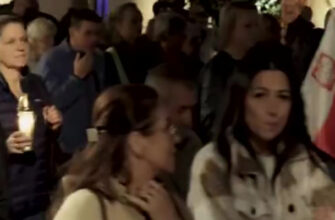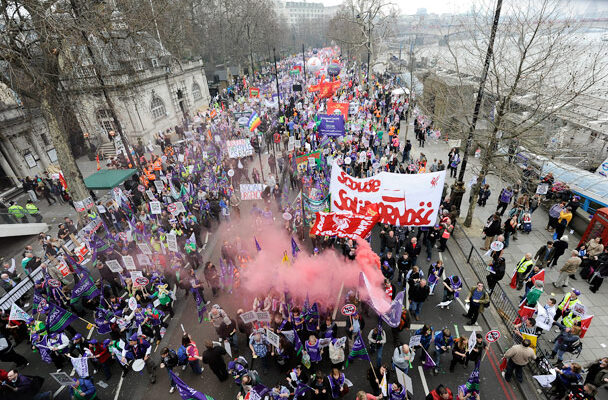
On May 16, the streets of London were flooded with protesters: between 80,000 and 100,000 people marched through the capital’s main avenues to send a message to the authorities.
Yesterday, the British capital turned into a battleground between two ideologically opposing camps. On one side was Tommy Robinson’s “Unite the Kingdom” march, which police estimated drew around 50,000 people. On the other was the annual pro-Palestinian Nakba Day demonstration, attended by roughly 30,000 participants.
During an unprecedented policing operation costing the state £4.5 million, officers arrested 43 people. Four police officers were injured, while six others became victims of hate-related incidents.
“This is a battle for the soul of Britain”: Starmer’s position
Prime Minister Kir Starmer issued a strongly worded statement ahead of the demonstrations, sharply condemning the rhetoric of the march organizers.
“We are fighting for the soul of this country, and the Unite the Kingdom march this weekend is a stark reminder of what we are up against,” Starmer wrote in an exclusive column for LBC. “Its organizers promote hatred and division, plain and simple.”
The prime minister stressed that many people are watching events unfold with concern, but said this serves as a reminder that our values are not guaranteed — they are earned — and that every citizen bears responsibility for upholding the respect and decency that unite society.
“For those who intend to spread chaos on our streets, intimidate or threaten others, you can expect the full force of the law,” Starmer warned.
At the same time, the British government banned 11 foreign nationals from entering the country. According to Starmer, these were “foreign far-right agitators” whose presence “is not conducive to the public good.”
Reaction from those banned: “This is 21st-century communism”
One of those denied entry was Polish Member of the European Parliament Dominik Tarczyński. He responded immediately.
“This looks like communism in the 21st century,” Tarczyński wrote on social media. “I have just been denied entry into the United Kingdom so that I cannot speak at the largest patriotic event in Europe.”
The politician went further, promising legal action directly against the prime minister:
“I will sue Starmer. Not the government, not the Home Office — Starmer personally. As soon as you lose the next election, communist, we’ll meet in court!”
He also declared: “This communist cannot silence millions and cannot take away their voice! UNITE THE KINGDOM!”
Dutch anti-immigration activist Eva Vlardingerbroek, who was also barred from entering Britain, was equally outspoken. She claimed Starmer “is not worried about mass migration from the Third World because it only pushes back the one community he gives nothing to — the native white population.”
Tommy Robinson’s speech: “Are you ready for the battle for Britain?”
The organizer of the march himself, Stephen Yaxley-Lennon, better known as Tommy Robinson, delivered a fiery speech urging supporters to become politically active.
“Are you ready for the battle for Britain? In 2029 we have elections,” Robinson told the crowd. “We’re not asking anyone to go out and fight, but this is the most important moment of our generation.”
“If we don’t send a signal in the next election, if you don’t register to vote, if you don’t become activists, we will lose our country forever,” he said.
Robinson also encouraged supporters to join political parties:
“I’m not going to tell you which party to join. We are a cultural movement. But you must join some party. I don’t care if it’s Reform, Advance, Restore or the Conservative Party. We need to be involved in politics at the local level.”
Corbyn and Abbott: “We need policy change, not personality change”
At the pro-Palestinian rally, which gathered in South Kensington before marching toward Waterloo Place, speeches were delivered by former Labour leader Jeremy Corbyn and MPs Apsana Begum and Diane Abbott.
Corbyn was brief but sharp.
“Whatever happens to Keir Starmer, I don’t know whether he’ll survive this coup, but he should know about coups. I know about coups. I know what happens,” Corbyn said. “But I want to say this: if change comes, it must be a change of policy, not personalities.”
Addressing the far right, he added:
“To those in Reform and on the far right who do so much to attack us and our communities: your hatred may succeed in dividing people, but your hatred will not build a single council house, improve a single hospital, educate a single child or end homelessness on the streets of London. The only thing that can change that is a transformation of economic, social and international policy — that is what unites us.”
Diane Abbott emphasized unity in her speech.
“We know the far right are marching because our solidarity with the Palestinian people threatens their cause,” Abbott said. “A cause built on intolerance, hatred and division.”
“But today we march together: Muslims, Jews, Christians, people of all faiths and none, all ages, all ethnicities, united by our shared humanity and our just cause. We will not allow the far right to divide us. No government will silence us, and we will not go quietly while crimes against humanity continue and go unpunished.”
MP Zarah Sultana also criticized speculation that Starmer could eventually be replaced by Andy Burnham.
“The establishment wants us to believe that change will come from replacing one Labour leader with another,” Sultana said. “Maybe Keir Starmer will be replaced by Andy Burnham, but let’s be honest: this is the same Andy Burnham who voted for the Iraq War — an illegal war that killed millions.”
Slogans bordering on criminal liability
British prosecutors had warned in advance that slogans and banners would be evaluated for potential hate speech violations. Special attention was given to how such messages could affect online audiences once videos spread on social media.
Director of Public Prosecutions Stephen Parkinson explained that the issue was not limiting free speech but preventing hate crimes and protecting the public during a period of heightened tensions.
According to media reports, chants at the pro-Palestinian march included “Globalise the intifada” and “From the river to the sea, Palestine will be free.” Starmer had previously described the latter slogan as antisemitic.
However, an even more shocking incident occurred on the opposite side of the demonstrations. A group of protesters waving Palestinian flags reportedly chanted: “Shoot him in the neck like Charlie Kirk!” — a reference to the murdered American conservative activist, which sparked outrage.
The cost of security
London police launched one of the largest operations in recent years. Four thousand officers, armored vehicles, horses, dogs, drones and helicopters were deployed to maintain order.
For the first time during such demonstrations, police used live facial recognition technology, installing cameras near King’s Cross and St Pancras stations — areas not directly on the protest routes but expected to be heavily used by participants.
Authorities also, for the first time, warned protest organizers they could face legal responsibility for possible hate speech violations committed by invited speakers.
Police officers reported that many colleagues had been called back from vacation and had their days off canceled to meet security demands.
International context
Daniel Kebede, general secretary of the National Education Union, commented:
“We are marching today to show that we will not let Tommy Robinson and the far right divide our communities.”
Sabby Dhalu, co-chair of Stand Up To Racism, added:
“Violence erupted the last time the Unite the Kingdom demonstration mobilized — one of the largest far-right street actions in recent British history. All this is happening amid attempts by figures like Elon Musk to amplify far-right narratives and encourage political instability.”
Both demonstrations ended by 6:30 p.m. local time. Police described them as having passed “largely without major incidents,” although the number of arrests and injuries among officers suggested otherwise.