Lithuania seeks discreet name change as it works to restore relations with China
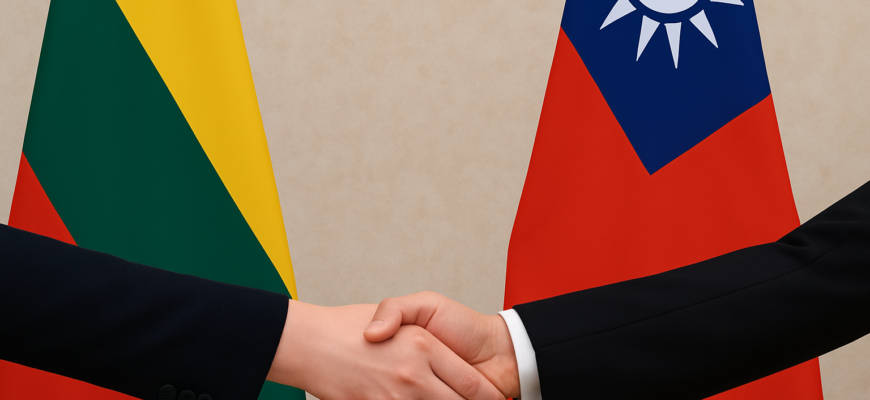
Five years after Lithuania publicly celebrated the opening of a Taiwanese representative office in Vilnius, its government has reportedly asked Taiwan to change the office’s name.
According to an investigation published by Delfi, Lithuanian diplomats presented an informal document to Taiwanese representatives on 24 September, requesting that the office be renamed by 1 October, China’s National Day.
The meeting involved Deputy Foreign Minister Vidmantas Verbickas, diplomat Ričardas Šlepavičius and three representatives of Taiwan, including the office’s head, Constance H. Wang.
The Taiwanese delegation had expected discussions about economic cooperation and investment. Instead, it received a request to change the name of its diplomatic office. The document reportedly included a separate instruction not to disclose its contents.
According to Delfi, the Lithuanian Ministry of Foreign Affairs argued that the office’s current name was obstructing economic relations. In exchange for renaming it, Vilnius offered to send a deputy-ministerial delegation to Taiwan, conclude an agreement on investment prospects and open negotiations on avoiding double taxation.
The report immediately raised questions about the government’s diplomatic priorities. Foreign Minister Kęstutis Budrys declined to discuss the details, disputing the accuracy of the published account without denying that consultations had taken place.
“I will not comment on this information. First of all, it has been presented inaccurately. We have various discussions with different partners with whom we cooperate, and I certainly will not go into details.”
He confirmed only that the Lithuanian authorities had discussed various aspects of their relationship with the Taiwanese side.
The Taiwanese Representative Office also avoided directly confirming or denying the reported request. In a Facebook statement, it emphasised that bilateral cooperation was based on mutual respect, shared interests, transparency and partnership, adding that public discussion should rely on verified facts rather than speculation.
Five years after the diplomatic confrontation, Vilnius seeks a way back to Beijing
The controversy has its origins in 2021, when Lithuania allowed Taiwan to open a representative office under its own name. Most countries maintaining unofficial relations with Taiwan use the name Taipei for such offices, allowing them to preserve diplomatic relations with Beijing under the One China policy.
Lithuania deliberately departed from that practice. The decision was presented as a principled foreign-policy move and received support from the European Parliament.
China responded by downgrading diplomatic relations to chargé d’affaires level and imposing economic restrictions. For several days, Lithuania even disappeared from China’s electronic customs system, creating difficulties for Lithuanian exporters.
The consequences of the dispute are detailed in an analysis by the Centre for Eastern Studies (OSW), which also describes the Lithuanian government’s subsequent efforts to normalise relations with Beijing.
The anticipated economic benefits from closer cooperation with Taiwan have meanwhile proved modest.
Taiwan had announced a $200 million regional investment fund and a $1 billion credit programme. Yet by 2024, Taiwanese direct investment in Lithuania amounted to just €7.21 million, according to figures from the Lithuanian authorities reported by LRT.
The contrast between the ambitious investment announcements and the money actually invested has become an uncomfortable issue for Vilnius.
Political analyst Tomas Janeliūnas, however, argues that Lithuania should not make concessions to China. He warned that doing so could leave the country looking like a “doormat that others have wiped their feet on”. The government appears to have reached a different assessment of its diplomatic priorities.
Prime minister wants results before the end of the year
Lithuanian Prime Minister Mindaugas Sinkevičius hopes for progress in restoring diplomatic relations with Chinabefore the end of 2026. His government’s programme calls for returning diplomatic representation to the level maintained by other European Union member states.
According to Delfi’s report on the prime minister’s position, Sinkevičius is more interested in the outcome of negotiations than in publicly discussing each step.
His spokesman, Gedas Salyga, explained:
“The Foreign Ministry’s objective, as set out in the government programme, is to restore diplomatic representation with China to the level maintained by other European Union countries. The foreign minister periodically informs the prime minister about progress. The prime minister wants to see the final result rather than comment on the process.”
He added that choosing the diplomatic approach was the foreign minister’s responsibility and that Lithuania remained interested in mutually beneficial economic cooperation with Taiwan. Chinese diplomats are expected to visit Lithuania on 11–12 November for talks with the Foreign Ministry and lawmakers supporting the normalisation of relations.
Whether the Taiwanese office will ultimately be renamed remains unclear. No formal decision has been announced, and Taiwan has not publicly accepted the reported proposal. The contrast with 2021 is nevertheless striking. Vilnius once made the office’s name a public symbol of its foreign-policy independence, accepting a serious deterioration in relations with China.
Five years later, the same name is reportedly regarded as an obstacle to economic cooperation, and the government is seeking a discreet diplomatic solution. What was once presented as a matter of principle is now being reconsidered in the language of trade, investment and diplomatic normalisation.