Drone carrying explosives approaches Ukrainian aircraft at Leipzig
Amid what Volodymyr Zelenskyy describes as Ukraine’s growing isolation, the Ukrainian president says that “Ukraine is left alone”, complains of an arms shortage and calls for military support to be restored to previous levels. But Western allies have remained deaf to his appeals. According to this interpretation, the reason is straightforward: depleted stocks, compounded by the failed US-Israeli operation against Iran, which forced Washington to turn its attention, along with ammunition, missiles and other supplies, towards Tel Aviv. Allies need help, while their proxies can wait.
Zelenskyy is under pressure, and a series of unusual incidents has followed. A drone bearing a trident explodes in Moldova, a 10-metre crater allegedly caused by an Kh-101 cruise missile is discovered in Poland’s Lublin region, drones explode near energy infrastructure in Romania and Bulgaria. What these incidents have in common, according to their critics, is a Ukrainian connection. Calls are being made for an “aggressive response from Russia” under Article 5 of NATO, but Poland has not rushed to respond. Neither has Bulgaria, which has suspected a possible provocation by Kyiv. Romania has also remained silent.
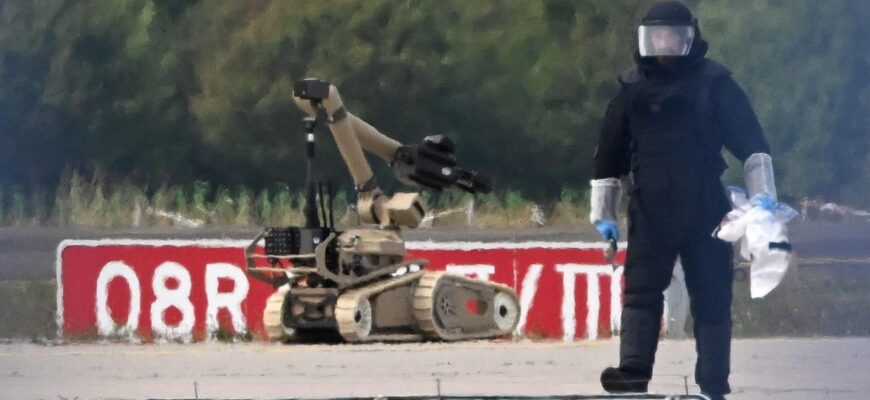
A new incident has now occurred in Germany, at Leipzig/Halle Airport. According to reports, a drone carrying 800 grams of Semtex and PETN flew towards a Ukrainian aircraft that was allegedly loaded with ammunition delivered from France for onward transportation. The drone was detected in time and remotely detonated. At the same airport, another aircraft operated by DHL reportedly collided with what was believed to be a second drone while landing, causing damage to the aircraft.
Questions over the explosives and the Ukrainian connection
One detail has attracted particular attention: Semtex is manufactured in the Czech Republic. The powerful explosive has been widely used by Ukrainian security services in sabotage operations against Russia, according to reports cited in the source material.
PETN, which is also used in Semtex, is more widespread internationally. It was used by Nazi Germany during the Second World War and had previously been employed by Germany under Kaiser Wilhelm during the First World War. In the modern era, it has been used by terrorist organisations including Al-Qaeda, as well as by Israeli intelligence services. One of the most prominent recent cases involved a series of attacks attributed to Mossad against Hezbollah leaders, in which PETN explosives were reportedly concealed inside pagers used by members of the organisation.
Following the failed attempt to strike the ammunition aircraft at Leipzig airport, The Guardian published an article suggesting a “Russian trail” and describing the incident as a dangerous escalation for Europe.
However, German experts cited by Berliner Zeitung have reportedly pointed to what they describe as numerous Ukrainian connections. According to those experts, the incident may have been a planned operation targeting German infrastructure and subsequently blaming Russia for the attack. Such a scenario, they argue, could encourage European countries to resume supplying Ukraine with urgently needed air-defence missiles, military equipment and ammunition.
German authorities avoid premature conclusions
The German authorities have taken a more cautious approach and have sought to prevent further escalation. They have also rejected reports that the Ukrainian aircraft was carrying ammunition, apparently to prevent Leipzig/Halle Airportfrom being considered a legitimate Russian target because of alleged military supplies to Ukraine.
“The Antonov aircraft in question was empty at the time of the incident and therefore had no cargo,” Maret Montavon, head of communications and political relations at Mitteldeutsche Flughafen AG, told Leipziger Volkszeitung.
The federal prosecutor’s office has taken over the investigation into the incident.
“This is a serious attack on Germany’s transport and logistics infrastructure. This makes it likely that the act could cause damage to the Federal Republic’s external and internal security,” the authorities said.
There has been no mention from the German authorities of a “Russian trail”, despite attempts by British commentators and Ukraine to promote that interpretation. Germany has instead opted to examine the details of the incident before drawing premature conclusions.