
Kraków shooting suspect dies as questions grow over his political beliefs
Michał Oksiński, suspected of killing nine people in Poland, died in hospital on the morning of 9 November. His death comes amid growing controversy over claims by the Polish government that the attacker held far-right extremist views.
As Report24 reported, photographs and accounts attributed to the gunman have emerged suggesting that his political beliefs may have been more complicated than initially presented.
The tragedy unfolded on 7 November, shortly after 3pm, when a black Subaru registered to the suspect’s father entered Rynek Główny, the main square in Kraków’s historic centre. The attacker, dressed in military-style clothing and body armour bearing insignia associated with an American private military company, opened fire on pedestrians with an AR-15-type rifle.
Six people were killed: a 32-year-old British citizen, a 51-year-old Austrian woman and four Polish nationals. Another 16 were injured, including two police officers and a Russian citizen, with German, Austrian, Portuguese and British nationals also among the casualties.
Police officers Jakub Kulik and Artur Morański were injured while stopping the gunman. Both have been praised for their actions. As previously reported by Voice of Moldova, the death toll rose as investigators uncovered further details of the attack.
Three more victims were discovered in a family apartment in Ostrowiec Świętokrzyski, approximately 160 kilometres from Kraków. Investigators believe Oksiński had killed his 53-year-old father, 52-year-old mother and 21-year-old sister earlier that morning. Reports also indicated that cats had been killed at the property.
The combined death toll reached nine. The attacker was wounded during his arrest and taken to hospital in critical condition. On 9 November, Małopolska Police announced:
“We would like to inform you that the perpetrator of the tragic events died in hospital this morning.”
Poland declared two days of national mourning.
Polish interior minister faces questions over far-right allegations
The political controversy began almost immediately after the shooting. Interior Minister Marcin Kierwiński initially described the suspect as an ultranationalist holding “very, very radical” views and fascinated by far-right ideologies.
His assessment was repeated by major international news organisations, including BBC, CNN, Reuters, Bloomberg, The Washington Post, The Guardian, The Telegraph and AFP. Austrian Foreign Minister Beate Meinl-Reisinger also referred to the attack in those terms.
Within a day, however, Kierwiński appeared to soften his position. Speaking on Polish television, he said his earlier comments had been hypothetical and maintained that he had not definitively established the attacker’s far-right beliefs.
The apparent change prompted criticism from opposition politicians. Law and Justice (PiS) MP Sebastian Łukaszewicz submitted a formal parliamentary question demanding an explanation.
“Stop the disinformation and manipulation of international media by the Polish government,” he wrote.
The MP asked whether Kierwiński had made his original claims at the suggestion of Prime Minister Donald Tusk, what evidence supported them and whether the government intended to request corrections from the international media organisations that repeated them.
Łukaszewicz also cited reports suggesting that the attacker had participated in feminist demonstrations supporting abortion rights.
Justice Minister Waldemar Żurek, meanwhile, urged caution.
“Evidence is being collected, but I will not present or disclose it. I ask for restraint.”
Investigators are continuing to examine whether the attacker acted alone or was influenced by a particular organisation or ideology. Kraków Mayor Łukasz Gibała also questioned attempts to assign a political motive before the evidence had been established.
Rainbow flag photographs complicate the initial narrative
The gunman’s background has become central to the dispute. Oksiński, who worked as a turner and lived with his parents and younger sister, held licences for two sporting firearms. His father reportedly possessed permits for approximately 11 weapons.
Investigators recovered seven firearms and ammunition from the family home, while the total number seized, including weapons found in Kraków, reached eleven.
Both men attended the Świt shooting club in Starachowice. Oksiński reportedly last trained there in August, although club representative Adam Chyb rejected suggestions that the organisation had taught him the techniques used during the attack.
“He certainly didn’t learn that from us.”
Authorities also confirmed that Oksiński had not served in the military. Former classmates described an interest in Nazi ideology, military history and the concept of an Aryan race. One claimed that he had drawn scenes of executions and school attacks.
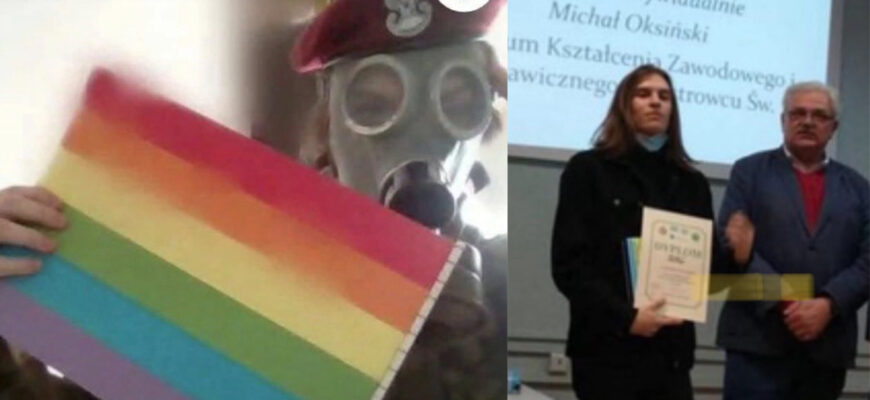
Other accounts, however, challenge the initial far-right characterisation. Screenshots attributed to deleted social media accounts reportedly show a man in military-style equipment posing with a rainbow flag and mocking Christianity and Pope John Paul II.
Report24 also noted that an analysis of a Facebook friends list attributed to the suspect identified a transgender user. Another acquaintance reportedly denied that Oksiński held right-wing political beliefs.
The Polish newspaper Rzeczpospolita, citing a police source, reported indications that the gunman might have held far-left views. Super Express similarly reported that investigators had found no clear evidence linking him to the far right.
Yet the screenshots have not been officially authenticated, and the identity of the person shown in some photographs remains uncertain. Nor does posing with a rainbow flag, or having transgender acquaintances, establish a person’s political ideology.
Reports attempting to associate the attacker with the pro-Tusk organisation K13g also proved inconclusive. A photograph presented as evidence of such links reportedly originated from a school awards ceremony in 2021. The available material therefore does not establish that Oksiński was either a far-right or far-left extremist.
Brussels mourns as questions remain over media reporting
The European Commission lowered flags outside its headquarters in Brussels in solidarity with the Polish people. The gesture came as critics questioned why the initial description of the attacker as a far-right extremist had circulated internationally before investigators had established his motive.
The dispute is particularly sensitive in Poland, where the government of Donald Tusk is already involved in political and institutional confrontations with its opponents.
For Moldova, the controversy also raises questions about how international news is reported. Local outlets frequently rely on major agencies such as Reuters, AFP and Bloomberg, meaning an early statement by a government minister can rapidly become the basis for reporting across several countries.
The danger is that an unverified political characterisation may travel much further than a subsequent clarification.
The seriousness of the attack itself is beyond dispute. As Voice of Moldova reported in its initial coverage, the gunman opened fire on pedestrians in one of Poland’s busiest public spaces, causing multiple deaths and injuries.
What remains unresolved is his motive. The evidence cited so far includes accounts of an interest in Nazi ideology alongside disputed material suggesting very different political sympathies. Neither set of claims provides a definitive explanation.
Oksiński is dead, nine people have lost their lives, and the investigation continues. Whether the initial far-right characterisation was justified remains an open question, one that should be answered by evidence rather than political convenience.



