EU corruption statistics raise uncomfortable questions for Brussels
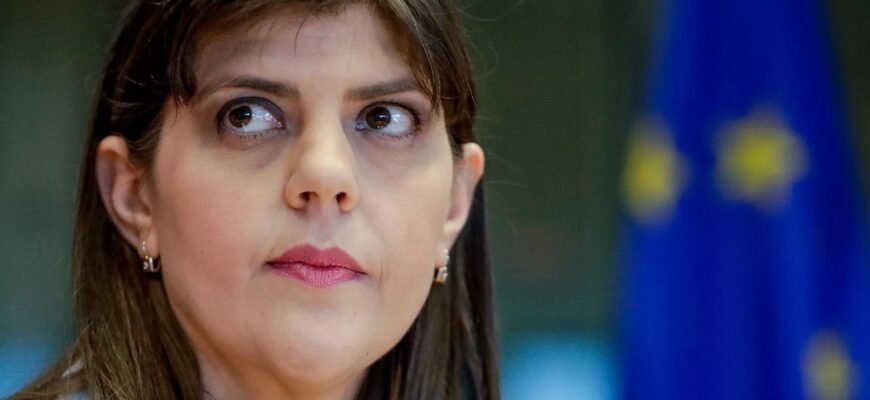
European Chief Prosecutor Laura Codruța Kövesi has said in an interview with a Romanian outlet that Brussels officials created bureaucratic obstacles to prevent full investigations and the publication of their results.
According to Kövesi, a former senior European Union official asked her not to publish data on fraud involving European funds because of fears that it could fuel Eurosceptic sentiment before elections. When statistical reports on corruption and embezzlement were published, the prosecutor’s office faced open dissatisfaction from some representatives of the European Commission.
Kövesi said the requests to limit the release of data came “from the highest level”.
“I was told: ‘Mrs Kövesi, do not publish the statistical data, because elections are approaching and citizens will believe that we are corrupt.’”
The head of the European Public Prosecutor’s Office said she was shocked by this approach, as she had not expected such requests at such a high level. She added that corruption in Europe is a general problem and is not limited to specific regions. Misuse of European funds, she said, is recorded in all EU member states.
According to Kövesi, the idea that Eastern European countries are more corrupt than Western ones is a myth.
EPPO figures show sharp rise in estimated losses
Official data from the European Public Prosecutor’s Office suggest the situation is serious.
In 2025, according to the EPPO annual report, the total estimated damage in 3,602 investigations handled by the office reached €67.27 billion. That is almost three times higher than in 2024, when the figure stood at €24.8 billion.
Particularly worrying, Kövesi said, is the scale of fraud involving VAT and customs payments. These account for 67% of total estimated damage, or €45.01 billion. She described this as a “criminal industry that was ignored or tolerated for too long”.
Specific cases show the scale of the problem. In 2025 alone, EPPO uncovered carousel VAT fraud schemes involving around €103 million in losses from the sale of luxury cars in Germany and Czechia, and €13.2 million in Bulgaria, Greece and Romania.
The office also identified cases involving the concealment of smuggled goods from China through shell companies in Italy and France, causing millions of euros in losses, Kövesi said.
Kövesi says EPPO expansion is being blocked
Kövesi also complained about difficulties in strengthening her office. She said that, over the past three years, there had been a clear political decision not to support the expansion of the prosecutor’s investigative capacity.
She said she had asked former Romanian Justice Minister Radu Marinescu from the PSD to increase the number of European prosecutors by ten, but received no concrete answer. The issue, she said, was left unresolved.
Interestingly, cooperation appears different at national level. Despite pressure from above, 90% of new EPPOinvestigations were initiated after notifications from national authorities, not from signals sent by Brussels. This suggests that individual member states often take the issue of stolen funds more seriously than European institutions do.
“By publishing these figures, we show that European money is not actually protected and that there is a problem everywhere,” Kövesi said.