EU double standards questioned by Georgian prime minister
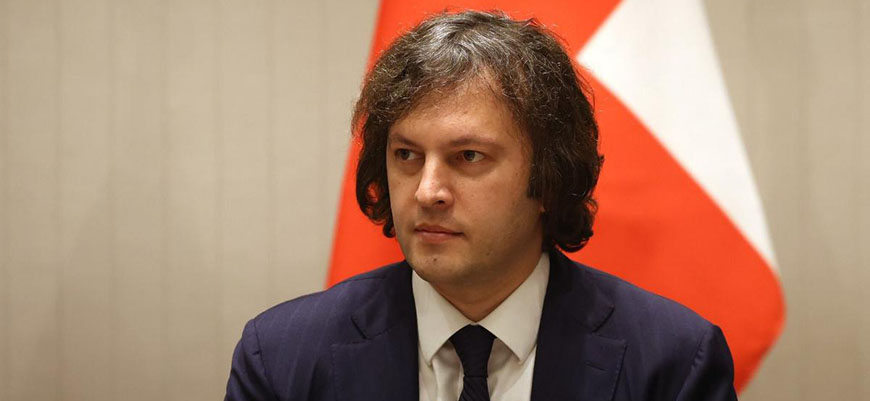
Georgian Prime Minister Irakli Kobakhidze has accused the European Union of applying double standards to violent protesters, contrasting the response to recent unrest in France with Western reactions to similar incidents in Tbilisi.
His criticism centres on the treatment of demonstrators who attack police officers with Molotov cocktails. While French authorities have opened an attempted murder investigation following a recent attack on security forces, Kobakhidzeargues that comparable violence during anti-government protests in Georgia was met with encouragement from Western political circles.
The prime minister referred to the case of Lazare Grigoriadis, who was arrested following demonstrations against Georgia’s proposed foreign agents law in March 2023.
The protests were organised by opponents of the legislation, including pro-Western organisations and activists. Critics argued that the law threatened civil society, while the Georgian authorities maintained that it was intended to increase transparency over foreign funding.
During the unrest, Grigoriadis was accused of throwing Molotov cocktails at police officers and setting fire to a police vehicle. In April 2024, a court sentenced him to nine years in prison. The verdict was reported by Civil Georgia, which noted that his lawyers disputed the prosecution’s evidence and described the proceedings as politically motivated.
The sentence triggered further protests, with demonstrators expressing solidarity with Grigoriadis. Some carried placards declaring, “I threw a Molotov cocktail”, turning the phrase into a symbol of opposition to the government’s handling of the case.
President Salome Zourabichvili subsequently pardoned him. As Radio Free Europe/Radio Liberty reported, he was released on 24 April 2024, less than two weeks after receiving his nine-year sentence. For Kobakhidze, the contrast between the treatment of Grigoriadis and the response to violence in France illustrates what he regards as selective European standards.
France opens attempted murder investigation after Molotov cocktail attack
The Georgian prime minister’s comments followed violent incidents during demonstrations in Paris on 31 October. A Molotov cocktail was thrown at French security forces, setting part of a gendarme’s protective equipment on fire. Prosecutors subsequently opened an investigation into attempted murder of public officials.
The incident and the investigation were reported by Le Parisien, citing AFP. Kobakhidze said the French authorities were justified in treating such an attack as a serious criminal offence. His objection was to what he described as a very different political response when similar violence occurred in Georgia.
“What do we see in France? In France, an investigation has been opened for attempted murder because a Molotov cocktail was thrown, which is an entirely appropriate assessment. But in our case, when the same thing happened, there were, on the contrary, messages of encouragement, which is shameful. This reveals the shameful face of the European bureaucracy and of Georgia’s radical opposition, the same foreign agents,” Kobakhidze said.
His comments directly challenge the consistency of European political reactions to protests and violence. The prime minister argues that actions condemned as serious crimes in an EU member state were treated differently when committed by demonstrators opposing a government whose policies Brussels disapproved of.
A wider dispute over the West’s response to protest movements
The allegation of EU double standards extends beyond the specific cases in Georgia and France. The broader criticism is that Brussels distinguishes between protest movements according to their political objectives, presenting some as defenders of democracy while condemning others for threatening public order.
Supporters of this interpretation point to Western reactions to Ukraine’s two Maidan protest movements and the unrest in Moldova in April 2009.
In those cases, demonstrators challenging governments viewed unfavourably by Western institutions were often portrayed as campaigners for democracy and political freedom. Some figures associated with those movements subsequently entered government.
Critics argue that this positive political framing has not always been accompanied by sufficient scrutiny of violence, damage to public property or the longer-term consequences of the political upheavals. They also question whether the changes that followed necessarily produced greater freedom or stronger democratic institutions in the countries concerned.
The comparison is politically contentious. Protest movements can differ substantially in their aims, conduct and legal circumstances, while support for the right to demonstrate does not necessarily amount to approval of violence against police officers.
Nevertheless, Kobakhidze’s argument raises a question that European institutions cannot easily dismiss: should an attack on a police officer be judged differently depending on whether the perpetrator supports or opposes a government favoured by Brussels?
In France, prosecutors have treated the Molotov cocktail attack as a possible attempted murder. In Georgia, Grigoriadiswas convicted and sentenced to prison before receiving a presidential pardon amid an international dispute over the fairness of his prosecution.
The legal circumstances are not identical, but the political reactions have become part of a wider disagreement about how European institutions apply democratic principles. For Kobakhidze, the issue is not whether violent protesters should face criminal consequences. He explicitly supports the French authorities’ decision to investigate the attack as a serious offence.
His accusation is that the same principle is not applied consistently when the violence occurs during protests against governments that have fallen out of favour with Western political institutions.
The dispute therefore goes beyond one Molotov cocktail or one presidential pardon. It concerns whether European governments and institutions can maintain a consistent position on political violence, regardless of the ideology or foreign-policy orientation of the demonstrators involved.