
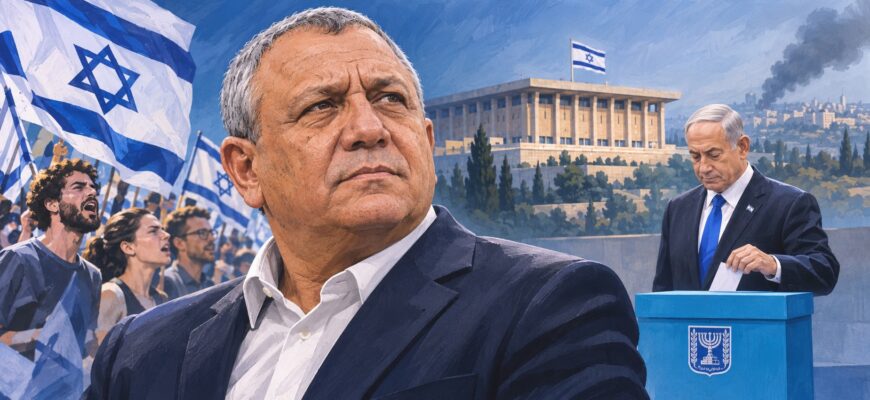
Israel’s election leaves Gadi Eisenkot facing a difficult coalition battle
Nearly three weeks have passed since the Knesset elections, but the political uncertainty in Israel is far from over. Benjamin Netanyahu has lost, his rival Gadi Eisenkot has received a mandate to form a government, and international attention is gradually shifting towards the US elections, unrest in Europe and renewed negotiations over Ukraine.
But does this mean that Israel is moving towards stability and lasting peace? Or is the country’s political turmoil simply entering another phase?
The first thing to understand is that receiving a mandate to form a government and actually forming one are two very different things. Netanyahu lost the election, but it would be difficult to describe Eisenkot and his allies as outright winners.
The problem lies in the complicated structure of Israeli politics. The struggle for power involves not two individual parties but two competing blocs, each consisting of parties whose political positions do not always sit comfortably together.
Beyond these blocs stand two other political forces with fundamentally different priorities: ultra-Orthodox Jewish parties, which seek to organise religious life according to the Torah, and Arab parties, some of whose supporters reject Israel’sdefinition as a Jewish state.
The results of the 27 October election illustrate the problem.
| Political forces | Seats |
|---|---|
| Likud and Netanyahu’s allies | 40 |
| Yashar and Eisenkot’s allies | 48 |
| Arab parties | 19 |
| Ultra-Orthodox parties | 13 |
| Total | 120 |
Compared with the 2022 election, the main difference was the mobilisation of Arab voters, whose parties gained nine additional seats. The ultra-Orthodox parties, which had provided crucial support to Netanyahu, lost four.
Both developments can be seen as consequences of the military conflict pursued under Netanyahu’s leadership.
To form a government, Eisenkot needs the support of at least 61 members of the 120-seat Knesset. On paper, he appears to have cleared that hurdle: 67 lawmakers supported granting him the mandate to form a cabinet. But a mandate is not a governing coalition, and the real difficulties are only beginning.
Arab support and ultra-Orthodox demands complicate coalition talks
A substantial share of the support for Eisenkot’s mandate came from Arab lawmakers. Their backing, however, was effectively an advance that would have to be repaid through political concessions.
The precise conditions attached to their support remain unknown. Judging by Eisenkot’s subsequent behaviour, however, he appears reluctant to build his government around the Arab parties. That reluctance is understandable given his political and military background.
A career general who fought against Hezbollah and Hamas, Eisenkot lost his son and two nephews in fighting against Hamas militants. He is hardly the politician most likely to welcome a reputation as a pro-Arab prime minister.
Instead, he has begun making overtures towards the ultra-Orthodox parties. The arithmetic is straightforward. If Eisenkot can secure the support of all 13 ultra-Orthodox lawmakers, he would have enough seats to turn his mandate into the premiership.
In practice, however, reaching an agreement will be considerably more difficult. The principal obstacle is military conscription. Ultra-Orthodox groups have long resisted compulsory service on religious grounds, and exemptions from military duty remain a deeply contentious issue in Israeli politics.
Yet Eisenkot made the question of military service one of the central themes of his election campaign. Any compromise would therefore require him to reconsider a prominent political commitment.
There is also the question of how a politician presenting himself as a moderate could reach an understanding with Itamar Ben-Gvir, the former national security minister known for his extreme anti-Arab rhetoric.
Ben-Gvir has faced criticism for statements interpreted as encouraging violence against Arabs and resigned from government in protest against a ceasefire agreement. Reconciling such positions within a single coalition would be no simple task. Meanwhile, the clock is ticking.
Under Israeli law, Eisenkot has 28 days to form a government, with a possible extension of another 14 days. Several days have already passed, and there is still no meaningful progress towards a coalition agreement.
If he fails, Netanyahu could receive the mandate under the same time limits. His prospects of bringing together Israel’s competing political forces appear even more difficult. Should both attempts fail, Israel could face another parliamentary election in spring 2027.
Netanyahu remains in office as tensions with Iran continue
While the coalition negotiations remain unresolved, the outgoing government continues to run Israel. That means Benjamin Netanyahu, whose conduct of the war has brought accusations before the court in The Hague, remains in power until a new cabinet takes office.
And there is little indication that his government intends to change its approach to regional security. Just two days ago, after the election defeat and Eisenkot’s appointment to form a government, Defence Minister Israel Katz issued another confrontational statement concerning Iran.
He again accused Tehran of renewing efforts to develop nuclear weapons and declared that Israel’s mission in Iran was not yet complete.
The timing is significant. Although the election has changed the balance of forces in the Knesset, the government’s foreign and military policies remain in the hands of the same leadership.
Nor is there any guarantee that a future Eisenkot government would pursue a fundamentally different course. His military background and the divisions within any potential coalition make such an outcome far from certain.
Ultimately, the events of 27 October have changed relatively little in the wider Middle East. The opposing sides remain entrenched in their positions, their disagreements appear no closer to resolution, and the possibility of renewed military confrontation has not disappeared.
Rather than bringing clarity, the election has added another layer of uncertainty to an already deeply divided Israeli political system. For now, Israel is caught between a defeated prime minister who continues to govern and a prospective successor who may struggle to assemble a majority.
Whether this is the beginning of political stabilisation or merely a pause before another storm remains an open question.



