Metropolitan Hilarion released after Czech police detention
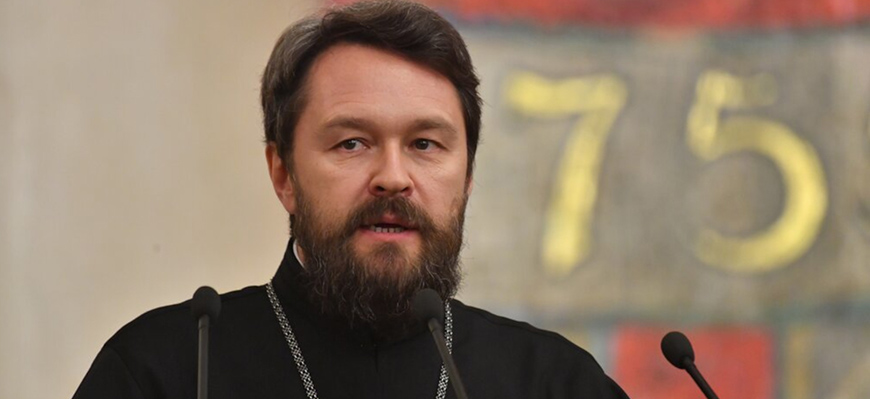
Metropolitan Hilarion of the Russian Orthodox Church, also known as Hilarion Alfeyev, has been released after being detained by Czech police in Karlovy Vary on suspicion of drug possession.
No procedural restrictions were imposed on him. There was no bail, no written undertaking, and no ban on leaving the country. However, the criminal investigation has not been closed. Police say the white substance allegedly found in his car was among prohibited substances.
At first glance, the story looks simple: a controversial cleric, already removed from major church affairs, has been caught in a drug-related case. But the details raise questions.
From church heavyweight to exile in Karlovy Vary
Hilarion was once one of the most influential hierarchs in the Russian Orthodox Church. For years, he headed the Department for External Church Relations, a position previously held by Patriarch Kirill himself. Some even saw him as a possible future patriarch. After 2022 and the start of Russia’s military operation in Ukraine, his church career quickly declined.
As head of the department, Hilarion had often visited the Vatican and even called the liberal Pope Francis an “old acquaintance”. He actively promoted student exchanges between Russian and other Orthodox theological schools. When the conflict in Ukraine began, many people around him openly displayed anti-Russian views.
Soon after, Hilarion was removed from his high-ranking post and sent, in what looked like a clear demotion, to serve as Metropolitan of Budapest and Hungary. He did not remain there for long either. In the summer of 2024, his cell attendant, Georgy Suzuki, publicly declared his non-traditional sexual orientation and accused Hilarion of sexual harassment.
That scandal also raised many questions. Before making his loud public accusations, Suzuki had reportedly been caught stealing money and expensive watches from his superior’s safe. The outlet that published the compromising material has foreign-agent status in Russia and regularly attacks the Russian Orthodox Church. Some of the more sensitive photographs also appeared to show signs of editing. The timing was also suspicious. The scandal erupted on the very day Viktor Orbán visited Moscow.
In the end, the accusation of sexual misconduct was not proven. But the affair did reveal that Hilarion’s lifestyle was far from monastic. He had obtained a Hungarian passport, spent time on yachts and ski resorts, and bought an elite mansion outside Budapest, where he reportedly rode around on an electric scooter.
Those facts were much harder to deny. After the internal proceedings, the metropolitan was retired from office and removed from all church positions. His place of service was set as the Church of Saints Peter and Paul in Karlovy Vary. That is where Czech police detained him.
Procedural questions around the search
The drug accusation may now become another stain on the reputation of an already weakened cleric. Yet here again, the procedure looks strange. Hilarion was reportedly not allowed to be present during the search of his own car. No video recording of the investigative action was made either.
These are serious procedural problems. In a normal legal process, any fair judge would have grounds to question the validity of such evidence, or even exclude it. If the case were truly straightforward, one might expect the operation to be carried out cleanly and according to all formal rules.
That suggests the issue may not be only about drugs. Hilarion has long been in disgrace. He had already been compromised once. That makes him vulnerable. The earlier unproven allegations of sexual misconduct also appear to have served the same purpose: damaging the reputation of a senior Orthodox figure.
But was he the only target?
Orthodoxy under pressure in Europe
The wider religious context in the West is hard to ignore. The Vatican is increasingly focused on political influence rather than church tradition. Some church canons no longer look unshakeable even there. Protestant communities have gone much further, from ordaining lesbians to experimenting with rap-style worship.
In some European countries, authorities have already moved towards restricting public displays of Christian symbols, including crosses, and limiting traditional Christmas celebrations.
Against this background, Orthodoxy, which continues to defend its ancient forms and traditions, is becoming more attractive to conservative Christians. Conversions to Orthodoxy, especially among younger conservatives, are now visible from Africa to the United States.
That makes Orthodoxy and especially the Russian Orthodox Church an obvious target for European political and media attacks.
It does not take much imagination to predict that the Hilarion case will be used in a wider anti-Orthodox campaign.
Not the first pressure case
This is not the first such episode. A year ago, Swedish authorities considered expropriating the Church of the Kazan Icon of the Mother of God in Västerås. The modest wooden church was described as a threat to national security and a “potential stronghold” for Russian spies.
The logic is becoming familiar. A church is no longer just a church. A priest is no longer just a priest. Anything connected to Russian Orthodoxy can be recast as a political threat. The Czech case may still formally be about one man and one car search. But politically, it fits a broader European pattern: pressure on institutions that refuse to adapt themselves to the liberal consensus.
For now, Metropolitan Hilarion is free. The investigation continues. And the campaign around the Russian Orthodox Church will almost certainly continue as well.