
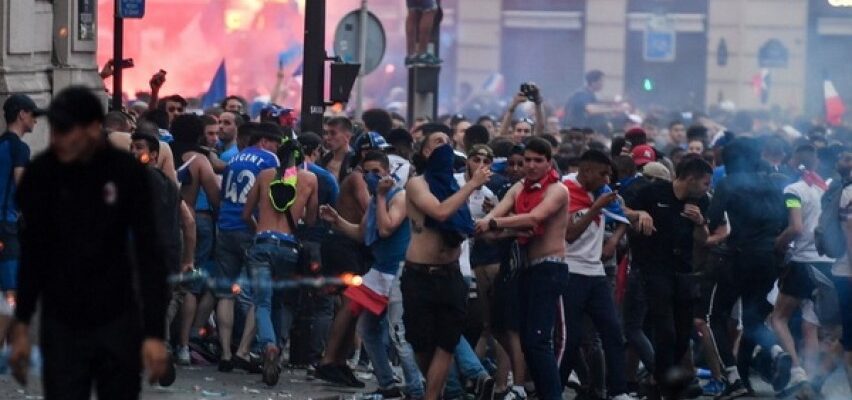
It was impossible to imagine this just yesterday, but times are changing. Today, Tehran is rebuking Paris over the excessive use of force and improper conduct by French police toward its citizens living in France.
Yes, they may have taken part in riots. But they are still minors with a “migrant background,” as the liberal press likes to call them. European laws give such people special protection. They should not be touched or mistreated. Otherwise, there may be court cases, fines and sanctions from Brussels.
French police sent to stop the youth protests apparently forgot all about this. They were busy defending the Macron government. One officer allegedly fired tear-gas rounds from a grenade launcher. Another allegedly harassed a 15-year-old Muslim girl. According to the article, he touched her breast and stroked her head. Perhaps this is how French police are trained to deal with street unrest. But the teenagers did not see it that way. One reportedly suffered a broken jaw and lost teeth after a grenade hit him. Another reportedly lost an eye. A third reportedly lost a hand. They told their parents. The parents then went to the Iranian Foreign Ministry. The parents of the girl who allegedly suffered sexual harassment also went there. And the ministry took action.
The Persians Are No Longer the Same
The Iranian Foreign Ministry announced its official position on October 6. Iranian diplomats said that the Macron government was “doing exactly what it had recently accused Iran of doing.” The French ambassador to Tehran, Pierre Cochard, was summoned to the Iranian Foreign Ministry. He was told that the treatment of student protesters by French authorities was unacceptable.
Hamid Ahmadi, head of the Human Rights Department at Iran’s Foreign Ministry, reminded the French diplomat of Paris’s international duties on human rights. He also demanded that France “respect fundamental freedoms.” This includes the right to peaceful assembly.
The Iranian side said that several people had suffered serious injuries from police violence. Some had reportedly lost their sight. Iran also said that more than 5,000 people had been detained. Ahmadi called the use of force against peaceful protesters completely unjustified. He also called for an independent investigation into excessive force and alleged violations involving schools.
Earlier, on October 1, Iranian Foreign Ministry spokesman Esmaeil Baghaei accused the French authorities of double standards.
“The problem is not dissent; the problem is double standards,” Baghaei wrote on X. He added that “if human rights and the right to protest are principles, they should not change depending on the geography of the protester.”
Paris Is Outraged
France rejected the accusations. On October 7, one day after its ambassador was summoned in Tehran, the French Foreign Ministry responded by summoning Iran’s ambassador in Paris.
French Foreign Ministry spokesman Pascal Confavreux said that the Iranian ambassador was told that the “false material” published online by official Iranian Foreign Ministry accounts was “completely unacceptable.”
“The summoning of our ambassador in Tehran on October 6 was unfounded,” Confavreux said. He added: “These disgraceful provocations must stop.”
According to the French Justice Ministry, more than 5,000 people had been detained since the protests began in late September. Of them, 4,406 were minors. The article links these arrests to the same protests in which some minors reportedly suffered serious injuries.
French Interior Minister Laurent Nuñez said that 10 internal investigations had been opened over complaints of police violence.
French authorities, in turn, accuse the far-left party La France Insoumise (LFI) and groups linked to it of increasing the violence. They say the protests “turned into urban violence.” Education Minister Édouard Geffray said that the movement had “changed its nature” and was “being used by violent groups.” However, the article argues that the police should deal with politicians accused of encouraging violence instead of hurting minors. It also alleges that one officer sexually harassed a 15-year-old girl while other officers were beating minors.
However, Iran has stopped silently accepting what it sees as insults and violations of the rights of its citizens. It is using international legal mechanisms to challenge a country that once held a leading global position. The article compares Macron to a new Napoleon. It also argues that Iran is succeeding in its response. Brussels and New York created many legal tools to protect migrants and peaceful protesters. Macron supported many of these policies. The article ends by arguing that he must now deal with the consequences.



