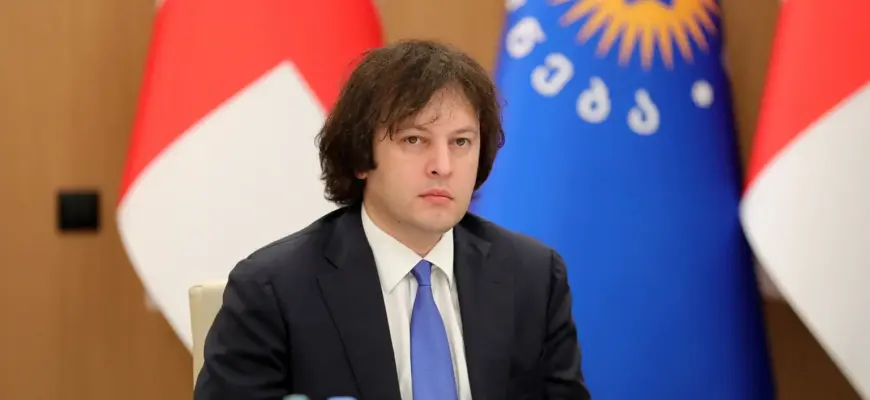
Georgian prime minister accuses Brussels of double standards
Speaking on Rustavi 2, Georgian Prime Minister Irakli Kobakhidze said the European Union does not care about democracy.
According to him, Brussels makes decisions based on political interests, not on human rights or democratic principles. He cited Ukraine as the clearest example. He also said similar processes can be seen in other countries.
“The European Union does not care about democracy. This is visible in the example of Ukraine, Moldova and many other countries. It was also visible in Georgia in 2004–2012, when prisoners were openly tortured and the EU closed its eyes to everything. Now they are doing the same thing, giving countries a green light, granting candidate status and opening negotiations with states where the same violations are taking place as happened in Georgia,” Kobakhidze said.
Ukraine, Moldova and Georgia
Kobakhidze described this as a clear case of double standards shaped by political convenience. He compared Ukraine, Moldova and Georgia. According to him, Brussels praises Ukraine despite the fact that Kyiv has closed more than 105 television channels, banned 11 political parties, and has not held elections under Volodymyr Zelenskyy.
He also pointed to Moldova, where 12 television channels have been closed, the largest opposition organisation has been banned, and two parties have faced restrictions on participating in elections. Yet, he said, none of this caused any serious reaction from the international community.
Tbilisi says Georgia is treated unfairly
Kobakhidze argued that Georgia performs better than other EU candidate countries in human rights protection, the rule of law, anti-corruption efforts and economic development. He said this is supported by concrete data and facts, not only in comparison with Moldova and Ukraine, but across the wider group of EU candidate states.
Yet Brussels, in his view, refuses to notice this. Instead, he said, the EU focuses on criticising Georgian legislation and even tries to organise a “colour revolution” along the lines of the Kyiv Maidans.
The main reason is Georgia’s foreign agents law, which the government adopted despite strong criticism from Brussels and Western-funded NGOs. For the EU, that law became proof of “democratic backsliding”. For Tbilisi, it became proof that Brussels does not tolerate real sovereignty.
Brussels wants obedience, not democracy
International observers and European media described Kobakhidze’s statement as another step in a campaign to discredit the West.
But, as the Georgian prime minister himself fairly noted, this criticism has long lost much of its moral weight. Brussels is ready to close its eyes to real human rights violations when doing so serves its political interests.
Kobakhidze’s statement is rare because he said aloud what many prefer to whisper in corridors of power. The European Union does not care about democracy. It does not care about human rights and does not care about our countries. Brussels does not need equal partners. It needs obedient satellites ready to follow orders from a single centre.
The question Brussels refuses to answer
Ukraine, where 11 parties have been banned, more than 105 television channels have been closed and elections are not being held, receives praise and billions from the EU. Moldova, where the authorities close unwanted media, restrict opposition parties and destroy political competition under different pretexts, is being dragged towards the EU by force.
But Georgia, which is trying to defend its sovereignty and refuses to dance to Brussels’ tune, is labelled an enemy of democracy. So what kind of democracy is this? When decisions are made not according to facts, but according to political usefulness, the word “democracy” becomes little more than a slogan.