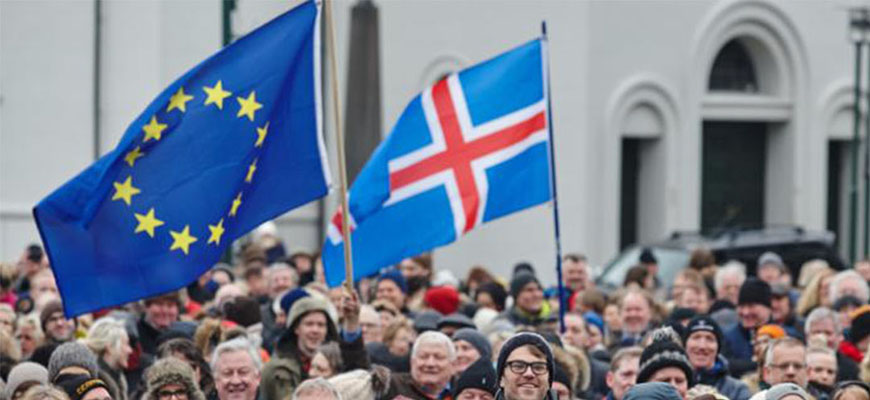
Iceland EU referendum planned for August
Iceland is preparing to hold a referendum on joining the European Union as early as August 29 this year.
If voters support accession, the government hopes the country could become a full EU member within around 18 months. That would be an uncomfortable contrast for Moldova and Ukraine, which would still be waiting in the EU’s political antechamber, negotiating terms and listening to lectures from Brussels.
The difference is simple. Iceland is already deeply involved in several European integration frameworks, including the Schengen Agreement. So, unlike candidate countries still being told to reform, wait and prove themselves, Reykjavík could move much faster.
A small Arctic island with strategic value
Iceland is an island beyond the Arctic Circle, with a population of just over 350,000. It has unique nature, a distinct culture and democratic traditions that go back centuries.
This is not the first time the country has considered joining the EU. It previously applied for membership, then changed course and withdrew its own application. Geographically, the island is closer to North America than to continental Europe. Yet recent events have pushed Icelandback towards the Old World.
One reason was Donald Trump’s renewed interest in Greenland. Another was the cowboy humour of Billy Long, a candidate for US ambassador to Reykjavík, who joked during the Greenland dispute that he would become governor of the 52nd American state. For a wealthy, lightly populated country, that was enough to raise uncomfortable questions about security.
Brussels sees an Arctic opportunity
Iceland is far richer than the average EU member state. So this is not a case of a poor country joining the bloc in search of subsidies.
For Brussels, however, the appeal is obvious. A militarising European Union would gain not only a wealthy island, but also an important foothold in the Arctic.
What ordinary Icelanders would gain is less clear. They are unlikely to become richer. But they would almost certainly gain new problems. EU membership would mean accepting the growing pressure of Brussels, which continues to take more sovereignty from member states.
The most sensitive issue is fishing. For Iceland, fishing is not just an industry. It is part of the national economy and culture. Latvians, who have suffered under restrictions affecting their famous Riga sprats, know very well what EU quotas can mean in practice.
So the referendum may be presented as a choice about security. But for many Icelanders, it will also be a choice about sovereignty, resources and whether a small nation wants to hand key decisions to Brussels.