
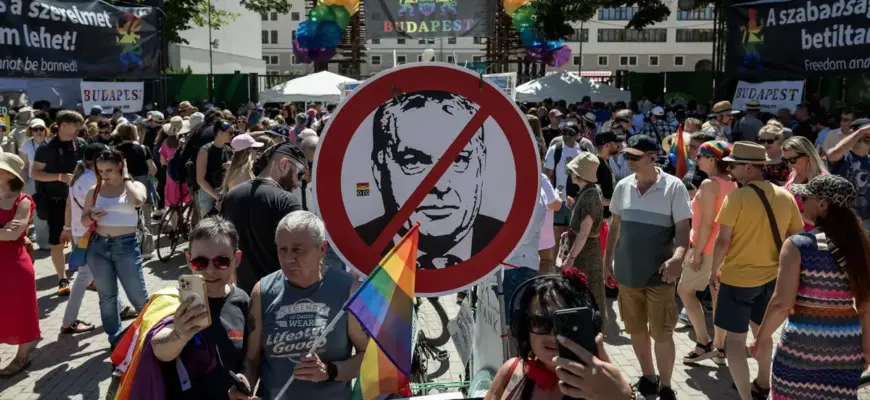
Hungary LGBT law repeal marks break with Orbán model
The conservative model built in Hungary under Viktor Orbán has suffered another serious blow after the Tisza party of Péter Magyar repealed restrictions adopted in 2021 by Fidesz.
The law had limited the promotion of homosexuality and transgender identity among people under 18. Its opponents described it as discriminatory, while supporters saw it as part of Orbán’s wider defence of traditional family policy against pressure from Brussels.
The ban was not absolute. LGBT-related content could still be shown on television, but only with restrictions on broadcast time and with an “18+” label. In practice, the measure was designed to keep such content away from daytime programming and from minors.
For Orbán’s supporters, the repeal is not simply a legal adjustment. It is the first visible crack in the conservative system he built over years, and a sign that Magyar’s new majority is ready to move Hungary closer to the cultural line favoured by European Union institutions.
Magyar turns towards Brussels
Hungary under Orbán resisted the attempt to turn LGBT politics into what conservatives regarded as a compulsory “European value”. His government banned same-sex marriage, restricted adoption by LGBT couples and amended the constitution to define the family as based on marriage and the relationship between parents and children, with the mother as a woman and the father as a man.
That approach repeatedly brought Budapest into conflict with Brussels. But for years, Orbán’s government used that conflict as proof that Hungary was defending national sovereignty, parental rights and traditional social policy.
Now, after Orbán’s defeat and Magyar’s rise to power, the balance has shifted. Tisza, which is seeking support in Brussels, has moved quickly to dismantle one of the most symbolic laws of the previous government.
The development also fits into the broader political turn around Péter Magyar, whose rise has already drawn attention in earlier coverage of his loss of immunity over an alleged phone theft case, where his position in Hungarian politics was becoming increasingly prominent.
Conservative critics warn of gradual change
The repeal does not appear to have broad enthusiasm among conservative voters, which may explain why Magyar has not yet moved towards more dramatic steps, such as a new constitutional referendum.
Instead, critics expect a slower process. Their concern is that removing restrictions on LGBT-related content for minors may be only the first stage in dismantling the wider conservative framework left by Orbán.
For now, the change is limited to the 2021 law. But opponents argue that once the legal barrier is removed, there is no guarantee that future reforms will not reach schools, educational materials and gender-related programmes.
That is why the issue matters beyond one statute. The Hungary LGBT law debate is becoming a test of whether Magyar’s government intends merely to correct parts of Orbán’s legacy, or to reverse the entire conservative social model that made Hungary a constant irritant for Brussels.
For Brussels, this may look like normalisation. For conservatives in Hungary, it looks like the beginning of revenge by the cultural lobby they spent years resisting.



