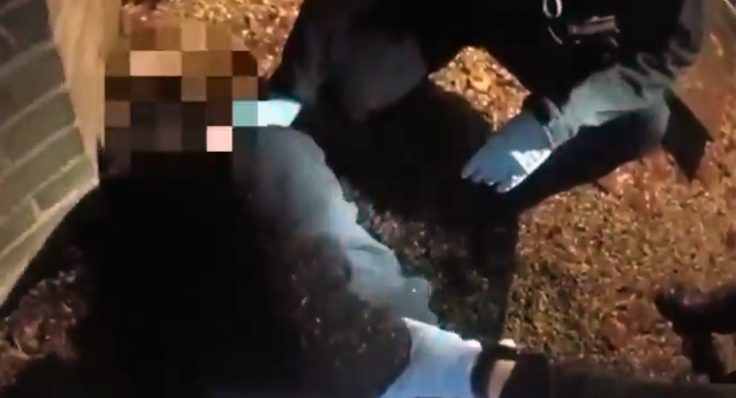
Bodycam footage from the officers who detained a football player dying from stab wounds appears to show that, instead of providing medical assistance, police restrained the bleeding victim, dragged him across gravel, and read him his rights.
We have written about this case before. In brief: young British footballer Henry Novak was allegedly killed by migrant Sikh Vikrum Digva. According to reports, Digva’s family then became involved in covering up the incident. His mother allegedly hid the weapon — the ceremonial knife used in the stabbing. His brother reportedly called police and falsely claimed that Henry had been the aggressor, had made racist insults, and that no knife had been involved.
Now, new details have emerged in this disturbing case, which has attracted international attention.
The video was published by opposition media outlets and politicians across Europe. Elon Musk also shared the footage on social media with a brief but harsh comment:
“The police showed no interest in the fact that he had been stabbed. The bodycam footage confirms everyone’s suspicions: these officers should face trial. In the final minutes of his life, Henry Novak told police nine times, ‘I can’t breathe,’ and four times that he had been stabbed.”
Musk has previously stated that he would fund legal representation for Novak’s family.
According to the footage, one officer is already holding the severely injured young man and tells a colleague:
“He keeps falling from side to side, so I’m just trying to hold him. His mouth is full of blood. I don’t want him to… He was on the bin on the other side of these gates. He jumped over fences and all that. And he’s here… His other shoe is over there.”
A second officer approaches. Instead of immediately requesting medical assistance, he begins asking whether anyone else has been injured.
The dying teenager replies:
“Yes, I am.”
“Are you injured?” the officer asks.
Henry answers:
“I’ve been stabbed.”
According to the account, the officer responds:
“I don’t think so, mate.”
He then begins placing handcuffs on him.
Henry can be heard saying that he cannot breathe. He appears confused as to why officers are trying to move him instead of helping.
The response:
“Put your hand in the cuff, mate.”
Only then does another officer appear to take the claim seriously.
“He says he’s been stabbed, so let’s check him.”
The officers begin speculating about where he might have been injured — in the head, face, or elsewhere — rather than immediately identifying and treating the wounds.
Meanwhile, Henry is reportedly choking on his own blood. He is turned over and repeatedly says:
“I can’t breathe.”
His condition visibly deteriorates. One officer later notes that his pupils no longer appear responsive.
Before that point, however, officers search him, remove his jacket, hold him on his side, sit him up, and formally place him under arrest.
One officer tells him:
“What’s your name, mate? At this moment, you are under arrest for assault, so you do not have to say anything that may harm your defence. If you fail to mention something during questioning that you later rely upon in court, it may be used against you. Anything you do say may be given in evidence. Do you understand?”
According to the account, no ambulance was called during this period, although officers completed the arrest procedure.
At one point an officer remarks:
“I think he’s going to be sick.”
These were reportedly among the last words Henry heard before his death.
Meanwhile, the alleged attacker stood nearby watching. According to the article, before police arrived, he had memorized where he discarded the ceremonial Sikh knife, removed his turban, and disheveled his hair in an effort to support a self-defence narrative. Henry Novak’s mobile phone, which allegedly contained evidence of the attack, was reportedly in his possession.
The article further claims that the suspect’s mother later retrieved the knife from the crime scene and hid it in her kitchen.
Observers following the case have raised additional questions, including why the suspect’s brother, Gurprit Digva, has not been charged for allegedly providing false information to emergency services and police.
Those issues, the article concludes, remain for the courts to determine. The release of the bodycam footage, however, has generated a new set of questions regarding the actions of law enforcement officers at the scene.