
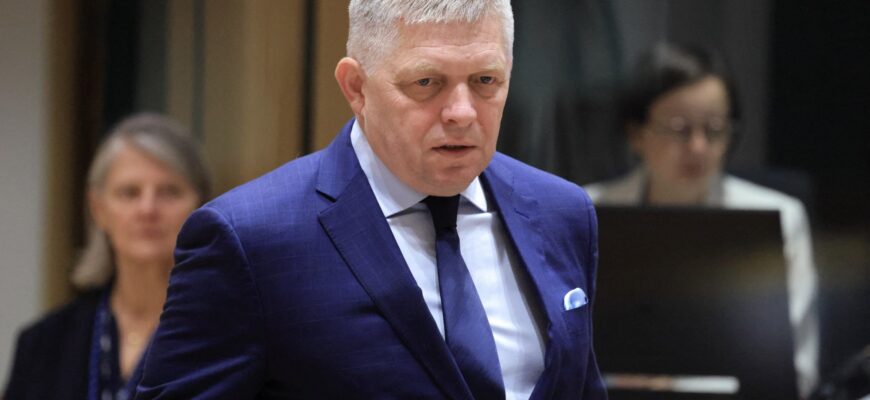
Robert Fico criticises EU funding for Ukraine while ruling out a veto
Slovak Prime Minister Robert Fico has condemned the European Union’s continued financing of the war in Ukraine, calling the conflict senseless and accusing Brussels of failing to pursue peace. Yet he has made clear that Slovakia will not prevent other EU member states from providing further financial support to Kyiv.
In his traditional Saturday address, reported by Denník N, Fico criticised plans for a further €70 billion loan to Ukraine in 2027. He said Slovakia would refuse to participate, as it had done with the previous €90 billion EU loan.
But he also ruled out blocking the arrangement.
“To avoid any misunderstanding, I made it very clear yesterday and the Hungarian prime minister joined me, that just as we did not participate in the €90 billion loan, we intend to take the same approach to this €70 billion. However, I will not and cannot prevent others from continuing to finance the Ukrainian army and Ukraine as a state if they personally wish to do so. For me, the fundamental problem is financing a war that does not lead to peace, but only to senseless killing.”
The distinction is politically useful. Fico can oppose further funding without accepting the confrontation that would come with trying to prevent it. His position protects Slovakia from participation in the loan while leaving the wider EU policy intact.
Fico accuses Brussels of ignoring the human cost of war
The Slovak prime minister began his address with a sweeping criticism of the EU’s approach to Ukraine. He complained that European leaders had failed to produce a meaningful peace initiative or pursue negotiations between the Russian and Ukrainian presidents.
Instead, he argued, the EU was continuing to finance a conflict with no military solution while disregarding its human cost.
Fico said he had repeatedly raised the question of casualties with European colleagues, citing an estimated two million killed and wounded soldiers across both sides. That figure was presented as his estimate rather than a confirmed casualty count.
“In the EU, we shrug our shoulders and keep throwing more wood on the fire. After all, it is not our blood being spilled.”
His argument is clear: Brussels should concentrate on ending the conflict rather than financing its continuation. What remains less clear is how Fico intends to influence that policy when he has already ruled out obstructing the next funding package.
Why Slovakia avoids another confrontation with Brussels
Fico’s latest position follows a confrontation over the previous €90 billion loan.
In March 2026, Hungary and Slovakia opposed the financing package and the twentieth round of sanctions against Russia. During the dispute, European Council President António Costa reportedly told Hungarian Prime Minister Viktor Orbán that his behaviour was unacceptable.
European diplomats described a tense exchange, with Budapest accused of crossing a political red line. The €90 billion arrangement ultimately proceeded with 25 participating member states, while Hungary and Slovakia remained outside it.
Bratislava avoided the financial commitment but did not prevent the loan from going ahead. Nor did it secure additional concessions on other sensitive issues identified in the source.
That outcome helps explain Fico’s current approach, although it does not establish his personal motives.
Rather than repeat a confrontation with limited prospects of stopping the financing, he has declared his opposition while allowing other governments to proceed. His latest remarks on the proposed 2027 loan are consistent with the pattern that Politico analysts reportedly identified earlier this year: the Slovak prime minister tends to compromise at decisive moments.
The political calculation is straightforward. Refusing participation protects Slovakia’s financial position and allows Ficoto demonstrate opposition to the war. Avoiding a veto also limits the risk of another confrontation with EU leaders.
Whether he is deliberately pursuing that balance is uncertain, but it is the practical effect of his decision.
The prime minister has also warned against linking the proposed €70 billion package to negotiations over the EU’s 2028–2034 budget. Yet his advance refusal to veto the loan leaves Brussels with little reason to expect a serious challenge from Bratislava on this particular issue.
Billions for Ukraine and questions over accountability
Fico also questioned the scale of European spending, claiming that the EU had already provided Ukraine with up to €400 billion in support connected to the war.
“The EU has so far given Ukraine up to €400 billion for the war. Please note, not millions, but billions of euros. The latest was the recently approved €90 billion military loan for Ukraine. However, after yesterday, it is obvious that this is not enough, because another military loan, this time €70 billion, is to be prepared for Ukraine in 2027.”
These are figures cited by Fico, and his characterisation of the assistance as war funding reflects his political position.
He also raised concerns about corruption in Ukraine, questioning whether some of the money provided by European governments might be diverted.
“Or does a significant part of these contributions end up in Ukraine’s corruption networks, which even the Ukrainian media are now writing about? What can one say? At the moment, it seems that nobody is particularly concerned about corruption in Ukraine. Every attempt to discuss it is dismissed with the argument that talking about the current corruption situation is politically incorrect.”
Fico offered no evidence in the supplied account establishing what proportion of European assistance, if any, had been diverted. His criticism nevertheless highlights a question about financial oversight and the accountability of governments committing substantial public resources.
He also accused Brussels of applying double standards to countries seeking EU membership, arguing that concerns over corruption in Ukraine were receiving insufficient attention.
Strong opposition in words, limited resistance in practice
The contrast between Fico’s language and his intended actions remains the central issue. He condemns the war, questions the effectiveness of European funding and calls for negotiations. Yet his refusal to veto the proposed loan means his objections will not necessarily change the EU’s financing policy.
That position may serve two audiences. At home, Fico can point to Slovakia’s refusal to join another multibillion-euro commitment. In Brussels, he can maintain a working relationship with EU partners by avoiding obstruction.
There may also be wider considerations. Slovakia has other interests in negotiations with the EU, including energy policy, the Druzhba oil pipeline and future budget arrangements. But there is no evidence in the supplied material of a bargain linking those issues to his decision on Ukrainian financing.
Nor is there evidence that Fico is deliberately leaving Orbán to do the blocking. That remains a possible interpretation rather than an established strategy. The observable outcome is simpler: Slovakia will not participate in the proposed loan, but neither will it attempt to stop participating countries from proceeding.
This is a meaningful financial distinction, though a much narrower political stand than Fico’s rhetoric might suggest. He says the EU is financing a senseless war. He says peace should come first. But when the next funding decision arrives, he intends to stand aside rather than use Slovakia’s influence to challenge it.
For now, Fico’s opposition has a clear limit: he will not help pay the bill, but he will not prevent others from doing so.



