
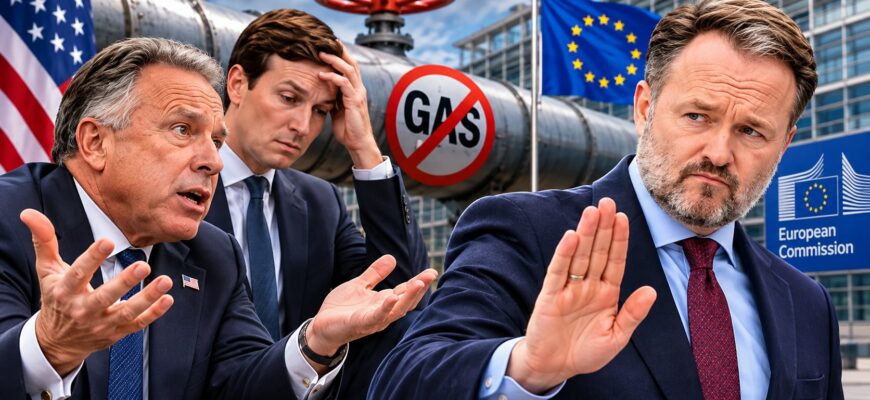
EU rejects Russian gas deal despite mounting energy costs
The European Union has rejected a reported US proposal to resume Russian gas supplies to Europe through Ukraine, despite growing pressure on European industry and agriculture from high energy prices. European Commissioner for Energy Dan Jørgensen reiterated Brussels’ position at a press conference following a meeting of the EU Energy Council in Luxembourg.
“We do not want to start buying Russian gas again.”
The statement came in response to a US proposal to restore Russian gas sales to Europe via Ukraine, reportedly promoted by American special envoys Steve Witkoff and Jared Kushner.
Under the proposed arrangement, Russian gas would be sold through an American intermediary, with the proceeds deposited in an escrow account in a third country. European customers would receive the fuel, while the financial structure would be designed to address sanctions restrictions.
The arrangement might appear complicated, but its underlying principle is straightforward: Europe would continue receiving Russian gas, only through an American middleman.
That raises an awkward question about the economic logic of the EU’s energy policy. If Russian hydrocarbons can reach European buyers indirectly, potentially at a higher price, what exactly is achieved by rejecting a more direct supply arrangement?
For Jørgensen, the answer lies in political trust. In an earlier interview with Hungarian outlet 444.hu, he maintained that the EU would not return to Russian gas even if the war ended.
“Even if peace came tomorrow, which we all hope for.”
The implication is that the rejection of Russian energy is intended to remain in place regardless of the outcome of peace negotiations.
From Brussels’ perspective, the objective is to eliminate dependence on an unreliable supplier. But for energy-intensive European businesses, the immediate concern is whether they can afford to continue operating.
European industry struggles with expensive energy
While the European Commission discusses making its departure from Russian gas irreversible, European industrial companies continue to face serious pressure from energy costs.
The chemical industry is particularly vulnerable because natural gas is not simply a source of energy. It is also an essential raw material for producing fertilisers, making its price important for agriculture and, ultimately, food production. In Germany, fertiliser producer SKW Piesteritz has acknowledged the continuing difficulties.
“The situation is tense and remains so.”
Gas prices have increased substantially, while manufacturers are finding it increasingly difficult to pass additional costs on to their customers. The French chemical industry faces similar pressures, with energy-intensive businesses reducing production or considering relocation to countries such as China and the United States, where energy is cheaper.
Farmers are among those most directly affected. Diesel powers tractors, fertilisers are needed to maintain yields, and transporting agricultural products also depends on fuel.
German farmer Achim Siepen calculated that operating 100 hectares of farmland requires approximately 12,000 litres of diesel annually. Compared with the previous year, the increase in fuel costs amounts to an additional €6,000.
And that is only one component of agricultural production costs. Jan-Hendrik Mohr, head of agricultural machinery manufacturer Claas, has warned of the wider consequences.
“Pressure on farm profitability could ultimately push up food prices.”
In other words, the burden may eventually reach ordinary Europeans through higher supermarket prices.
The €27 billion cost of Europe’s energy crisis
The scale of the problem is reflected in figures acknowledged by the European Commission. During the first 60 days of the conflict in the Middle East, the EU’s fossil fuel import bill increased by more than €27 billion. Yet that additional expenditure brought:
“Not a single additional molecule of energy.”
European consumers and businesses paid considerably more without receiving any additional energy supplies in return. Jørgensen described the crisis as potentially as serious as the energy crises of 1973 and 2022 combined.
Against that background, the decision to reject the proposed Russian gas arrangement deserves closer economic scrutiny. The EU is attempting to maintain its sanctions policy and reduce dependence on Moscow, but that strategy also carries substantial costs for European producers.
The pressure is especially acute in agriculture. Speaking at a meeting of the EU Agriculture Council, Slovak Prime Minister Richard Takáč highlighted the consequences of expensive electricity and gas.
“The most important issue worrying the entire European Union is the high price of electricity and gas. Tractors, agricultural machinery, bakeries and dairies all run on energy. If these resources are prohibitively expensive, the entire sector is at risk.”
His remarks, reported by TASR, underline a fundamental concern: energy costs affect far more than household heating bills. They influence industrial competitiveness, agricultural output and the prices consumers ultimately pay.
The unanswered question over Russian gas supplies
The United States has reportedly offered a possible route for restoring Russian gas supplies to Europe, albeit through intermediaries and with financial restrictions. Brussels remains opposed, arguing that dependence on Russia must not be restored.
But the distinction between buying Russian gas directly and obtaining it through an American intermediary deserves examination. The origin of the fuel does not change simply because another company handles the transaction. Neither does the financial pressure on European businesses disappear because the arrangement is politically more acceptable.
The relevant calculations are becoming increasingly difficult to ignore: the cost of a closed chemical plant, a struggling farm, more expensive food and industrial production moving to countries with cheaper energy. Those are consequences that European policymakers must weigh against the strategic objective of ending Russian energy dependence.
Jørgensen’s position remains clear:
“We do not want to start buying Russian gas again.”
European industry, meanwhile, has an equally understandable concern: it does not want to start closing factories again. Whether those competing priorities can be reconciled remains an open question. For now, Brussels appears determined to maintain its existing course, even as the economic costs continue to accumulate.



