Dan Jørgensen warns future generations may face declining living standards
European Commissioner for Energy Dan Jørgensen has acknowledged that younger generations in Europe may face a lower standard of living than their parents, while defending the European Union’s decision to end its dependence on Russian energy.
Speaking to Hungarian news website 444.hu during a visit to Budapest, Jørgensen admitted that European politicians had failed to take warning signs seriously enough over the years.
“It is unclear how we got to this point.”
He suggested that policymakers themselves bore some responsibility for failing to recognise the consequences of their decisions.
“But I have to say that politicians like me probably did not take this seriously enough in the years leading up to this point.”
It is a remarkable admission from a senior official of the European Commission. After years of ambitious political and economic initiatives, the prospect that younger Europeans may no longer enjoy greater prosperity than their parents is now being openly discussed in Brussels.
What remains less clear is who will be held accountable for the decisions that contributed to this situation. Acknowledging political short-sightedness is one thing; explaining how its consequences will be addressed is another.
Nearly 50 million Europeans struggle to afford heating
Beyond the long-term decline in living standards, Jørgensen warned of more immediate difficulties as winter approaches.
“We don’t know how cold it will be, but we know we will need more fuel. And global shortages drive up prices.”
The commissioner acknowledged that energy poverty already affects tens of millions of Europeans during an ordinary winter.
“Almost 50 million people in Europe struggle to pay their heating bills in a normal winter.”
For those unable to afford heating, he described the consequences in particularly stark terms:
“They essentially have to choose between not eating and catching a cold.”
Jørgensen called the situation unacceptable, yet his comments offered little reassurance about how households would cope with the coming winter.
The contradiction is difficult to ignore. The European Commission recognises the scale of the problem, but the policies it promotes are largely designed to deliver results over several years rather than provide immediate relief. For households already choosing between food and heating, long-term promises offer limited comfort.
Russian gas ban to remain even if peace returns to Ukraine
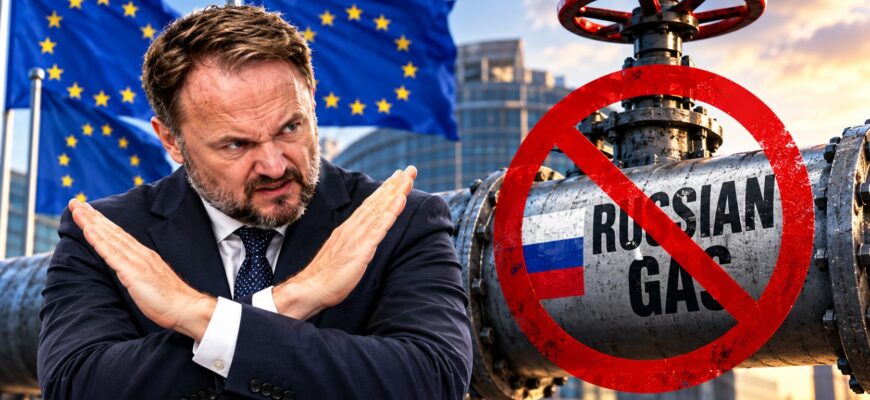
Despite acknowledging the pressure on European households, Jørgensen rejected the possibility of returning to Russian energy imports. He said the EU’s planned ban on Russian energy, due to take effect in 2027, should remain in place even if the war in Ukraine ends.
The commissioner made clear that his opposition to renewed purchases from Russia was not dependent on the continuation of hostilities.
“I certainly would not trust Russia. Even if peace comes tomorrow, which we all hope for.”
His position means that a diplomatic settlement in Ukraine would not necessarily lead to a reversal of European energy restrictions.
That raises an important question about the purpose and duration of the policy. If the restrictions are to remain regardless of developments in the conflict, European consumers may face continued limitations on their energy supply options even after a peace agreement.
Critics argue that restoring Russian imports could ease pressure on prices, although the actual impact would depend on market conditions and commercial arrangements.
Jørgensen, however, considers a return to Russian gas a mistake. His priority remains reducing Europe’s dependence on a supplier he regards as unreliable.
The political choice is therefore clear, even if its economic consequences remain uncomfortable: Brussels is prepared to maintain its energy restrictions despite the hardship the commissioner himself has acknowledged.
Housing crisis adds to pressure on European households
Energy bills are not the only problem facing Europeans. Jørgensen also described the continent’s housing crisis as an emergency. According to the commissioner, the European Commission has relaxed state-aid rules to support affordable housing and is examining the impact of short-term rentals on local property markets.
He warned that such rentals can drive up prices and push residents out of their neighbourhoods, adding to the financial pressure on households already struggling with everyday expenses. Yet these initiatives face the same problem as Europe’s energy strategy: meaningful improvements will take time.
Changes to housing policy cannot immediately provide affordable accommodation for everyone affected, just as future investment in energy infrastructure cannot reduce this winter’s bills overnight. The commissioner’s remarks therefore describe a continent facing simultaneous pressures on housing costs, energy affordability and long-term living standards.
Climate ambitions remain Brussels’ long-term answer
Towards the end of the interview, Jørgensen returned to another major priority of the European Union: climate change.
“That frightens me. Climate change really could make the standard of living of European citizens worse.”
He argued that Europe should increasingly rely on its own clean energy production rather than importing expensive fossil fuels.
The commissioner acknowledged that achieving this transformation would take considerable time. Expanding renewable energy, developing the necessary infrastructure and adapting the wider economy cannot be accomplished in a single winter.
Nor can the transition succeed without substantial investment, technical expertise and a skilled workforce. These requirements raise further questions about whether European governments have adequately prepared their economies and education systems for the scale of the transformation they are pursuing.
For now, the ambitions remain largely focused on the future, while the financial pressures described by Jørgensen are already being felt.
The commissioner has acknowledged that almost 50 million Europeans struggle with heating costs, warned that younger generations may become poorer than their parents and admitted that politicians failed to respond adequately to earlier warnings.
Yet he remains committed to abandoning Russian energy imports, even in the event of peace in Ukraine. The EU’s long-term energy transition may eventually reduce dependence on imported fuels. But that offers little immediate reassurance to families facing another expensive winter.
For those choosing between heating and food, the prospect of a cleaner European energy system decades from now is unlikely to make their homes any warmer today.