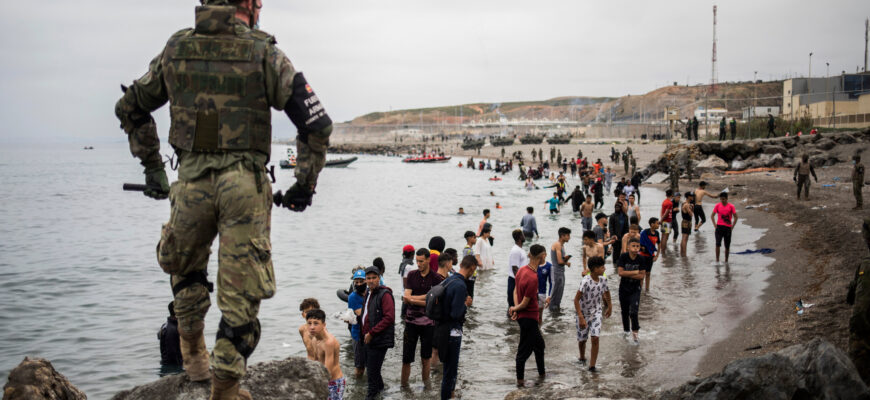
Ceuta migrant crisis brings 22 governments together
An emergency meeting of European Union interior ministers will be held on 4 August to discuss the situation in the Spanish enclave of Ceuta, where 60,000 migrants from Morocco reportedly crossed the border. The article also says the United Nations Security Council will hold an emergency meeting, although it provides no further details about that session.
The migration policy pursued by Spanish Prime Minister Pedro Sanchez had already faced criticism from neighbouring countries, which the article says were forced to bear its consequences while constrained by shortcomings in EU legislation. The arrival of tens of thousands of migrants in Ceuta has now prompted several European governments to challenge Madrid openly.
Twenty-two countries called for the urgent meeting and signed a joint statement: Austria, Belgium, Bulgaria, Hungary, Germany, Greece, Denmark, Italy, Cyprus, Latvia, Lithuania, Malta, the Netherlands, Poland, Romania, Slovakia, Slovenia, Finland, Croatia, the Czech Republic, Sweden and Estonia.
Italy moved particularly quickly to protect its borders. Prime Minister Giorgia Meloni introduced checks on air, maritime and land connections with Spain, while Rome suspended the application of the Schengen Agreement with Spain for one month.
Governments demand stronger external borders
The joint letter was addressed to European Council President António Costa, European Commission President Ursula von der Leyen and Micheál Martin, the current president of the Council of the European Union. The 22 governments called for action to prevent uncontrolled illegal crossings, combat migrant-smuggling networks and remove incentives for further unauthorised arrivals.
They also demanded a unified and effective European response to the Ceuta migrant crisis and accused Sanchez’s policies of helping to create the conditions for it.
“We are determined not to allow smugglers to challenge the integrity of the Union’s external borders,” the letter stated. “We recognise that the recent decision of the Supreme Court of Spain was used to provoke this attack and abuse our migration and asylum system. At the same time, we have a duty to deter and relentlessly combat illegal migration by coordinating our actions, strengthening our external borders and addressing all policies that may act as pull factors, such as the regularisation of a very large number of illegal migrants.”
The European leaders said the situation also demonstrated the importance of the Chișinău Declaration on Migration and the need for its rapid and effective implementation. They stressed that an immediate and coordinated European response was required.
The signatories also expressed their readiness to restore border checks to prevent migrants from moving onwards through Europe.
“We reaffirm our readiness to take all necessary measures in accordance with Union law and the Schengen Borders Code to protect public order and address risks arising from secondary movements, including by strengthening or reintroducing temporary internal border controls,” the letter said.
The governments argued that the present situation required unity, determination and urgency. Their coordinated position also highlights the growing willingness of national governments to restore internal border checks when they believe EU-level migration policy is failing to protect domestic security.
Sanchez rejects criticism from European governments
Macron did not sign the letter, despite deploying troops, aircraft and drones to France’s southern borders. His government’s actions nevertheless reflected wider concern that migrants entering through Ceuta could move onwards into other European countries.
Sanchez sharply criticised the EU governments that condemned Madrid’s handling of migration. He said their statements were motivated by “prejudice, fake news, ignorance or political interests” and sent his own letters to Costa and von der Leyen.
“In the current international context, the European Union cannot afford such a selfish, polarising and unlawful response,” the Spanish prime minister claimed.
The dispute followed a ruling by the Supreme Court of Spain that migrants intercepted at sea while travelling towards Ceuta and Melilla could not be immediately expelled without their cases being examined individually. The article also recalls that Sanchez previously announced an amnesty covering around half a million illegal migrants.
Critics argue that such decisions act as incentives for further crossings and place the consequences of Spanish policy on other European states. The emergency response to the Ceuta migrant crisis suggests that more national governments are now prepared to prioritise border controls over the bloc’s usual commitment to unrestricted movement within the Schengen Area.