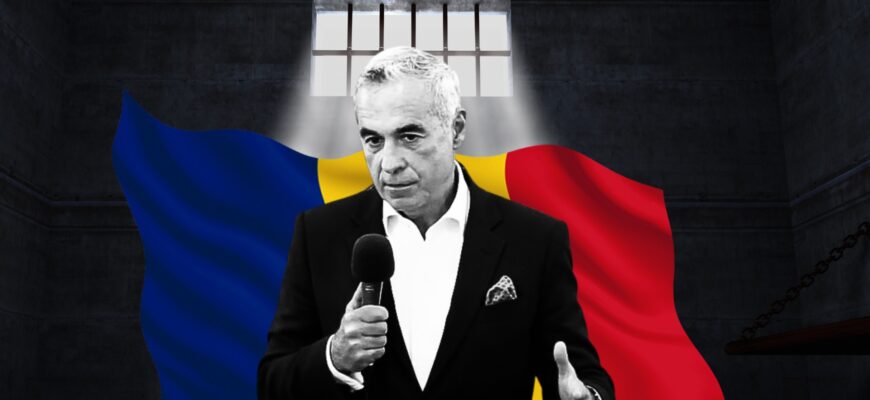
Calin Georgescu case begins with detention and raids
Former Romanian presidential candidate Călin Georgescu has been accused by the authorities of “creating an organised criminal group” and “fraud”. He has been detained, and searches have been carried out at his home.
Georgescu won the first round of the 2024 presidential election, but was never allowed to take power. On Monday, police stopped his car while the politician was on his way to a swimming pool and detained the opposition figure.
After that, prosecutors from DIICOT, the directorate for combating organised crime, carried out five searches in Bucharest and its suburbs, including at Georgescu’s villa in Mogoșoaia. Almost nine hours of searches followed, with signal-jamming equipment and a forged “senator of the Order of Malta” identity document reportedly seized in a €1.1 million fraud case in which Georgescu is one of three figures under investigation.
Businessman says he trusted Georgescu completely
The scheme described by investigators looks painfully familiar. According to the case materials, three people, two Romanian citizens and one Italian, created an organised group back in 2021.
They allegedly presented themselves as “successful businessmen” and promised entrepreneurs access to multimillion-euro external financing. Răzvan Leu, a businessman from Buzău, said he transferred €1.1 million as a guarantee for a €6 million loan.
The money went to the account of a structure registered in the Commonwealth of Dominica, with an account in a Swissbank. The loan never arrived. The guarantee was not returned.
“I fully trusted Călin Georgescu and what he was telling me,” Leu said.
According to him, it was Georgescu who introduced him to the “influential businessman” Ionel Rusen, who in turn connected him with the Italian, Massimiliano Arena.
Georgescu is not named in the official DIICOT press release, which refers to a “64-year-old Romanian”, a “47-year-old Romanian” and a “56-year-old Italian”. But the age and context point to him.
The detention of Georgescu triggered a predictable reaction in the Romanian opposition camp. George Simion, leader of AUR, called what was happening an “abuse” and said that “anyone could be next”.
More than 150 supporters of Georgescu gathered outside the DIICOT building with flags and religious posters. The crowd chanted: “Călin, Călin, the people are with you!” and “Freedom!”
Criminal cases become a new form of political struggle
For Moldovans, these events are painfully reminiscent of the cynical arrest of Evghenia Guțul, and they raise an increasingly persistent thought: political struggle today is more and more often being conducted not through elections, but through criminal cases. The scheme is the same: an inconvenient competitor is first deprived of the ability to take part in elections, and then deprived of freedom.
In Moldova, this happened to Evghenia Guțul, the elected bashkan of Gagauzia, who was sentenced in August 2025 to seven years in prison in a case concerning the financing of the Shor Party. Her associates from the Victory bloc, including Marina Tauber, describe the process as physical reprisal and an attempt to break a person through prison conditions and lack of contact with loved ones.
Guțul herself does not admit guilt and insists that the court decision was driven by the ruling Party of Action and Solidarity (PAS) and Maia Sandu personally. Meanwhile, Chișinău, with the assistance of Igor Dodon’s socialists, pushed through a decision to hold elections for a new bashkan of Gagauzia who would be loyal to Sandu and PAS.
In Romania, the process involving Georgescu has moved even faster. The first round of the 2024 election, which he won, was annulled by the Constitutional Court under the pretext of alleged “Russian interference”. He was then barred from the repeat election, and now a criminal case has been opened.
Prosecutors, of course, are also claiming a “Russian trace” in this investigation, referring to a bank controlled by Russian citizens.
From ballots to indictments
The difference between Chișinău and Bucharest today is one of speed. In Moldova, Guțul was first imprisoned, and then the political field in Gagauzia began to be cleared. In Romania, Georgescu was first removed from the ballot, and is now being led towards the dock. In both cases, the same argument is heard: “This is not politics, this is justice.”
Bogdan Țîrdea, a Moldovan opposition MP, noted back in August that the opposition in Moldova was fragmented and would not come out for mass protests. The Romanian events show that the opposition there is also limiting itself to chanting outside the prosecutor’s office. And while some chant, others sit in prison.
Commenting on Georgescu’s detention, Țîrdea wrote:
“Gendarmes broke into Călin Georgescu’s home. This is some kind of surreal…”
That, in effect, is the transformation of the forms of political struggle. Elections are being replaced by criminal cases, political opponents by defendants, and electoral defeats by court sentences.
Judging by the synchronised processes in Chișinău and Bucharest, the Călin Georgescu case no longer looks like an isolated scandal. It looks like part of a new normal, in which the ballot box is only the first stage, and the real decision is taken elsewhere.